쥘리 피사로와 그녀의 아들 뤼도비크-뤼돌프, 일명 로도 (Julie Pissarro et son fils Ludovic-Rodolphe dit Rodo, 1878)
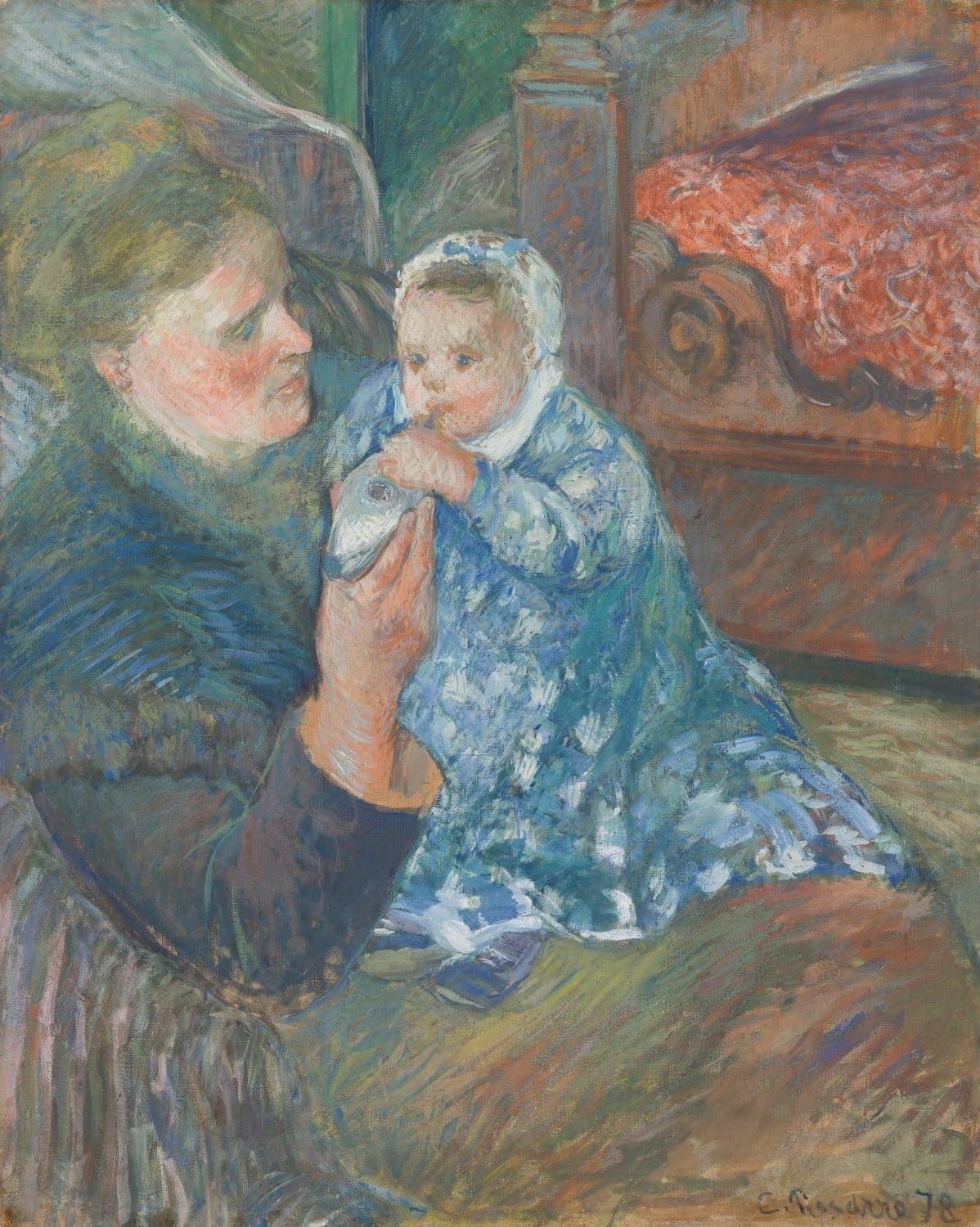
1870년대 후반 퐁투아즈 시절, 카미유 피사로는 야외의 자연 풍경뿐만 아니라 고단한 일상 속에서 자신을 묵묵히 지탱해 주던 아내 쥘리와 갓 태어난 넷째 아들 뤼도비크-뤼돌프(애칭 '로도')의 따스한 모자 관계를 화폭에 기록했습니다.
당시 극심한 가난과 지속되는 생활고 속에서도 피사로는 가정의 소박한 온기를 놓치지 않았으며, 실내로 스며드는 은은한 자연광을 통해 모성애의 성스러운 침묵을 포착했습니다. 가로 54cm, 세로 68cm 크기의 캔버스에 유채로 완성된 이 작품은, 훗날 아버지의 뒤를 이어 예술가의 길을 걷게 되는 어린 아들의 순수한 생명력과 어머니의 헌신적인 사랑을 다정한 색채의 붓터치로 엮어낸 피사로의 대표적인 가족 초상화입니다.
관람자의 시각 인지 체계는 화면 중앙에서 화사한 푸른빛과 은백색의 터치로 빛나는 아기의 옷과 하얀 보닛, 그리고 앙증맞은 손으로 쥐고 있는 젖병에 가장 먼저 도달합니다. 밝은 채도와 섬세한 빛의 반사는 시각 피질의 중심와를 즉각 포획하며 화면 전체의 서정적인 구심점을 확립합니다.
이어서 시선은 아기에게 젖병을 물려주며 조용히 바라보는 어머니 쥘리의 따뜻하고 묵직한 옆모습과 붉은 뺨의 온기로 자연스럽게 이동합니다. 어머니의 자애로운 표정을 확인한 시선은 짙은 숄의 결을 타고 내려와 바닥의 흙빛 담요를 훑은 뒤, 화면 우측 상단에 자리 잡은 고풍스러운 목조 침대와 화사한 붉은 직물 패턴으로 부드러운 도약 안구 운동을 이어갑니다.
어두운 실내의 그림자와 인물들을 부드럽게 감싸는 여과된 자연광이 망막 위에서 하나의 조화로운 온기로 통합되는 순간, 관조자는 번잡한 외부 세상의 소음을 잊고 어머니의 품속에 안긴 듯한 깊은 심리적 안도감과 내면의 평온을 체험하게 됩니다.
이 그림을 그릴 당시 피사로는 인상주의 화가로서의 독자적인 입지를 다지는 동시에, 에드가 드가 및 메리 카사트와 함께 모자(母子) 관계를 주제로 한 근대 회화의 새로운 지평을 치열하게 고민하고 있었습니다.
그는 고전주의 성모자화의 도식화된 이상화를 과감히 벗어던지고, 실제 가정의 일상적인 보살핌과 애틋한 현실을 가감 없이 담아냄으로써 근대 가족화의 새로운 규범을 제시했습니다. 당시 동료 화가들은 피사로가 보여준 정직한 시선과 꾸밈없는 감정의 깊이에 대해 "가장 진실하고 소박한 인간애가 살아 숨 쉬는 화면"이라며 깊은 경의를 표했습니다.
어머니의 헌신과 유년의 순수함을 따뜻한 휴머니즘과 단단한 조형 언어로 승화시킨 피사로의 이 모자 초상화는, 현대 미술사에서 인상주의가 감각적 빛의 유희를 넘어 삶의 가장 거룩하고 진솔한 온기를 영원히 각인한 기념비적인 걸작으로 확고하게 평가받고 있습니다.
Julie Pissarro and Her Son Ludovic-Rodolphe, Called Rodo (Julie Pissarro et son fils Ludovic-Rodolphe dit Rodo, 1878)
During the late 1870s in Pontoise, Camille Pissarro frequently turned his empathetic gaze inward, documenting the tender domestic sanctuary formed by his devoted wife Julie and their fourth son, Ludovic-Rodolphe (affectionately known as "Rodo").
Despite enduring persistent financial hardship and the relentless struggles of rural family life, the master captured the sacred quietude of maternal care beneath the soft indoor daylight filtering into their home. Measuring 68 by 54 cm, this vertical oil on canvas portrays the young child—who would later follow in his father's footsteps as a painter and engraver—nursed tenderly by his mother, standing as a heartfelt tribute to familial love and resilience.
The viewer's perceptual apparatus naturally anchors upon the luminous cluster of blue and white strokes defining the infant’s gown, bonnet, and the feeding bottle cradled in his tiny hands. This concentrated high-key brightness stimulates the fovea, establishing an intuitive emotional and compositional nucleus that organizes the entire visual field.
From this brilliant center, the ocular trajectory tracks upward to the warm, stoic profile of Julie Pissarro, whose weathered features and flushed cheek convey a lifetime of quiet devotion.
Gliding downward through the heavy, textured folds of her dark shawl, the eye traverses the rich earth-toned blanket below before ascending toward the carved wooden bedstead and vibrant crimson upholstery in the upper right.
As the ambient indoor shadows and gentle highlights integrate into a cohesive visual intimacy within the observer's mind, active visual scanning dissolves into profound contemplative stillness, wrapped in the comforting and restorative embrace of maternal devotion.
While executing this intimate canvas, Pissarro was engaged in close aesthetic dialogues with Edgar Degas and Mary Cassatt, exploring how to revitalize the traditional theme of the mother and child through modern realism.
Completely stripping away the artificial sentimentality and religious grandiosity of salon painting, Pissarro rendered the authentic rhythms of domestic nurture, establishing a foundational paradigm for modern humanist portraiture. Contemporary peers revered his uncompromised sincerity, celebrating his ability to reveal lasting nobility within ordinary family existence.
Masterfully harmonizing tactile domestic textures with profound humanist tenderness, Pissarro's portrait of his wife and son remains celebrated across art history as an enduring pinnacle of late-nineteenth-century figurative painting.
본 콘텐츠의 저작권은 저작권자에게 있으며, 무단 전재 및 재배포를 금합니다.