주의 고하심 에케 안칠라 도미니 Ecce Ancilla Domini!
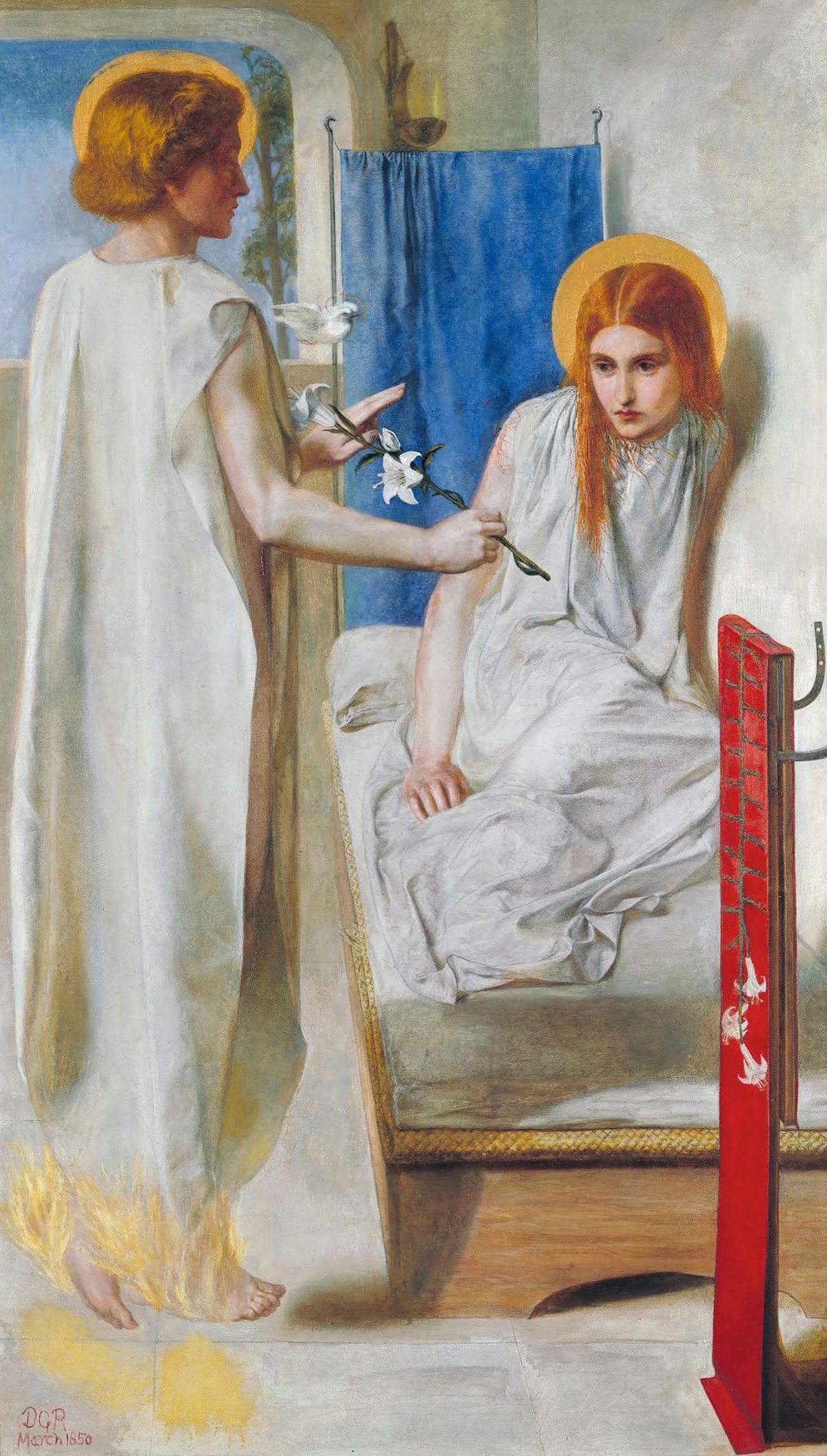
19세기 영국 라파엘로 전파의 거장 단테 가브리엘 로세티(Dante Gabriel Rossetti, 1828–1882)가 1849년부터 1850년 사이에 완성한 기념비적 종교 유화 주의 고하심(Ecce Ancilla Domini!, 또는 수태고지, 영어: The Annunciation, 공식 소장품 등록번호: N01210)은 72.4 cm × 41.9 cm 크기의 세로형 캔버스에 유채로 그린 대표적인 초기 라파엘로 전파 회화 최고 걸작입니다.
영국 런던의 유서 깊은 미술품 컬렉션을 거쳐 1886년 국립미술관(National Gallery)을 거쳐 1897년 테이트 미술관(Tate)의 설립과 함께 편입되었으며, 현재 영국 런던의 세계적인 테이트 브튼(Tate Britain, London)에 영구 소장되어 보존되어 오고 있습니다.
전통적 성모 수태고지의 파격적 재해석과 화가의 고뇌
1849년 말 런던에서 젊은 나이로 라파엘로 전파를 결성하고 혁신적인 예술 운동을 이끌던 단테 가브리엘 로세티는, 성서 속 수태고지(Annunciation)라는 전통적 주제를 기존의 화려하고 극적인 바로크적 기법에서 벗어나 극도로 소박하고 사실적인 인간적 내면의 경건함으로 재현하고자 깊은 고뇌에 잠겼습니다.
화가는 찬란한 날개와 화려한 왕관을 쓴 천사의 전형적 도상을 과감히 배제하고, 하얀 옷자락에 불꽃을 달고 맨발로 공중에 떠서 하얀 백합을 건네는 대천사 가브리엘과 침대에 두려움에 찬 눈빛으로 움츠러든 마리아의 모습을 어떻게 압도적인 백색의 순수함과 서늘한 색채 속에 담아낼지 치열하게 번민했습니다.
테이트 미술관의 공식 소장 도록에 따르면, 이 작품은 당시 화가 자신의 친동생인 크리스티나 로세티를 모델로 삼아 마리아의 창백하고 놀란 표정을 완성했으며, 화면 오른쪽 전면에 세워진 붉은 자수 틀에 수놓아진 백합 문양과 날아드는 성령의 비둘기는 순결과 거룩한 신성 지배의 도상학적 핵심 장치로 분석됩니다.
화가는 온통 하얀색과 차가운 은빛 대기가 감도는 소박한 실내를 배경으로, 하나님의 부름을 마주한 마리아의 숭고하고도 인간적인 순간을 화폭에 담았습니다.
화면 왼쪽에는 금빛 후광을 두르고 하얀 옷을 입은 대천사 가브리엘이 침대에 앉아 있는 마리아에게 다가가 순결한 하얀 백합 한 송이를 건네고 있으며, 창가에는 하얀 성령의 비둘기가 날아들고 있습니다.
화면 중앙의 침대 위에는 헝클어진 붉은 머리칼의 마리아가 하얀 잠옷을 입은 채 벽에 바짝 기대어 두려움과 경외가 뒤섞인 눈빛으로 천사를 바라보고 있습니다.
화면 오른쪽 전면에는 붉은색 수직 자수 틀이 강렬한 보색 대비를 이루며 세워져 있고, 화면 구석에 새겨진 작가의 모노그램과 1850년 제작 연도는 초기 라파엘로 전파가 추구했던 급진적 순수주의와 정교한 세밀함을 손에 잡힐 듯 생생하게 웅변합니다.
천사가 건네는 백합에서 놀란 마리아의 눈빛과 붉은 자수 틀로, 시선의 심리적 여정
그림을 마주하는 순간 관람객의 무의식적 시선은 화면 중앙 왼쪽에서 대천사 가브리엘이 내미는 순백의 백합 꽃송이와 마리아의 손길이 맞닿을 듯 가까워지는 긴장감 넘치는 지점으로 가장 먼저 빨려 들어갑니다.
하늘의 계시를 거부할 수 없는 운명으로 받아들여야 하는 엄숙하고도 서늘한 순간은 보는 이에게 강렬한 시각적 몰입감과 함께 심리적 전율을 선사합니다.
이어 시선은 침대 헤드에 몸을 움츠린 채 창백한 뺨과 커다란 눈으로 천사를 응시하는 마리아의 두려움 어린 표정과 헝클어진 붉은 머리칼의 세밀한 묘사로 자연스럽게 이동합니다.
세속의 평온이 깨지고 거대한 신성한 역사 속으로 소환된 인간의 연약함을 체감하는 순간, 관람객은 19세기 영국 청년 화가들이 꿈꾸었던 냉혹하리만치 순수한 종교적 성소 속으로 온몸이 빨려 들어가게 됩니다.
마지막으로 시선은 화면 오른쪽 전면을 강렬하게 가로지르는 붉은 자수 틀의 수직 라인과 백합 자수 장식을 거쳐, 화면 전체를 지배하는 서늘하고 차분한 백색 대기감으로 멈춥니다.
전면 인물들의 충격적인 영적 교감과 후면 절제된 실내 공간의 조화를 마주하며, 관람객은 종교화의 오랜 관습을 깨부수고 새로운 진실을 추구한 거장 로세티의 혁명적 정신을 가슴 깊이 마주하게 됩니다.
19세기 영국 초기 라파엘로 전파 회화의 정점과 조형미, 미술계의 평가
미술계와 테이트 미술관 공식 도록은 주의 고하심을 로세티가 초기 라파엘로 전파 운동 시절에 이뤄낸 가장 혁신적이고 논쟁적인 종교화 회화 성취로 평가합니다.
단순한 성서 재현을 넘어 전통적인 도상을 모두 거부하고 차가운 백색 계열의 색채와 강렬한 붉은색의 대비를 통해 수태고지의 영적 충격을 완벽하게 담아냈을 뿐만 아니라, 천사의 투명한 옷자락 질감, 마리아의 불안한 심리 묘사, 실내 공간의 기하학적 엄숙함을 극도로 섬세한 캔버스 유화 기법으로 완벽하게 구현했기 때문에 그렇습니다.
인간의 영혼을 뒤흔드는 신성한 부름의 무게를 가장 격조 높은 시각 예술로 승화시킨 로세티의 이 소중한 화폭은, 오늘날까지도 전 세계 수많은 감상자들에게 깊은 충격과 잊을 수 없는 시각적 전율을 전해주는 불멸의 명작으로 손꼽히고 있습니다.
Ecce Ancilla Domini!
Painted between 1849 and 1850 by the master of the Pre-Raphaelite Brotherhood Dante Gabriel Rossetti (1828–1882), Ecce Ancilla Domini! (also known as The Annunciation, Accession No. N01210) is a monumental religious masterpiece in oil on canvas measuring 72.4 cm × 41.9 cm (28.5 in × 16.5 in).
Preserved through esteemed provenance including the National Gallery before entering the Tate collection upon its founding in 1897, it is housed today in the celebrated permanent collection of Tate Britain in London, United Kingdom.
Radical Reinterpretation of the Annunciation and Early Pre-Raphaelite Reform
During the winter of 1849 in London, Dante Gabriel Rossetti, leading the newly formed Pre-Raphaelite Brotherhood, sought to revolutionize religious painting by stripping away centuries of academic convention to portray the Annunciation with unprecedented psychological realism and stark simplicity.
Moving away from opulent wings, regal thrones, and triumphant halos, the master meditated deeply on how to depict the Archangel Gabriel floating barefoot with flickering flames on his hem to offer a white lily to a terrified, awakening Virgin Mary, harmonizing austere white tonalities with striking chromatic accents.
According to curatorial records from Tate Britain, Mary's features were modeled on the artist's sister, Christina Rossetti, while the prominent vertical embroidery frame in the foreground bearing a lily motif and the descending dove of the Holy Spirit serve as powerful iconographic emblems of purity and divine election.
Rossetti staged the visionary composition against a stark, whitewashed interior setting dominated by cool, silvery light.
In the left register, the Archangel Gabriel, clad in a simple white robe with golden hair and a subtle halo, steps forward to present a delicate white lily to Mary, accompanied by the dove of the Holy Spirit fluttering near the window.
In the center, Mary is huddled upon her narrow bed, her unbound reddish hair falling about her shoulders as she recoils slightly against the wall, gazing at the heavenly messenger with wide, apprehensive eyes.
In the right foreground, a vibrant crimson embroidery frame creates a powerful vertical anchor, while the artist's monogram and date (1850) inscribed in the lower corner celebrate the radical purity and precise draughtsmanship of the young movement.
Subconscious Trajectory of the Gaze: From the Archangel's Lily to Mary's Apprehensive Gaze and Crimson Frame
The observer's subconscious gaze is immediately magnetized by the central register, drawn to the delicate white lily offered by the angel and the poignant space where it nears Mary's receptive yet startled hand.
The profound tension of a mortal soul confronting divine destiny establishes an instant focal point of psychological intensity, spiritual drama, and quiet awe.
The visual path then shifts upward toward Mary's pale visage, her wide, fearful eyes, and the tangled locks of her reddish hair pressed against the neutral wall.
Taking in the vulnerable posture and the austere, monastic quietude of the room, the viewer directly experiences the intimate, chilling intimacy of a sacred awakening.
Finally, the visual trajectory moves toward the striking red embroidery frame in the lower right, before sweeping across the cool, unified white atmosphere that envelops the entire canvas.
Observing the harmonious equilibrium between psychological realism, stark color contrasts, and precise Pre-Raphaelite draftsmanship, the spectator perceives the timeless poetry of divine calling and the profound aesthetic brilliance Rossetti embedded within the canvas.
The Monument of Early Pre-Raphaelite Reform: Critical Legacy
Art historians revere Tate Britain's Ecce Ancilla Domini! as the supreme revolutionary milestone of Rossetti’s early career, illustrating his consummate ability to shatter academic tradition in favor of uncompromising psychological and spiritual truth.
By orchestrating delicate textural contrasts between crisp white linen drapery, glowing golden hair, warm flesh tones, and the sharp shock of crimson embroidery within a vertical compositional space, Rossetti transformed a sacred narrative into an exquisite aesthetic treatise on faith, fear, and human destiny.
This magnificent historical canvas endures as an inspiring testament to the master's creative fortitude, celebrating the quiet poetry of everyday existence and the transformative grace of living art.
본 컨텐트의 저작권은 팔렛트제주에 있습니다. 허가없는 무단전제를 금지합니다.
Copyright © Palette Jeju. All rights reserved. Unauthorized reproduction or redistribution is strictly prohibited.