주막에서 춤추는 농민들 Interior of Inn with Dancing Peasants
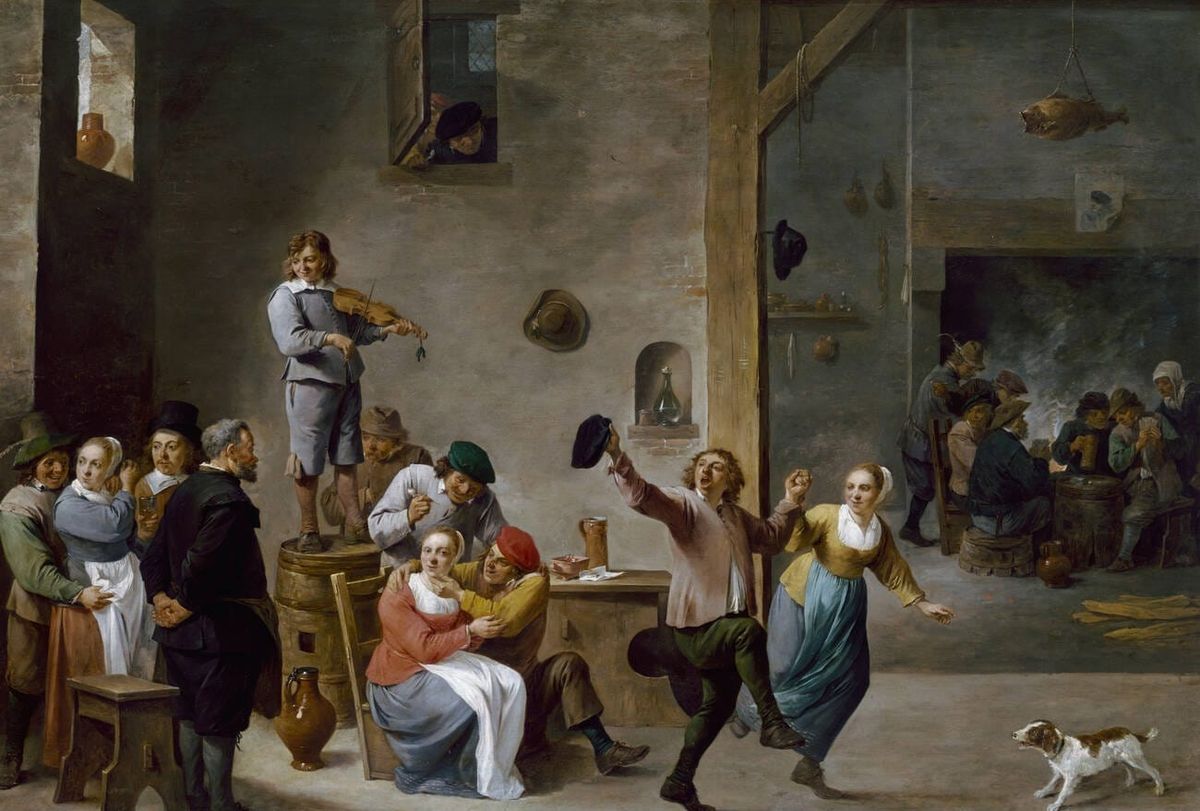
17세기 플랑드르 바로크 풍속화 및 선술집 실내화의 거장 소 다비드 테니어르스(David Teniers le Jeune, 1610–1690)가 1640년대 중후반 안트베르펜과 브뤼셀 전성기 시절에 완성한 기념비적 실내 풍속 대작 유화 춤추는 농민들이 있는 주막 실내(Interior of Inn with Dancing Peasants, 또는 주막 안의 흥겨운 춤판, 프랑스어: Intérieur de cabaret avec paysans dansant, 네덜란드어: Interieur van een herberg met dansende boeren)는 58.0 cm × 83.5 cm 크기의 가로형 패널(목판)에 유채로 그린 대표적인 북유럽 주점 풍속화 최고 걸작입니다.
유럽 유수의 유서 깊은 왕실 및 귀족 컬렉션을 거쳐 국제 미술계에서 독보적인 예술적 가치를 인정받았으며, 현재는 저명한 개인 소장처 및 미술관에 보존되어 있습니다.
아드리안 브라우어의 거친 주점을 넘어선 평화로운 서민의 흥을 향한 화가의 고뇌
1640년대 플랑드르 화단을 이끌던 삼십 대의 테니어르스는, 선배 화가인 아드리안 브라우어가 주로 다루었던 칼부림이나 난투극, 술주정꾼들의 난잡한 행태에서 벗어나 서민들의 일상에 깃든 순수한 기쁨을 화폭에 담고자 깊이 몰두했습니다.
화가는 하루의 고단한 노동을 마치고 널찍한 주막 마루에 모여 바이올린 선율에 맞춰 신명 나게 발을 구르고 사랑을 속삭이는 평범한 이웃들의 진솔한 활기를, 어떻게 맑고 투명한 은빛 대기(Silvery manner)와 절제된 실내 명암법 속에 담아낼지 치열하게 번민했습니다.
당시 북유럽 풍속화에서 주막의 음악과 춤은 일상의 고단함을 털어내는 공동체의 건강한 유대감을 뜻하는 동시에, 지나친 방탕을 경계하는 부드러운 도덕적 균형을 상징했습니다.
화가는 천장이 높은 시골 주막 안에서, 나무통 위에 올라선 소년 악사의 경쾌한 바이올린 연주에 맞춰 춤을 추고 담소를 나누는 주민들의 생생한 순간을 화폭에 담았습니다.
화면 중앙에서는 분홍빛 셔츠를 입은 사내가 모자를 번쩍 치켜들고 흥겹게 환호성을 지르며 노란 상의와 푸른 치마를 두른 여인의 손을 잡고 경쾌한 스텝을 밟고 있습니다.
그들의 발치 앞에서는 귀여운 강아지가 꼬리를 치며 함께 뛰놀고 있고, 화면 왼쪽 나무통 위에서는 깃털을 꽂은 멋쟁이 소년 악사가 당당하게 서서 바이올린 활을 켜고 있습니다.
그 아래 의자에서는 붉은 모자를 쓴 사내가 수줍어하는 여인의 턱을 어루만지며 은근슬쩍 구애를 펼치고 있으며, 왼쪽 구석에서는 단정한 예복을 입은 귀족 신사가 주민들의 소박한 춤판을 흐뭇하게 지켜보고 있습니다.
벽 위쪽 작은 창문으로 고개를 내민 구경꾼과 오른쪽 깊숙한 벽난로가에서 모닥불을 쬐며 카드놀이를 즐기는 사내들의 모습은, 웃음과 온정이 가득한 17세기 플랑드르 주막의 따스한 풍경을 손에 잡힐 듯 생생하게 웅변합니다.
모자를 치켜든 춤꾼의 발걸음에서 바이올린 소년과 벽난로의 사내들로, 시선의 심리적 여정
그림을 마주하는 순간 관람객의 무의식적 시선은 화면 중앙 널찍한 마루에서 밝은 창가 빛을 받아 화사하게 빛나는 남녀 춤꾼의 분홍빛 셔츠와 노란 옷소매, 그리고 허공으로 뻗은 사내의 검은 모자로 가장 먼저 빨려 들어갑니다.
입을 벌려 신나게 노래하며 한쪽 발을 높이 쳐든 춤꾼의 생동감 넘치는 자세와 다소곳하면서도 가벼운 스텝으로 회전하는 여인의 미소는 보는 이에게 깊은 시각적 활력과 함께 들썩이는 춤판의 흥겨움을 선사합니다.
이어 시선은 마루 바닥을 가로지르는 점박이 강아지를 지나, 화면 왼쪽 나무통 위에 올라서서 날렵하게 활을 켜는 소년 악사의 맑은 눈망울과 그 아래 의자에 앉아 사랑을 속삭이는 연인들의 다정한 손길로 이동합니다.
서로를 바라보며 미소 짓는 이웃들의 따뜻한 교감을 확인하는 순간, 관람객은 바이올린 선율과 웃음소리가 울려 퍼지는 17세기 플랑드르 시골 주막 한복판 속으로 온몸이 빨려 들어가게 됩니다.
마지막으로 시선은 왼쪽 구석에서 얌전히 관람하는 단정한 신사 일행을 지나, 벽 위쪽 창문으로 내다보는 개구쟁이 소년의 얼굴과 오른쪽 안쪽 방 거대한 벽난로 앞에서 연기를 뿜으며 둘러앉은 사내들의 아늑한 실루엣에 멈춥니다.
전면의 역동적인 춤사위와 후면의 은은한 모닥불 온기가 빚어내는 완벽한 공간적 조화를 마주하며, 관람객은 소박한 서민들의 일상 속에 깃든 진정한 삶의 안식과 거장 테니어르스가 건네는 묵직한 인간적 위로를 가슴 깊이 마주하게 됩니다.
17세기 플랑드르 실내 축제 풍속화의 정점과 조형미, 미술계의 평가
미술계는 춤추는 농민들이 있는 주막 실내를 테니어르스가 넓은 실내 건축 공간 속에서 다채로운 인물 군상의 표정과 동작을 가장 완벽한 기량으로 조화시켜 완성한 대표적인 최고봉 명작으로 평가합니다.
단순한 술자리 묘사를 넘어 서민들의 춤과 음악, 사랑과 휴식을 완벽한 대각선 및 원근법 구도 속에 배치했을 뿐만 아니라, 흙벽돌의 거친 질감, 린넨 앞치마와 모직 바지의 섬세한 옷주름, 도자기 술병의 매끄러운 광택, 방 안을 채우는 은빛 명암의 투명한 공기감을 극도로 섬세한 북유럽 사실주의 유화 기법으로 완벽하게 구현했기 때문입니다.
평범한 사람들의 가장 따뜻하고 순수한 기쁨을 격조 높은 시각 교향곡으로 승화시킨 테니어르스의 이 걸작 화폭은, 오늘날까지도 전 세계 수많은 감상자들에게 깊은 감탄과 잊을 수 없는 시각적 안식을 전해주는 불멸의 명작으로 손꼽히고 있습니다.
Interior of Inn with Dancing Peasants
Painted in the mid-to-late 1640s by the master of Flemish Baroque genre and tavern interior painting David Teniers the Younger (1610–1690), Interior of Inn with Dancing Peasants (French: Intérieur de cabaret avec paysans dansant, Dutch: Interieur van een herberg met dansende boeren) is an expansive interior genre masterpiece in oil on panel measuring 58.0 cm × 83.5 cm (22.8 in × 32.9 in).
Cherished across prestigious European aristocratic collections, it is preserved today in a distinguished private collection and gallery.
Beyond Brouwerian Turmoil, Tavern Camaraderie, and the Master of Silver Tones
During the mid-to-late 1640s in Antwerp, David Teniers the Younger refined his celebrated ability to capture tavern interiors, deliberately moving away from the violent brawls and grotesque caricatures popularized by Adriaen Brouwer.
The master meditated deeply on the wholesome joy of honest human leisure, exploring how to choreograph a dynamic dance reel, tender flirtations, and tavern sociability into a unified architectural space bathed in delicate chiaroscuro and his signature silvery tonal manner.
Teniers staged the animated scene within a high-ceilinged timbered inn filled with light from an open casement window.
In the center foreground, a spirited peasant wearing a pink doublet raises his hat high into the air as he belts out a song and leads a dancing maiden in a lively, rhythmic reel.
An alert terrier bounds across the floor beside them, while to the left, an adolescent fiddler perched upon a tall beer cask supplies the buoyant music with proud concentration.
Below the musician, a seated suitor in a red bonnet gently fondles the chin of a blushing young woman, while an elegantly dressed gentleman in black watches the rustic merriment with polite amusement.
From an interior upper window, curious onlookers peer down into the room, while in the deep hearthside recess to the right, villagers drink ale and play cards by the smoking fireplace, celebrating the acoustic vitality, domestic warmth, and unpretentious harmony of 17th-century Flemish rural life.
Subconscious Trajectory of the Gaze: From the Swirling Dancers to the Hearthside Gathering
The observer's subconscious gaze is immediately magnetized by the central-lower register, drawn to the radiant highlights illuminating the raised black hat, pink coat, and rhythmic footwork of the singing peasant dancer.
His exuberant physical release, joyful countenance, and the fluttering blue skirt of his dancing partner establish an instant focal point of physical vitality, kinetic delight, and narrative charm.
The visual path then shifts toward the left foreground, moving to the elevated fiddler upon the wooden cask and the intimate grouping of the suitor softly courting the seated maiden.
Taking in their expressive glances and the admiring presence of the visiting gentleman, the viewer directly experiences the authentic, heartwarming atmosphere of an afternoon tavern celebration.
Finally, the visual trajectory retreats toward the background, sweeping past the curious spectator in the upper loft window before resting upon the seated villagers gathered around the glowing hearth fire in the far right chamber.
Observing the harmonious equilibrium between rotational crowd dynamics, deep architectural perspective, and precise Netherlandish draftsmanship, the spectator perceives the timeless nobility of communal happiness and the profound aesthetic solace Teniers embedded within the panel.
The Monument of Flemish Tavern Genre: Critical Legacy
Art historians revere Interior of Inn with Dancing Peasants as an extraordinary achievement in Teniers’s oeuvre, illustrating his consummate ability to unite multi-figure choreography, character psychology, and atmospheric interior perspective across a substantial wooden panel.
By orchestrating delicate textural contrasts between weathered timber beams, porous terracotta earthenware, coarse wool doublets, crisp linen aprons, and glowing chimney smoke within a unified spatial enclosure, Teniers elevated a tavern gathering into an exquisite aesthetic treatise on human harmony and vitality.
This grand historical panel endures as an inspiring testament to the master's creative fortitude, celebrating the quiet poetry of everyday existence and the transformative grace of living art.
본 컨텐트의 저작권은 팔렛트제주에 있습니다. 허가없는 무단전제를 금지합니다.
Copyright © Palette Jeju. All rights reserved. Unauthorized reproduction or redistribution is strictly prohibited.