죽은 아이의 초상 Portrait of a Dead Child
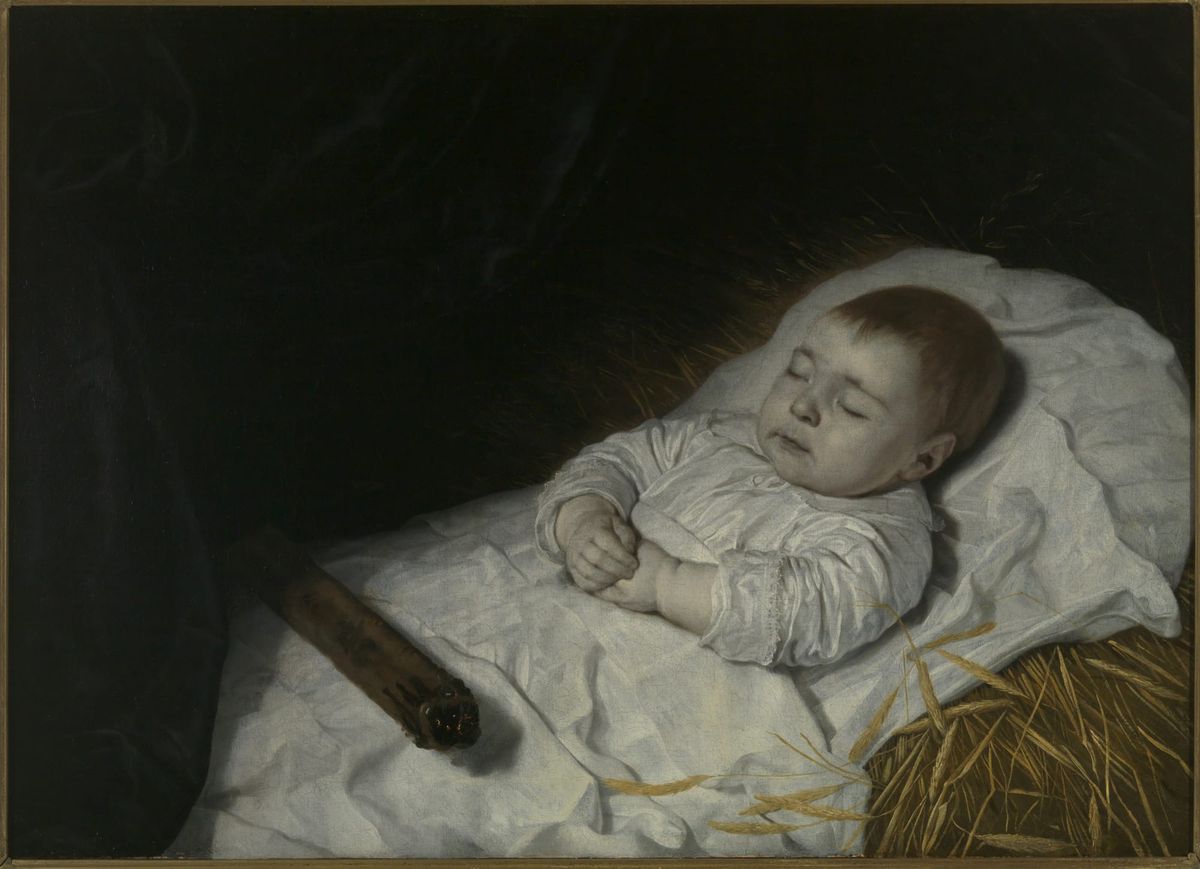
17세기 중반에 네덜란드의 대표적인 초상화가 바르톨로메우스 판 데르 헬스트(Bartholomeus van der Helst)가 제작한 이 작품은, 어린 자식을 잃은 부모의 슬픔과 생명의 덧없는 실상을 차분하고도 엄숙한 화풍 속에 투영합니다.
네덜란드 하우다의 하우다 박물관(Museum Gouda)에 소장된 이 작품의 공식 소장품 등록번호는 55322이며, 실제 작품의 실측 규격은 높이 70 cm, 너비 98 cm의 캔버스 유채화입니다.
작가의 고뇌/비하인드
작품의 전면에는 짚더미와 하얀 천 위에 평온하게 누워 잠든 듯 영면에 든 어린 아이의 모습이 묘사되어 있으며, 삶과 죽음의 경계에 놓인 인간의 무력한 실상을 고스란히 드러냅니다.
아이의 뺨에 남아 있는 미세한 생기의 흔적과 두 손을 곱게 모은 아기자기한 손동작은 영원히 돌아갈 수 없는 시간을 마주한 부모의 절제된 슬픔을 가감 없이 보여줍니다.
특히 중경에는 아이가 누인 하얀 침대 곁으로 타들어가다 멈춘 촛농과 마른 짚의 세밀한 묘사가 입체적인 볼륨감을 형성하고 있으며, 원경의 완전히 어두운 실내 배경은 오직 아이의 누운 모습에 시선을 집중시켜 깊은 대기감을 자아냅니다.
무의식 속 시선 및 심리 흐름
관람객의 시선은 가장 먼저 화면 중앙에서 하얀 포대기에 감싸여 평온하게 잠든 듯 누워 있는 아이의 창백하지만 순수한 얼굴로 자연스럽게 꽂힙니다.
이어 시선은 아이의 가슴 위에 단정하게 모인 두 손과 그 곁에 놓인 꺼져가는 촛불의 형태를 거쳐, 아래쪽에 흩어진 마른 짚과 풀잎의 사실적인 질감으로 부드럽게 이동한다.
마지막으로 시선은 화면 전체를 감싸는 묵직하고 거대한 어둠의 공간으로 확장되며, 어린 생명의 소멸이 가져다주는 먹먹한 슬픔과 숙연한 울림을 체감하게 된다.
미술계의 평가 및 조형미
미술사학계는 이 작품을 17세기 네덜란드 황금시대 초상화의 거장 판 데르 헬스트가 남긴 이례적인 사후 초상화의 수작이자, 죽음이라는 무거운 주제를 담담하고 품격 있는 사실주의 기법으로 포착한 뛰어난 작품으로 평가합니다.
캔버스 위에 정교하게 쌓아 올린 유채 물감은 하얀 천의 부드러운 주름, 아이의 섬세한 피부 톤, 그리고 타들어 간 촛불의 질감을 생생하게 살아나게 만듭니다.
인간의 가장 깊은 슬픔과 삶의 유한함을 예술의 경지로 조화롭게 녹여낸 이 작품은, 오랜 시간이 지나도 변함없는 미술사적 가치를 지니고 있다.
영문 번역본 구성
Portrait of a Dead Child
Created in the mid-seventeenth century by the prominent Dutch master Bartholomeus van der Helst, this work quietly reflects the profound grief of parents losing a young child and the transient reality of life through a solemn and restrained painterly style.
Housed in the Museum Gouda in Gouda, Netherlands, this piece bears the official inventory number 55322, and the actual physical dimensions of the oil on canvas measure 70 cm in height and 98 cm in width.
The Artist's Struggle and Behind-the-Scenes
In the immediate foreground, a young child is depicted lying peacefully as if asleep upon a bed of straw and white linen, vividly exposing the helpless reality of human existence poised upon the boundary between life and death.
The faint trace of warmth lingering on the child's cheeks and the delicate gesture of tiny hands folded neatly together unsparingly reveal the restrained sorrow of parents facing a time that can never return.
In the middle ground, the meticulous depiction of a burned-down candle stump and dry straw near the white linens establishes a volumetric spatial presence, while the completely darkened interior background in the distance focuses attention entirely on the resting child to generate a profound atmospheric depth.
Subconscious Gaze and Psychological Flow
The viewer's gaze is initially drawn directly to the pale yet pure face of the child at the center, wrapped in white swaddling clothes and resting with a peaceful expression resembling sleep.
The eye then shifts smoothly past the child's hands neatly clasped over the chest and the form of the dying candle beside them toward the realistic textures of the scattered dry straw and blades of grass below.
Finally, the gaze drifts outward into the heavy and massive expanse of darkness enveloping the entire composition, evoking a poignant sorrow and solemn resonance delivered by the fading of a young life.
Art World Evaluation and Formal Beauty
Art historians evaluate this work as an exceptional masterpiece of posthumous portraiture by seventeenth-century Dutch Golden Age master van der Helst, successfully capturing the heavy theme of death with composed and dignified realist techniques.
The meticulous layering of oil paint on canvas brings the soft folds of the white linen, the delicate flesh tones of the child, and the tactile texture of the spent candle to breathtaking life.
Successfully fusing humanity's deepest grief and the finite nature of life into the pinnacle of artistic mastery, this creation retains an enduring value in art history.
본 컨텐트의 저작권은 팔렛트제주에 있습니다. 허가없는 무단전제를 금지합니다.
Copyright © Palette Jeju. All rights reserved. Unauthorized reproduction or redistribution is strictly prohibited.