죽음을 앞둔 화가의 마지막 화폭과 거울 속 뒤틀린 진실, 폴리 베르제르의 술집 A Bar at the Folies-Bergère
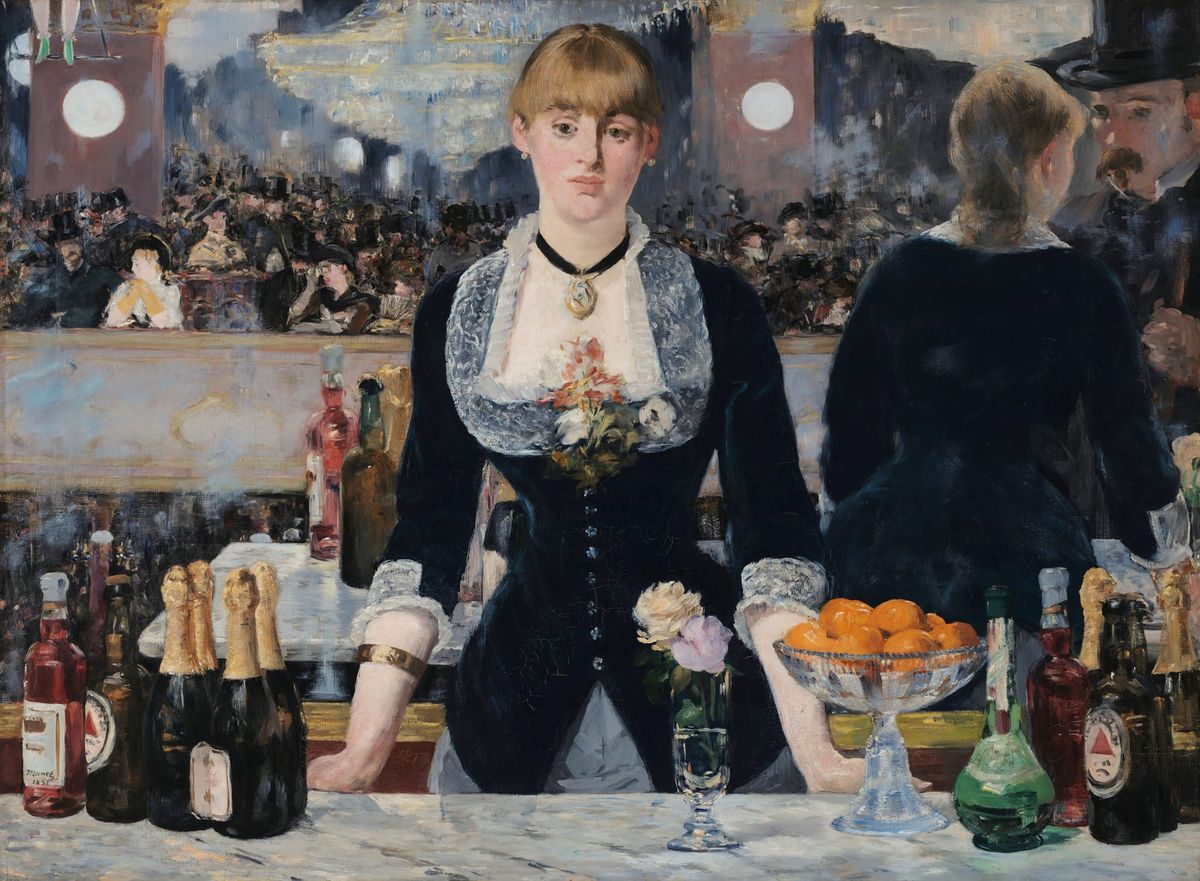
프랑스 인상주의의 아버지이자 근대 회화의 문을 연 에두아르 마네(Édouard Manet, 1832–1883)가 1882년 파리 살롱전에 출품한 유화 폴리 베르제르의 술집(A Bar at the Folies-Bergère)은 96.0 cm × 130.0 cm 크기의 캔버스에 유채로 그린 대표작입니다. 현재 영국 런던의 코톨드 미술관(The Courtauld Gallery, London)에 소장되어 있습니다.
썩어가는 다리와 휠체어 위의 투혼, 그리고 바텐더 쉬종의 눈물
이 그림이 완성되던 1881년에서 1882년 겨울, 마네는 매독 합병증인 척수로(Tabes dorsalis)로 인해 하반신 마비와 극심한 신경통에 시달리며 죽음의 문턱에 서 있었습니다. 서 있는 것조차 불가능해 휠체어에 앉아 그림을 그리던 마네는 자신의 생이 얼마 남지 않았음을 직감하고, 생애 마지막 살롱전을 장식할 유언과도 같은 대작에 착수했습니다.
마네는 평소 자신이 자주 드나들며 사랑했던 파리 최고의 카바레 '폴리 베르제르'의 실제 바텐더였던 '쉬종(Suzon)'을 자신의 화실로 직접 섭외했습니다. 마네는 화실 한가운데에 대리석 카운터와 술병들을 그대로 재현해 놓고 쉬종을 세웠습니다. 쉬종은 거장이 고통으로 신음하며 붓을 쥐는 모습을 매일 곁에서 지켜보며 수십 번의 포즈를 취해주었습니다.
당시 폴리 베르제르의 여급들은 단순한 바텐더가 아니라, 무대 뒤편에서 남성 고객들에게 암묵적으로 성을 파는 이중생활을 강요받던 취약한 노동자 계급이었습니다. 마네는 화려한 조명과 음악 뒤에 감춰진 쉬종의 고단함, 그리고 서서히 죽어가는 자기 자신의 처절한 고독을 캔버스 속 여인의 멍하고 슬픈 눈동자에 고스란히 담아냈습니다. 실제로 마네는 이 그림을 살롱전에 발표하고 불과 1년 뒤인 1883년 4월, 괴저로 한쪽 다리를 절단하는 수술을 받은 끝에 51세의 나이로 세상을 떠났습니다.
살롱전을 발칵 뒤집은 원근법의 파괴와 거울 속 은밀한 거래
1882년 살롱전에서 이 작품이 처음 공개되었을 때, 파리 미술계와 비평가들은 경악을 금치 못하며 마네가 "원근법도 모르는 엉터리 화가"라고 맹비난을 퍼부었습니다. 쉬종의 등 뒤에 걸린 거대한 거울 속 반사가 물리적 광학 법칙을 완전히 무시하고 있었기 때문입니다.
정면을 똑바로 응시하는 실제 쉬종의 모습과 달리, 거울 속 그녀의 뒷모습은 기묘하게 오른쪽으로 꺾여 모자를 쓴 콧수염 신사(마네의 친구이자 화가였던 가스통 라투슈가 모델)에게 은밀하게 몸을 숙이고 있습니다. 이는 명백한 의도적 왜곡이었습니다. 마네는 초벌 스케치에서는 정상적인 각도로 그렸으나, 완성작에서 거울 속 반영을 오른쪽으로 강제로 비틀어 배치했습니다.
정면의 쉬종이 관람객에게 보여주는 '차갑고 도도한 노동자'의 겉모습이라면, 거울 속 쉬종은 생존을 위해 부르주아 남성의 은밀한 제안을 받아들여야만 하는 '상품화된 여성'의 비참한 이면을 폭로한 것입니다. 관람객은 거울 속 신사의 자리에 서서 쉬종을 바라보는 구매자의 시선이 되는 동시에, 그녀의 쓸쓸한 정면 눈빛을 마주하며 깊은 윤리적 당혹감에 휩싸이게 됩니다.
공허한 눈동자와 붉은 삼각 라벨, 시선의 심리적 여정
그림을 마주하는 순간 관람객의 무의식적 시선은 화려한 샹들리에 불빛 속에서 유독 잿빛으로 가라앉은 쉬종의 공허한 눈동자로 가장 먼저 빨려 들어갑니다. 주변의 화려한 소음과 완벽히 차단된 듯한 그녀의 정적인 슬픔은 감상자의 발걸음을 멈춰 세웁니다.
이어 시선은 대리석 카운터 위에 놓인 투명한 술병들과 크리스털 볼 속의 오렌지, 그리고 세계 최초의 등록 상표인 붉은색 삼각형 라벨이 선명한 영국산 '배스(Bass) 맥주'로 향합니다. 당대 파리 최고의 유행 상품이었던 고급 주류와 화려한 과일들은, 그 뒤에 서 있는 여인 역시 돈으로 거래되는 또 하나의 소비재에 불과함을 서늘하게 웅변합니다.
마지막으로 시선은 우측 거울 속으로 이동하여 남성에게 몸을 기울인 쉬종의 비틀린 뒷모습과, 거울 좌측 최상단에 아주 작게 매달린 공중그네 곡예사의 초록색 신발에 가닿습니다. 아슬아슬하게 허공을 딛고 선 곡예사의 발과 모순된 거울의 각도를 확인하는 순간, 관람객은 화려한 근대 도시의 쾌락 이면에 도사린 인간의 불안과 소외를 뼈저리게 실감하게 됩니다.
근대 회화의 문을 활짝 연 최후의 유언, 미술계의 평가
미술계는 폴리 베르제르의 술집을 마네가 평생을 바쳐 탐구한 '근대성(Modernity)'의 완벽한 총결산이자, 20세기 아방가르드와 입체주의(Cubism)의 서막을 연 불멸의 걸작으로 평가합니다.
단일한 시점이라는 서양 고전 회화의 절대 규칙을 통렬히 부수고, 서로 다른 두 개의 시간과 심리를 한 화면에 공존시켰기 때문입니다. 죽음의 공포 앞에서도 끝내 붓을 놓지 않았던 거장의 마지막 숨결이 깃든 이 캔버스는 오늘날 19세기 파리의 눈부신 환락과 인간 실존의 슬픔을 증언하는 인류 최고의 명화로 우뚝 서 있습니다.
The Dying Master's Testament and the Fractured Reflection, A Bar at the Folies-Bergère
Painted in 1882 by Édouard Manet (1832–1883), the trailblazing pioneer of modern art, A Bar at the Folies-Bergère is an oil on canvas measuring 96.0 cm × 130.0 cm (37.8 in × 51.2 in), preserved in the permanent collection of The Courtauld Gallery in London, United Kingdom.
Sickness, Wheelchair Resilience, and the Searing Reality of Suzon
During the harsh winter of 1881–1882, Manet was fighting a losing battle against the agonizing neurological complications of locomotor ataxia (tertiary syphilis). Crippled and unable to stand, the master painted from a wheelchair, acutely aware that his days were numbered. Determined to produce a grand testament for his final Paris Salon, he recreated a bar setting within his studio, inviting Suzon, an actual barmaid from the famed Folies-Bergère entertainment hall, to sit for him.
At the time, barmaids at the Folies-Bergère inhabited a precarious social stratum, frequently pressured into transactional sexual liaisons with wealthy bourgeois patrons. Manet captured Suzon’s fatigue, professional detachment, and inner vulnerability, intertwining her quiet dignity with his own existential dread. Manet died just a year after the painting’s exhibition, following the emergency amputation of his gangrenous left leg at age 51.
The Salon Scandal: Spatial Deliberation and the Double Identity
When debuted at the 1882 Salon, conservative critics mocked the canvas, accusing Manet of technical incompetence due to the flagrant spatial impossibility of the rear mirror. While the physical Suzon stands completely upright facing forward, her mirrored reflection is pushed drastically to the far right, intimately bent toward a top-hatted male patron (modeled by artist Gaston La Touche).
X-ray and preparatory sketches reveal this was not a mistake but a calculated conceptual rebellion. Manet initially placed the reflection directly behind her, but deliberately shifted it to create a psychological dichotomy: the detached, professional front contrasted with the submissive, commodified role she must assume in the predatory male gaze. The spectator is cast into the uncomfortable position of the client negotiating with her, creating an enduring tension between voyeurism and empathy.
Subconscious Trajectory of the Gaze: Bass Ale, Oranges, and Trapeze Feet
The observer's subconscious gaze immediately converges upon Suzon’s vacant, melancholic eyes, which stand in quiet defiance against the blazing electric chandeliers and bacchanalian chaos of the Parisian music hall.
The visual movement then slides down to the tactile still life upon the marble slab—the gleaming champagne bottles, compote of oranges, and the distinct red triangle insignia of British Bass Pale Ale (the world's first registered trademark). These luxury commodities subtly equate the female bartender with the consumer products staged for sale.
Finally, the trajectory sweeps across the dislocated reflection on the right, before noticing the dangling green feet of the trapeze acrobat perched precariously in the upper-left corner. Juxtaposing high-wire physical danger with the psychological precarity of the working class, the viewer confronts the bittersweet alienation inherent to the capitalist metropolis.
The Dawn of Modernity: Critical Legacy
Art historians revere A Bar at the Folies-Bergère as the supreme culmination of Manet's career and the definitive threshold of Modernist painting.
By destabilizing Renaissance single-point perspective and presenting simultaneous psychological truths, Manet foreshadowed the revolutionary spatial dynamics of Cubism. This poignant masterpiece endures as a luminous celebration of Parisian spectacle and a timeless meditation on human vulnerability.
본 컨텐트의 저작권은 팔렛트제주에 있습니다. 허가없는 무단전제를 금지합니다.
Copyright © Palette Jeju. All rights reserved. Unauthorized reproduction or redistribution is strictly prohibited.