장작을 패는 멜롱 영감 (Le Père Melon sciant du bois, 1879)
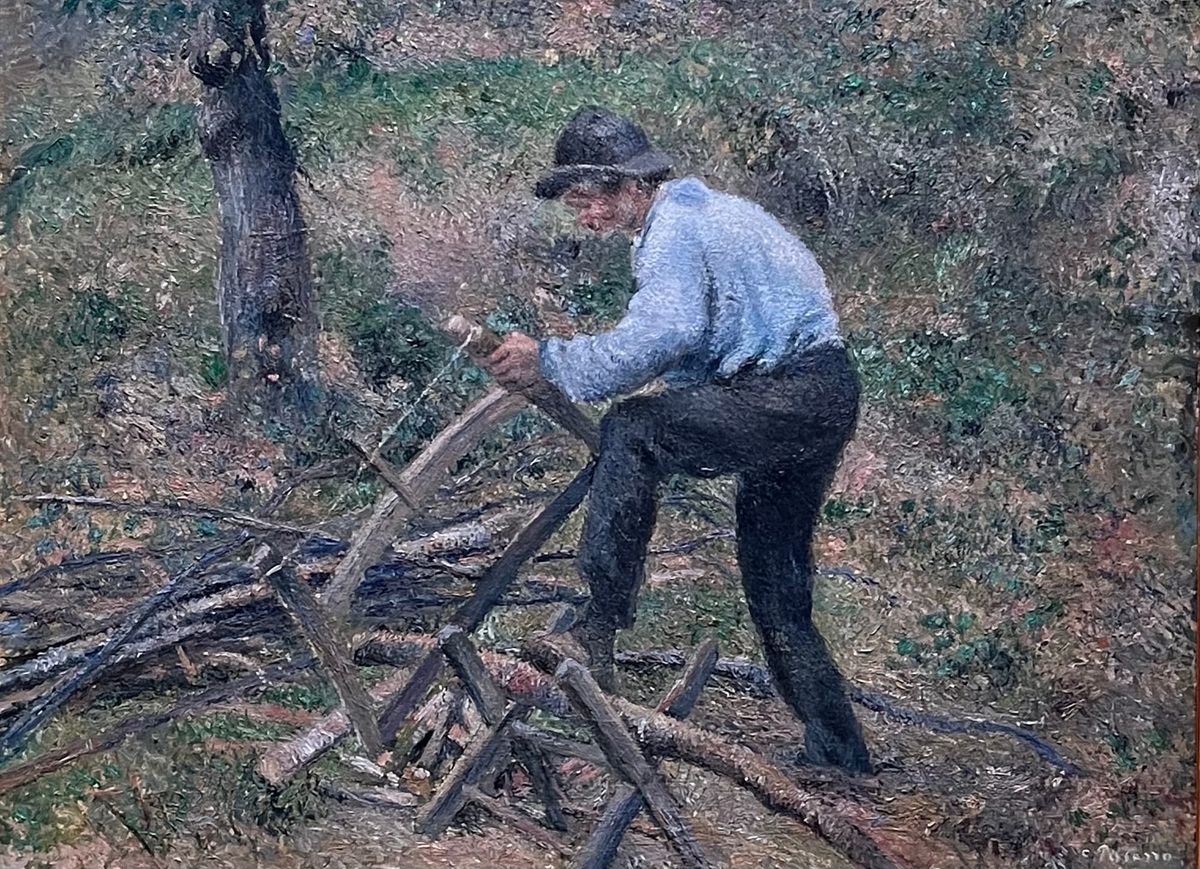
1870년대 후반 퐁투아즈 시절, 카미유 피사로는 숲속의 고요한 침묵을 가르는 시골 노인의 성실한 노동의 순간에 주목했습니다. 퐁투아즈 에르미타주 인근에서 잡일을 도맡아 하던 실존 인물 '멜롱 영감'을 모델로 한 이 작품은, 이상화된 영웅의 모습 대신 거친 흙바닥 위에 발을 단단히 딛고 선 농촌 노동자의 진솔한 일상을 기록한 수작입니다. 가로 73cm, 세로 54cm 크기의 캔버스에 유채로 완성된 이 그림은, 톱을 쥔 노인의 강인한 역학적 동세와 숲의 유기적인 질감을 촘촘한 붓터치로 결합하여 대지 위에 뿌리내린 인간의 성스러운 생명력을 웅변합니다.
관람자의 시각 인지 체계는 화면 중앙에서 밝은 푸른빛 작업복 셔츠를 입고 장작 위에 무릎을 굽혀 올린 인물의 역동적인 형태감에 가장 먼저 도달합니다. 숲속의 짙은 녹음과 갈색 토양 사이에서 푸른 셔츠가 뿜어내는 선명한 명도 대비는 시각 피질의 중심와를 즉각 포획하며 화면의 조형적 구심점을 확립합니다.
이어서 시선은 짙은 모자 아래로 드러난 노인의 집중된 옆얼굴을 스쳐, 장작을 힘차게 켜고 있는 두 손과 사선으로 교차된 톱날의 궤적으로 자연스러운 도약 안구 운동을 진행합니다.
톱과 얽혀 있는 통나무 지지대들의 복잡하고 거친 질감을 훑어낸 눈길은 노인의 단단한 검은 바지와 흙을 딛고 선 오른발의 묵직한 하중을 지나, 화면 좌측 상단의 굵은 고목 나무 기둥과 배경 전체를 뒤덮은 촘촘한 덤불의 진동하는 녹색 터치들로 부드럽게 확장됩니다.
나무를 켜는 소박한 마찰의 감각과 숲속 공기의 서늘한 질감이 망막 위에서 하나의 조화로운 지각으로 통합되는 순간, 관조자는 번잡한 일상의 번뇌를 내려놓고 원초적인 노동의 고요한 리듬 속에 머무는 듯한 깊은 심리적 안도감과 내면의 평온을 체험하게 됩니다.
이 그림을 그릴 당시 피사로는 제4회 인상주의 전시회를 거치며 인물과 풍경의 구조적 일체화를 모색하고 있었으며, 폴 세잔과 함께 작업하며 회화의 촉각적 물질성을 강화하는 실험에 몰두했습니다.
그는 장 프랑수아 밀레의 바르비종파적 숭고함을 계승하면서도, 인위적인 종교적 감상성을 걷어내고 순수한 색채의 병치와 짧고 단단한 필치로 인물의 근육과 나무껍질의 거친 결을 일체화시켰습니다.
동시대 미술계와 평론가들은 노동의 숭고함을 화려한 기교 없이 정직하게 담아낸 피사로의 캔버스를 두고 "흙과 땀의 가치를 가장 순수하고 품위 있는 조형 언어로 승화시킨 대가의 진정한 승리"라며 높은 찬사를 보냈습니다.
묵묵한 노동의 땀방울과 숲의 영속성을 탄탄한 조형미와 빛의 조화로 완성해 낸 피사로의 이 인물화는, 현대 미술사에서 후기 인상주의 인물 탐구가 지닌 인간주의적 품격과 자연과의 근원적 유대를 증명하는 독보적인 걸작으로 확고하게 평가받고 있습니다.
Old Melon Sawing Wood (Le Père Melon sciant du bois, 1879)
During the late 1870s in Pontoise, Camille Pissarro focused his empathetic gaze on the quiet rhythm of agrarian toil, capturing the resolute physical exertion of a local laborer known as "Old Melon."
Steering clear of academic grandiosity, the master depicted this working-class elder firmly grounded upon the forest soil, immortalizing the unvarnished dignity of rural routine. Measuring 54 by 73 cm, this horizontal oil on canvas seamlessly unites the dynamic muscular tension of manual sawing with the dense organic texture of the woods, celebrating the vital communion between man and the earth through richly woven brushwork.
The observer’s perceptual framework instantly anchors upon the sunlit cerulean blue work shirt of the laborer in the center, whose bent knee braces firmly against the wooden beam. The crisp tonal contrast between this vibrant garment and the surrounding woodland shadows arrests the fovea, establishing an intuitive and emotionally grounded nucleus for spatial orientation.
From this solid human center, the ocular trajectory tracks downward along the muscular curve of his arms to the taut diagonal vector of the bow saw, pausing upon the intricate crisscross of cut logs and the sawbuck resting in the lower foreground.
Navigating past his dark, heavily shadowed trousers and anchored footing on the soil, the gaze ascends through the weathered trunk of the ancient tree on the left before sweeping across the dense, vibrating tapestry of moss and foliage that envelops the entire background.
As the tactile rasp of cut wood and the cool forest breeze integrate into a unified sensory continuum within the visual cortex, active visual scanning dissolves into profound contemplative stillness, attuned to the restorative and timeless cadence of honest labor.
While creating this piece, Pissarro was deeply engaged with Paul Cézanne in developing a more tactile, structured surface that could capture physical permanence without sacrificing optical luminosity.
Translating Jean-François Millet’s deep humanist reverence into modern chromatic terms, Pissarro built the figure and foliage with thousands of dense, interlocking strokes, refusing salon sentimentalism in favor of pure pictorial truth.
Progressive critics universally lauded the work, admiring the master’s exceptional gift for elevating ordinary physical labor into an enduring monument of moral gravity and aesthetic authenticity.
Masterfully harmonizing tectonic structural weight with profound humanist empathy, Pissarro's depiction of Old Melon stands celebrated across art history as a defining masterpiece of nineteenth-century figurative Impressionism.
본 콘텐츠의 저작권은 저작권자에게 있으며, 무단 전재 및 재배포를 금합니다.