자화상 Autoportrait
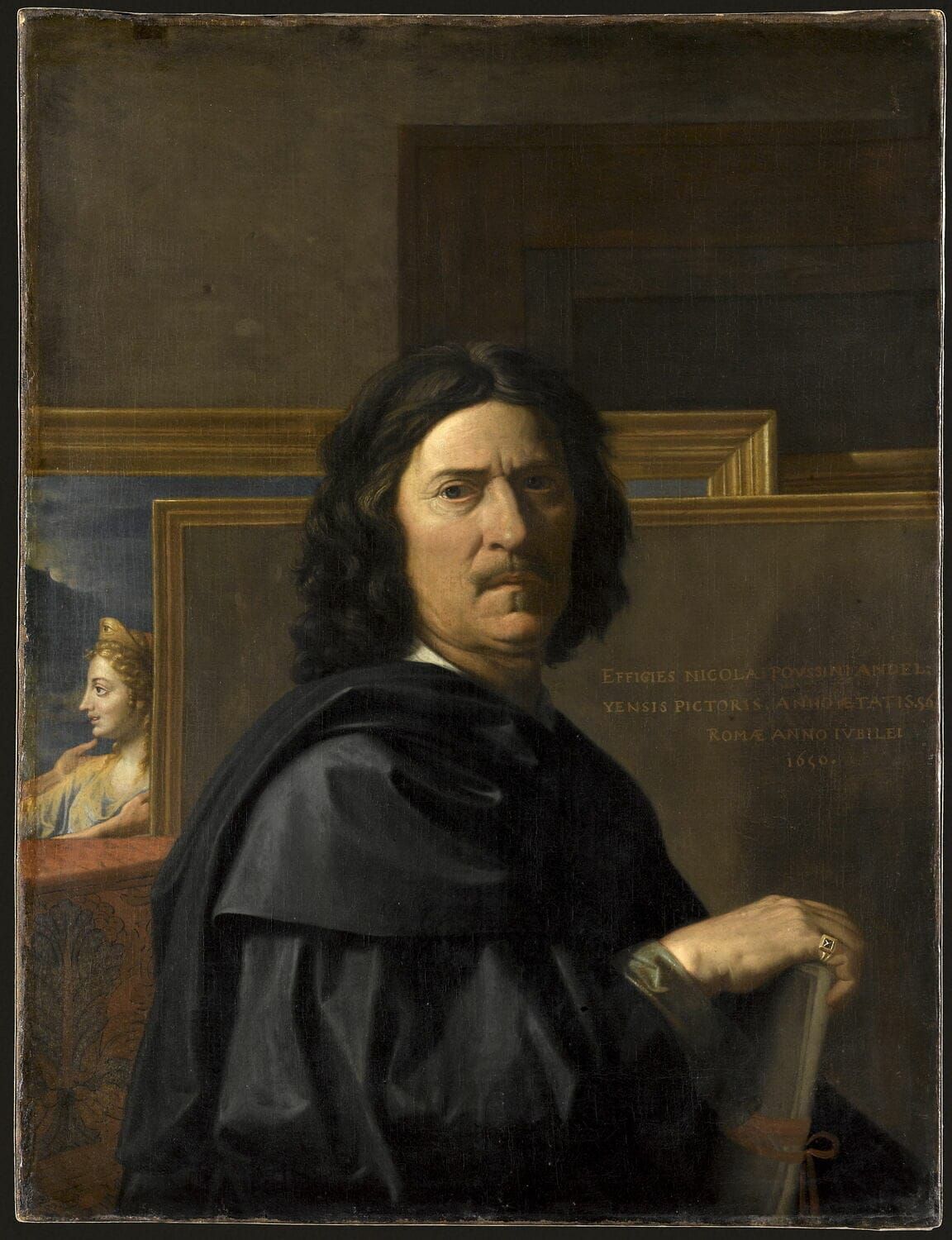
17세기 프랑스 고전주의 회화의 시조이자 서양 미술사 불멸의 거장 니콜라 푸생(Nicolas Poussin, 1594–1665)이 1650년 로마에서 완성한 기념비적 자화상 유화 자화상(Self-Portrait, 프랑스어: Autoportrait, 소장품 번호: INV 7302)은 98.0 cm × 74.0 cm 크기의 세로형 캔버스에 유채로 그린 대표적인 예술가 초상화 최고 걸작입니다.
현재 프랑스 파리의 루브르 박물관(Musée du Louvre, Paris)에 소장되어 있습니다.
절친한 후원자의 간청과 지적인 철학자 화가의 자존감을 향한 화가의 고뇌
1640년대 후반 프랑스 파리의 가장 절친한 친구이자 평생의 후원자였던 폴 프레아 드 샤르틀루(Paul Fréart de Chantelou)는 로마에 머물고 있던 푸생에게 자신의 컬렉션을 위해 자화상을 그려 보내달라고 수없이 간청했습니다.
푸생은 평소 자신의 얼굴을 그리는 일을 극도로 꺼렸으며, 손 떨림과 노환으로 인해 작업에 어려움을 겪고 있었습니다.
그러나 친구의 끈질긴 우정에 보답하기 위해 마침내 붓을 든 화가는, 단순한 외모의 묘사를 넘어 자신이 평생을 바쳐 추구해 온 고전주의 예술 철학과 회화의 숭고한 지적 가치를 세상에 웅변하는 걸작을 완성하고자 치열하게 고뇌했습니다.
화가는 검은색 학자풍의 외투를 단정하게 걸치고, 작업실에서 겹쳐 놓은 캔버스 액자들 앞에 위엄 있게 선 자신의 쉰여섯 살 모습을 화폭에 담았습니다.
푸생의 손가락에는 피라미드 모양의 다이아몬드가 박힌 반지가 끼워져 있는데, 이는 스토아 철학의 불변하는 이성과 영원한 지혜를 상징합니다.
그의 오른손은 소중한 그림들이 묶여 있는 포트폴리오(작품집)를 묵직하게 누르고 있습니다.
화면 왼쪽 배경 캔버스에는 이마에 눈이 달린 디아뎀(왕관)을 쓴 회화의 여신과 그녀를 사랑으로 감싸 안는 두 팔이 작게 그려져 있습니다.
이는 푸생이 회화를 단순한 손기술이 아닌 지적인 학문이자 우정의 결실로 여겼음을 보여주며, 배경 캔버스에 새겨진 1650년 희년 로마의 안델리 출신 화가 니콜라 푸생의 초상이라는 라틴어 명문은 대가의 꺾이지 않는 자부심을 손에 잡힐 듯 생생하게 웅변합니다.
정면을 꿰뚫는 거장의 눈빛에서 다이아몬드 반지와 겹쳐진 캔버스로, 시선의 심리적 여정
그림을 마주하는 순간 관람객의 무의식적 시선은 화면 중앙 어두운 작업실 공간 속에서 차분한 빛을 받아 선명하게 드러나는 푸생의 단호하고 위엄찬 눈빛과 굳게 다문 입술로 가장 먼저 빨려 들어갑니다.
쉰여섯의 나이가 느껴지는 깊게 파인 주름과 날카로운 콧날, 그리고 관람객을 정면으로 똑바로 꿰뚫어 보는 화가의 묵직한 시선은 보는 이에게 깊은 시각적 압도감과 함께 고결한 철학자를 마주하는 듯한 지적 긴장감을 선사합니다.
이어 시선은 어깨를 감싸고 있는 검은색 망토의 묵직한 주름을 따라 화면 오른쪽 아래로 이동하여, 스토아 철학의 상징인 피라미드 모양 다이아몬드 반지를 낀 채 드로잉 폴더를 단단히 쥐고 있는 화가의 손끝으로 옮겨갑니다.
육체의 떨림을 이겨내고 예술적 완성을 지켜낸 거장의 단단한 손등을 확인하는 순간, 관람객은 평생을 엄격한 조형 질서와 학문에 바친 한 예술가의 고독한 열정 한복판 속으로 온몸이 빨려 들어가게 됩니다.
마지막으로 시선은 화가의 등 뒤에 수직과 수평으로 겹쳐진 기하학적 액자 틀을 지나, 화면 왼쪽 캔버스에 작게 그려진 회화의 여신 얼굴과 황금빛 라틴어 비문에 멈춥니다.
엄격한 사각형 프레임과 깊은 어둠이 빚어내는 완벽한 기하학적 구조를 마주하며, 관람객은 회화를 지고의 학문으로 승화시킨 고전주의의 위대한 승리와 노거장 푸생이 건네는 묵직한 영혼의 울림을 가슴 깊이 마주하게 됩니다.
17세기 프랑스 고전주의 예술가 초상화의 정점과 조형미, 미술계의 평가
미술계는 루브르 박물관의 자화상을 서양 미술사에서 지적 성찰과 예술가의 사회적 위상을 가장 완벽하게 시각화한 최고봉의 자화상 걸작으로 평가합니다.
화려한 장식이나 과장을 배제하고 겹쳐진 사각형 캔버스와 문틀이 만들어내는 기하학적 공간 분할 속에 인물을 조각처럼 당당하게 배치했을 뿐만 아니라, 검은 옷감의 깊은 음영, 피부의 나이테, 반짝이는 금반지와 석판 명문의 물질감을 극도로 섬세한 고전주의 명암법으로 완벽하게 구현했기 때문입니다.
예술을 지고한 철학적 사유의 경지로 끌어올린 푸생의 이 걸작 화폭은, 오늘날까지도 전 세계 수많은 감상자들에게 깊은 감탄과 잊을 수 없는 시각적 전율을 전해주는 불멸의 명작으로 손꼽히고 있습니다.
Self-Portrait
Painted in 1650 in Rome by the founder of French classicism and immortal master Nicolas Poussin (1594–1665), Self-Portrait (French: Autoportrait, Inventory No. INV 7302) is a monumental milestone in oil on canvas measuring 98.0 cm × 74.0 cm (38.6 in × 29.1 in).
It is preserved in the distinguished permanent collection of the Musée du Louvre in Paris, France.
Chantelou's Entreaty, the Stoic Ring, and the Philosopher-Painter's Manifest
In the late 1640s, Paul Fréart de Chantelou, Poussin’s closest patron and confidant in Paris, persistently requested a painted portrait of the master for his private gallery.
Although Poussin generally resisted painting his own likeness and battled physical fatigue and hand tremors, he ultimately acceded to his friend's devotion.
The master resolved to create an intellectual manifesto that would elevate the status of painting from mechanical craft to the highest realm of liberal philosophy and Stoic reason.
The composition portrays the fifty-six-year-old master standing in his Roman studio, cloaked in a sober black scholar's mantle before a series of stacked, framed canvases.
Upon his right pinky finger rests a ring set with a pyramidal diamond, the classical emblem of Stoic constancy and immutable intellect, while his firm hand anchors a leather portfolio containing his master drawings.
In the background on the left, an allegorical canvas depicts the personification of Painting crowned with a diadem eye, embraced by hands of friendship.
The Latin inscription inscribed upon the canvas proclaims the identity of Nicolas Poussin of Les Andelys, Painter, at Rome in the Jubilee Year 1650, establishing a proud statement of artistic immortality.
Subconscious Trajectory of the Gaze: From Piercing Intellect to the Stacked Frames
The observer's subconscious gaze is immediately magnetized by the upper-central register, drawn to the severe, piercing gaze and dignified profile of the master emerging from the studio shadows.
His graying wavy hair, mustache, furrowed brow, and uncompromising frontal stare establish an instant focal point of sovereign intellect, moral gravity, and philosophical independence.
The visual path then descends along the heavy folds of his black toga-like mantle toward the lower-right register, arriving at his powerful hand adorned with the diamond ring resting upon the drawing folder.
Taking in the tactile firmness of his grip and the geometric precision of the jewel, the viewer directly experiences the resolute discipline and creative fortitude of an artist triumphing over physical frailty.
Finally, the visual trajectory sweeps toward the layered rectangular frames in the background, observing the classical profile of the allegorical muse on the left and the golden Latin lettering on the right.
Observing the harmonious equilibrium between rigorous rectilinear geometry, restrained tonal harmony, and sculptural draftsmanship, the spectator perceives the timeless nobility of the intellect and the profound aesthetic solace Poussin embedded within the monumental canvas.
The Monument of French Classical Self-Portraiture: Critical Legacy
Art historians revere the Louvre Self-Portrait as one of the most profound and intellectually rigorous self-portraits in Western art, illustrating Poussin’s complete synthesis of Stoic virtue and classical proportion.
By orchestrating delicate textural contrasts between dark woolen fabric, weathered human flesh, golden picture frames, and crisp stone inscriptions within an architectural grid, Poussin elevated a personal likeness into an exquisite philosophical treatise on the dignity of the painter.
This grand historical canvas endures as an inspiring testament to the master's creative fortitude, celebrating the victory of reason and the transformative grace of living art.
본 컨텐트의 저작권은 팔렛트제주에 있습니다. 허가없는 무단전제를 금지합니다.
Copyright © Palette Jeju. All rights reserved. Unauthorized reproduction or redistribution is strictly prohibited.