자화상 (Autoportrait, 1873)
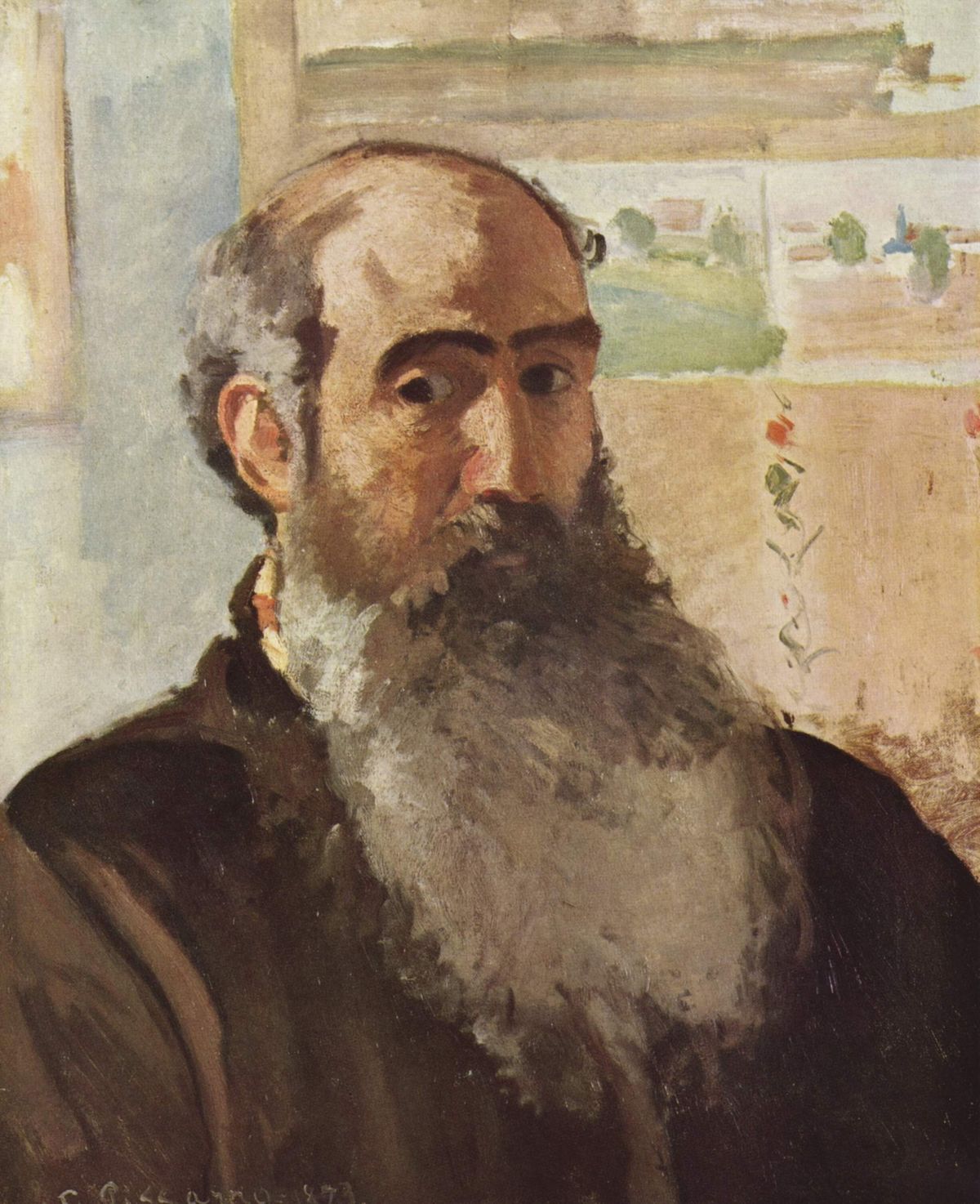
1873년 인상주의의 역사적인 첫 번째 독립 전시회를 1년 앞두고 있던 카미유 피사로는 퐁투아즈의 작업실 거울 앞에 앉아 자신의 내면과 마주했습니다.
마흔셋이라는 화가로서의 원숙한 나이에 접어든 그는, 당시 제도권 살롱의 외면과 극심한 경제적 압박 속에서도 흔들리지 않는 예술적 신념과 지성적인 결의를 화폭에 담담히 투영했습니다. 가로 46.7cm, 세로 56cm 크기의 캔버스에 유채로 완성되어 현재 파리 오르세 미술관에 소장된 이 작품은, 거장의 전 생애를 통틀어 몇 점 남지 않은 자화상 중에서도 가장 강렬한 존재감과 조형적 깊이를 지닌 대표작입니다.
관람자의 시각 인지 체계는 화면 상단에서 빛을 받아 밝게 반짝이는 넓은 이마와, 그 아래에서 관람자를 정면으로 꿰뚫어 보는 듯한 깊고 형형한 검은 눈동자에 가장 먼저 도달합니다. 얼굴 좌측으로 드리운 짙은 음영과 오른쪽 볼에 맺힌 온화한 피부 톤이 이루는 뚜렷한 명암 대조는 시각 피질의 중심와를 즉각 포획하며 화면 전체의 지적이고 심리적인 구심점을 확립합니다.
이어서 시선은 콧날의 단단한 능선을 타고 내려와, 가슴팍까지 풍성하고 웅장하게 흘러내리는 잿빛과 은백색 턱수염의 거친 마티에르로 자연스러운 도약 안구 운동을 진행합니다.
수염의 촉각적인 붓터치를 훑은 눈길은 화면 하단을 묵직하게 받쳐주는 검은 외투의 단순한 실루엣을 지나, 인물 뒤편 벽면에 걸린 피사로 자신의 서정적인 풍경화 판화들과 소박한 분홍빛 꽃무늬 패턴으로 부드럽게 상승합니다.
거친 붓질 속에서 드러나는 화가의 엄숙한 표정과 배경 속 따뜻한 전원 모티프가 망막 위에서 하나의 조화로운 인간상으로 통합되는 순간, 관조자는 세파에 흔들리지 않는 대가의 굳건한 내면과 마주하며 깊은 심리적 안정감과 묵직한 내적 평온을 체험하게 됩니다.
이 자화상을 그릴 당시 피사로는 클로드 모네, 에드가 드가, 피에르 오귀스트 르누아르 등 젊은 후배 화가들을 규합하여 새로운 예술가 조합을 결성하는 데 주도적인 역할을 하고 있었습니다.
동료들에게 '자애로운 대부(代父)'이자 지혜로운 스승으로 존경받았던 피사로는, 자신을 영웅적으로 미화하지 않고 대지의 철학자처럼 정직하고 소박한 모습 그대로 기록했습니다. 훗날 폴 세잔은 피사로의 이 진솔한 풍모를 평생 마음에 품으며 "그는 우리 모두의 아버지이자 영원한 나침반이었다"고 회고했습니다.
한 치의 과장도 없이 진실한 자기 성찰과 회화적 결의를 묵직한 조형미로 구현해 낸 피사로의 1873년 자화상은, 현대 미술사에서 인상주의의 태동을 이끈 거장의 확고한 정신적 뿌리와 인간주의적 존엄을 증언하는 불멸의 자화상으로 높이 평가받고 있습니다.
Self-Portrait (Autoportrait, 1873)
On the very threshold of the historic First Impressionist Exhibition of 1874, Camille Pissarro positioned himself before the studio mirror in Pontoise, confronting his own reflection with penetrating clarity.
At forty-three years of age, weathering persistent economic distress and relentless rejection from the academic Salon, the master projected an unwavering artistic conviction and intellectual resolve onto the canvas. Measuring 56 by 46.7 cm and preserved within the Musée d'Orsay, this vertical oil on canvas stands as one of the exceedingly rare self-portraits from Pissarro’s formative prime, radiating an extraordinary aura of psychological gravity and compositional weight.
The observer’s perceptual framework instantly grounds itself upon the broad, domed forehead illuminated by cool indoor daylight, descending to the acute, meditative gaze of his dark eyes. The pronounced chiaroscuro sculpting the contours of his weathered face arrests the fovea, establishing an intuitive and intellectually arresting anchor for the entire composition.
From this piercing focal center, the ocular trajectory tracks downward along the firm bridge of his nose, sweeping through the magnificent, cascading volume of his textured gray-and-silver beard.
Navigating across the dense, unembellished mass of his dark coat below, the gaze ascends toward the studio wall behind him, lingering upon the hung landscape prints and delicate floral motifs that subtly evoke his profound kinship with nature.
As the physical permanence of his stoic features and the ambient warmth of the background coalesce into a single unified presence within the visual cortex, active visual scanning dissolves into profound contemplative stillness, attuned to the quiet resilience of a visionary master.
While executing this self-portrait, Pissarro was actively organizing the independent cooperative that would soon shock Paris as the Impressionist vanguard. Revered by younger colleagues such as Claude Monet, Edgar Degas, and Pierre-Auguste Renoir as a wise and generous patriarch, Pissarro refused theatrical grandeur, depicting himself with the unvarnished honesty of a working craftsman and rural philosopher.
Paul Cézanne later paid homage to this upright spirit, famously remarking that Pissarro was like a father to them all and an enduring moral compass for modern art.
Masterfully harmonizing structural solemnity with profound humanist sincerity, Pissarro's iconic self-portrait remains celebrated throughout art history as an enduring testament to the intellectual courage that ignited the modern landscape revolution.
본 콘텐츠의 저작권은 저작권자에게 있으며, 무단 전재 및 재배포를 금합니다.