작열하는 태양 아래 꿈틀거리는 생명의 대지, 올리브 나무와 노란 하늘과 태양 Olive Trees with Yellow Sky and Sun
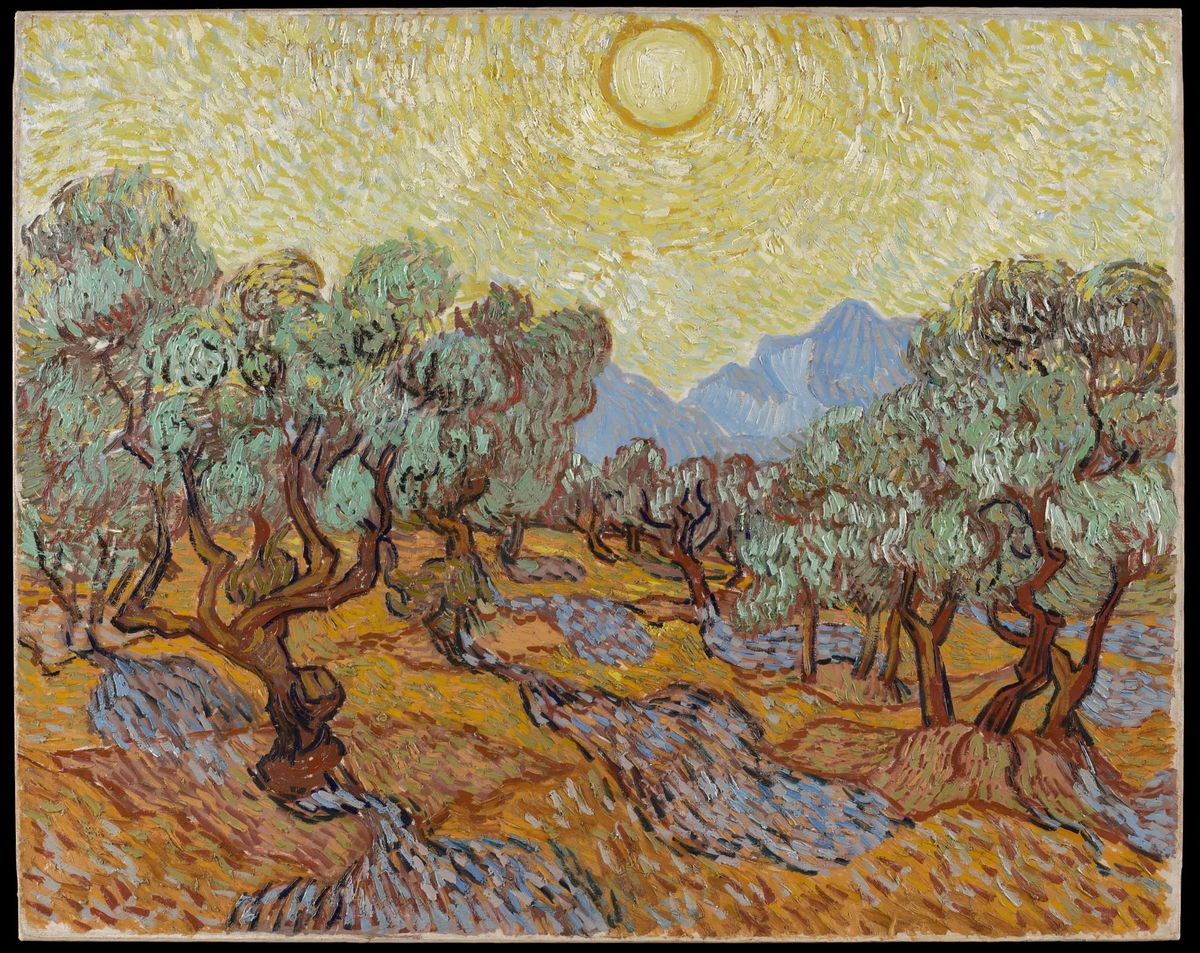
후기 인상주의의 거장 빈센트 반 고흐(Vincent van Gogh, 1853–1890)가 1889년 11월 프랑스 생레미의 생폴 드 모졸 정신병원 체류 시절 완성한 유화 《올리브 나무와 노란 하늘과 태양(Olive Trees with Yellow Sky and Sun, 또는 올리브 과수원)》은 73.7 cm × 92.7 cm 크기의 캔버스에 유채로 그린 대표작으로, 현재 미국 미니애폴리스 미술관(Minneapolis Institute of Art)에 영구 소장되어 있습니다.
게세마네 동산의 영적 번뇌와 프로방스 올리브 연작의 탄생
1889년 가을, 생레미 요양원에 머물던 반 고흐는 친구 폴 고갱과 에밀 베르나르가 종교적 상상력에 기대어 '올리브 동산의 그리스도'를 그리는 것을 보고 강한 문제의식을 느꼈습니다. 그는 관념적인 성서 묘사 대신, 눈앞에 실재하는 프로방스의 거친 올리브 나무들을 직접 마주하며 자연 그 자체 속에서 신성(神性)과 영적 번뇌를 포착하고자 했습니다.
고흐는 요양원 담장 밖 알피유(Alpilles) 산맥 자락에 자리한 올리브 밭으로 향했습니다. 그는 비틀리고 뒤틀린 은회색 올리브 고목들을 통해 고난과 인내, 그리고 대지의 원초적인 생명력을 표현했습니다. 동생 테오에게 보낸 편지에서 그는 "하늘을 온통 레몬빛 노랑으로 물들이고, 대지에는 보랏빛 그림자를 드리운 채 거대한 태양이 작열하는 올리브 밭을 그리고 있다"고 적으며, 전통적인 종교화를 넘어 자연의 리듬 속에 인간의 영혼과 고통을 담아내려는 치열한 예술적 집념을 고백했습니다.
무의식 속 시선의 공간 순환과 팽팽한 심리적 진동
감상자의 시선은 화폭 최상단 정중앙에서 눈부시게 이글거리는 황금빛 백열의 태양으로 가장 먼저 빨려 들어갑니다. 태양을 중심으로 동심원을 그리며 소용돌이치는 노란 하늘의 역동적인 붓 터치는 보는 이의 무의식 속에 강렬한 시각적 에너지와 경외감을 선사합니다.
이어 시선은 태양의 광휘를 타고 알피유 산맥의 서늘한 푸른 능선을 스쳐, 화폭 전면에 뒤틀린 채 꿈틀거리는 올리브 나무들의 줄기로 자연스럽게 하강합니다.
그 후 시선은 은빛과 청록색 잎사귀들의 물결을 지나, 대지 위에 파도치듯 굽이치는 황갈색 흙과 서늘한 보랏빛 그림자의 이랑을 따라 화면 전체로 유영합니다. 하늘의 작열하는 황금빛 열기와 대지의 서늘한 보라·청록빛 그림자가 이루는 극적인 보색 충돌 속에서, 관람자는 의식하지 못하는 사이 자연의 거대한 호흡과 화가가 겪었던 실존적 번뇌의 숭고한 융합에 깊이 빠져들게 됩니다.
자연의 신성화와 표현주의의 극치, 미술사적 평가
미술계는 이 작품을 반 고흐가 생레미 시기에 남긴 15점의 올리브 나무 연작 중에서도 감정의 응축과 색채 조형미가 가장 완벽하게 조화를 이룬 절대적인 걸작으로 평가합니다.
현실의 외형을 그대로 베끼는 데 그치지 않고, 굵고 물결치는 임파스토 기법과 대담한 원색의 대비를 통해 대지의 생명력을 마치 살아 숨 쉬는 유기체처럼 표현했습니다. 관념적 종교성을 극복하고 자연의 실재를 통해 현대적 영성을 구현한 이 걸작은, 훗날 20세기 표현주의와 야수파의 태동에 결정적인 길잡이가 된 불멸의 유산으로 손꼽히고 있습니다.
A Primordial Hymn Beneath the Blazing Firmament, Olive Trees with Yellow Sky and Sun
Painted in November 1889 during his momentous stay at the Saint-Paul de Mausole asylum in Saint-Rémy-de-Provence by Vincent van Gogh (1853–1890), Olive Trees with Yellow Sky and Sun is an oil on canvas measuring 73.7 cm × 92.7 cm (29.0 in × 36.5 in), preserved in the permanent collection of the Minneapolis Institute of Art in Minneapolis, Minnesota.
The Gethsemane of Nature: Modern Spirituality in the Provençal Grove
In the autumn of 1889, while recovering from severe psychological episodes in Saint-Rémy, Van Gogh grew increasingly frustrated by letters from Paul Gauguin and Émile Bernard describing their studio-invented depictions of Christ in the Garden of Olives. Rejecting their abstract religious symbolism, Vincent chose to confront the living reality of the Provençal countryside, seeking the divine within the tactile truth of nature.
Venturing into the olive orchards beneath the jagged slopes of the Alpilles mountains, Vincent produced a series of canvases celebrating the knotted, ancient trees as emblems of resilience and sacred struggle. Writing to his brother Theo, Vincent remarked that he had rendered an olive grove under a radiant yellow sun with a sky like an incandescent furnace, juxtaposed against purple-shadowed earth. Through the visceral physicality of paint, he created a modern visual gospel rooted entirely in the cycles of the earth.
Psychological Trajectory of the Gaze and the Cosmic Wave
The observer’s subconscious gaze is immediately seized by the blinding solar orb anchored in the upper zenith. Swirling in concentric ripples of vibrant lemon-yellow impasto, the celestial core radiates an intense, visceral heat that captivates initial visual awareness.
From this radiant apex, visual perception cascades past the cool blue silhouettes of the distant Alpilles mountains and descends into the twisted, muscular trunks of the olive trees.
The eye then rides the rhythmic waves of silvery-green foliage, eventually gliding along the furrowed contours of the ground where warm golden soils clash with cool, violet-tinged shadows. Navigating this profound dialectic between celestial fire and terrestrial endurance, the viewer subconsciously internalizes the elemental pulse of the universe and the artist's transcendent emotional release.
Expressive Impasto and the Dawn of Modernism: Critical Legacy
Art historians revere Olive Trees with Yellow Sky and Sun as the crowning achievement among Van Gogh’s fifteen olive orchard canvases, demonstrating the pinnacle of his late Post-Impressionist power.
By employing dynamic, serpentine brushstrokes and an audacious complementary palette of chrome yellow, cobalt blue, and rich violet, Vincent liberated landscape painting from passive observation into raw spiritual expression. Foreshadowing the radical spatial and emotional innovations of early 20th-century Expressionism, this canvas stands as an eternal testament to an artist who transformed human suffering into a triumphant, incandescent symphony of life.
Copyright © Palette Jeju. All rights reserved. Unauthorized reproduction or redistribution is strictly prohibited.
본 컨텐트의 저작권은 팔렛트제주에 있습니다. 허가없는 무단전제를 금지합니다.