자궁 속 태아 연구(Studies of the Fetus in the Womb)
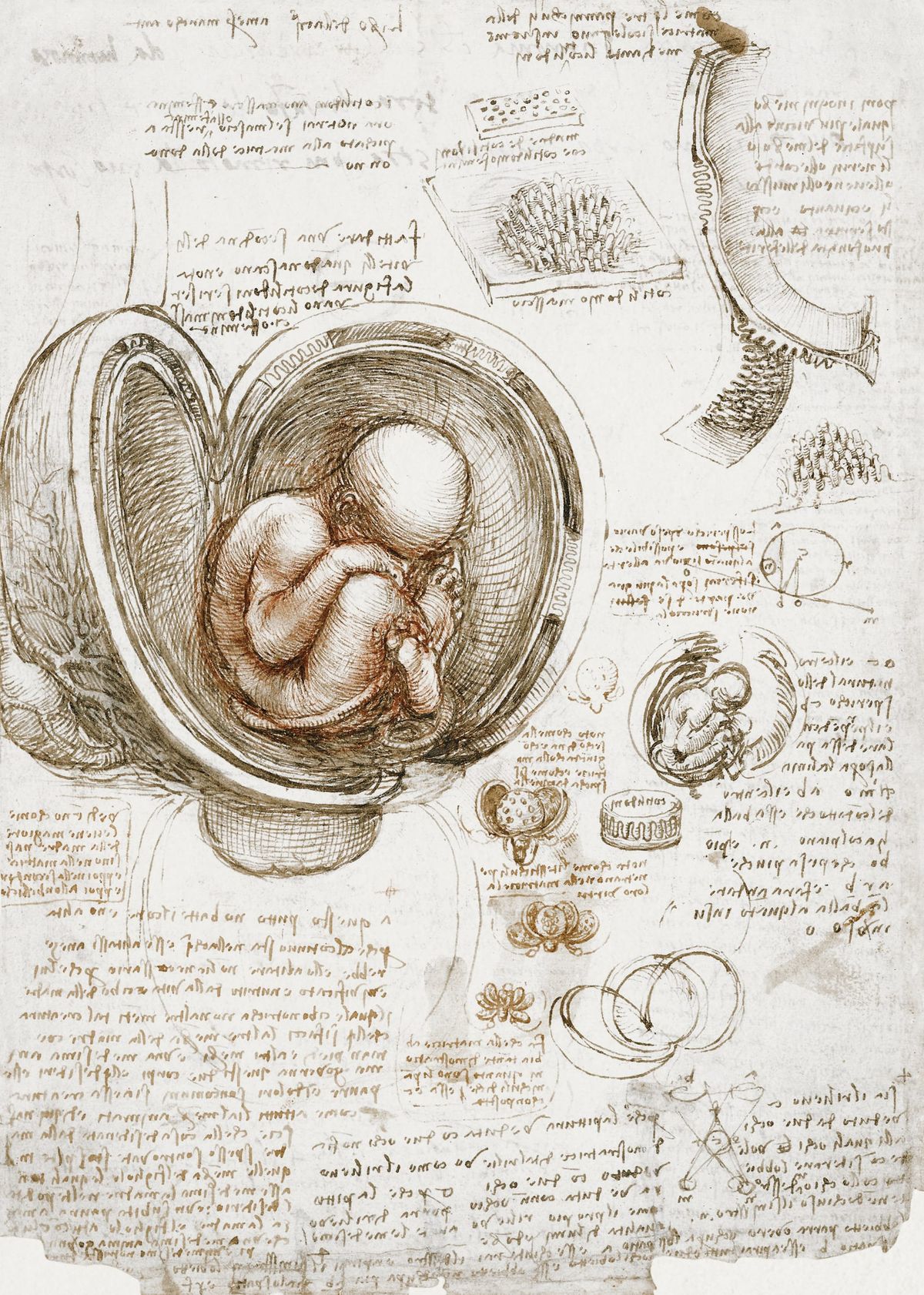
생명의 기원과 신비로운 해부학적 신비를 거장의 정밀한 필선과 과학적 탐구로 직조해 낸 르네상스 의학 드로잉의 정점, <자궁 속 태아 연구 (Studies of the Fetus in the Womb)>입니다. 이 작품은 천재 거장 레오나르도 다 빈치(Leonardo da Vinci, 1452–1519)가 1510–1512년경 완성한 희귀 해부학 소묘 유작으로, 실제 규격은 세로 30.5cm, 가로 22cm 크기이며 현재 영국 로열 컬렉션(Royal Collection Trust, Windsor Castle)에 소장되어 있습니다. 종이 위에 펜, 잉크, 붉은 크레용, 그리고 브라운 워시 기법을 사용하여 자궁 안에 웅크리고 있는 태아의 자세와 태반, 탯줄 및 혈관 구조를 입체적으로 정립해 낸 걸작입니다.
도상학적 분석에 따르면, 화면 좌측 상단의 커다란 자궁 단면도 속에는 다리를 웅크리고 머리를 숙인 채 태아 자세(Fetal position)를 취하고 있는 아기가 정교하게 묘사되어 있습니다. 레오나르도는 자궁 벽의 단면과 태반의 접합부, 그리고 탯줄이 태아의 몸으로 연결되는 유기적 경로를 음영 해칭으로 명확히 시각화했습니다. 우측과 하단에는 자궁 벽의 입체적 절개도, 자궁 혈관의 분배 구조, 그리고 태아의 위치 변화를 관찰한 소형 스케치들이 기하학적 도면과 함께 촘촘하게 배치되어 있습니다. 이는 단순한 미술적 드로잉을 넘어 인류 역사상 최초로 여성의 임신과 태아의 발생 과정을 과학적으로 도식화한 해부학적 이정표입니다.
작품의 여백을 빼곡하게 채우고 있는 거장 특유의 '거울 쓰기(Mirror writing)' 거꾸로 된 노트를 살펴보면, 르네상스 과학자로서의 치밀한 주석이 적혀 있습니다. 레오나르도는 노트에서 "태아는 자궁 속에서 스스로 호흡하지 않으며 어머니의 혈액을 통해 산소와 영양분을 공급받는다"는 점과 "아기의 심장은 어머니의 심장과 별개로 뛰며 탯줄이 이를 연결한다"는 당시로서는 대단히 혁신적인 해부학적 관찰 내용을 적어 두었습니다. 또한 자궁 벽의 수축 구조와 임신 중 장기의 변화에 대한 세세한 필기가 함께 기록되어 있어, 예술적 기량과 의학적 탐구심이 완벽하게 집일된 거장의 지적 정수를 확인할 수 있습니다.
이 화화판에는 의학사와 예술사를 통틀어 가장 높은 찬사를 받는 비하인드 스토리가 담겨 있습니다. 레오나르도는 파비아 대학교의 해부학 교수 마르칸토니오 델라 토레(Marcantonio della Torre)와 협력하여 인간과 동물의 시신을 직접 해부하면서 이 연구를 진행했습니다. 당대 교회 및 사회적 금기를 넘어 생명의 근원을 파헤친 그의 해부학 노구는 사후 수세기 동안 베일에 싸여 있다가 19세기에 이르러서야 세상에 재조명되었습니다. 현대의 해부학자들과 미술사학자들은 이 도면을 르네상스 인문주의와 현대 산부인과의 시초가 만나는 지점이이자, 인간 존재에 대한 거장의 깊은 존경심이 담긴 인류 공동의 위대한 유산으로 평가합니다.
이 스케치를 바라보는 감상자의 심리는 포근하면서도 정갈한 시선 순환 동선을 따라 차분히 이동합니다. 가장 먼저 화면 좌측 중심의 단면 도식 속에서 온화하게 웅크리고 있는 태아의 머리와 정교한 탯줄 윤곽에 시선이 멈춥니다. 이어 우측으로 시선이 흘러 자궁 벽의 절개면과 정밀한 혈관망 스케치를 관찰한 뒤, 하단에 배치된 기하학 도면과 소형 태아 관찰도 영역으로 시선이 내려앉습니다. 마지막으로 화면 가득 빼곡하게 그어진 거장의 거울 쓰기 노트 필선들을 타고 올라가 다시 태아의 아늑한 얼굴 윤곽으로 동선이 되돌아옵니다. 이러한 정돈된 시각적 회귀는 인지적 긴장감을 편안히 가라앉혀 주며 깊은 생명에 대한 숭고함과 정서적 안식을 가져다줍니다.
This masterpiece, titled Studies of the Fetus in the Womb, was created around 1510–1512 by the High Renaissance genius Leonardo da Vinci (1452–1519). Measuring 30.5 cm in height by 22 cm in width, this celebrated pen, ink, red chalk, and wash drawing on paper is permanently preserved in the Royal Collection Trust at Windsor Castle, United Kingdom. Depicting a human fetus curled within a dissected uterus alongside detailed vascular diagrams, the sheet stands as one of the most groundbreaking milestones in both artistic anatomy and medical history.
The formal composition isolates a cutaway view of the spherical uterus on the upper left, revealing a fetus in the classic breech position with legs folded and head bowed. Leonardo rendered the muscular walls of the womb, the attachment of the placenta, and the spiraling umbilical cord using fine diagonal hatching and soft wash glazes that give the organic forms remarkable three-dimensional presence. Surrounding the primary study are supplementary diagrams illustrating the interlocking vascular membranes, uterine layers, and geometrical calculations of organic spatial volume.
Dense, mirror-written annotations in Leonardo's iconic left-handed script provide extraordinary scientific insights into the mechanics of gestation. His notes explicitly record that "the fetus does not breathe inside the womb, but derives nourishment and life through the maternal blood supplied by the umbilical cord," while also observing that "the heart of the child beats independently from that of the mother." He further documented the structural contractions of the uterine lining, establishing a remarkably accurate empirical understanding centuries ahead of contemporary medical science.
Fascinating historical research illuminates the creation of this masterwork. Working in collaboration with the anatomist Marcantonio della Torre at the University of Pavia, Leonardo conducted direct dissections of human and animal specimens to unravel the mysteries of human creation. Though these anatomical notebooks remained unpublished for centuries following his death, modern medical historians and art scholars revere this page as a triumphant synthesis of empirical science, humanistic awe, and peerless draftsmanship.
Engaging with this profound drawing leads the viewer through a serene, intellectually fulfilling visual journey. The eye is initially drawn to the gentle form of the fetus nestled within the central sliced womb. The view glides rightward across the intricate cross-sections of the uterine walls, then descends through the smaller gestational diagrams and geometric sketches at the bottom. Tracing the rhythmic, flowing lines of Leonardo’s mirror writing along the margins, the gaze ascends naturally back to the curled child, completing a harmonious visual circle that releases mental friction and inspires quiet reverence.
본 리뷰에서 작품을 제외한 컨텐츠의 저작권은 팔렛트제주에 있습니다.
"퍼블릭도메인 고전명화"를 제외한 모든 창작 콘텐츠는 저작권법 제4조 및 제10조에 의거하여 보호됩니다. 무단 도용시 저작권법 제136조(벌칙)에 의거, 당사의 사전 서면 승인 없는 저작권 침해 행위를 금지합니다.