작두질하는 농부와 백마 The Chaff-cutter
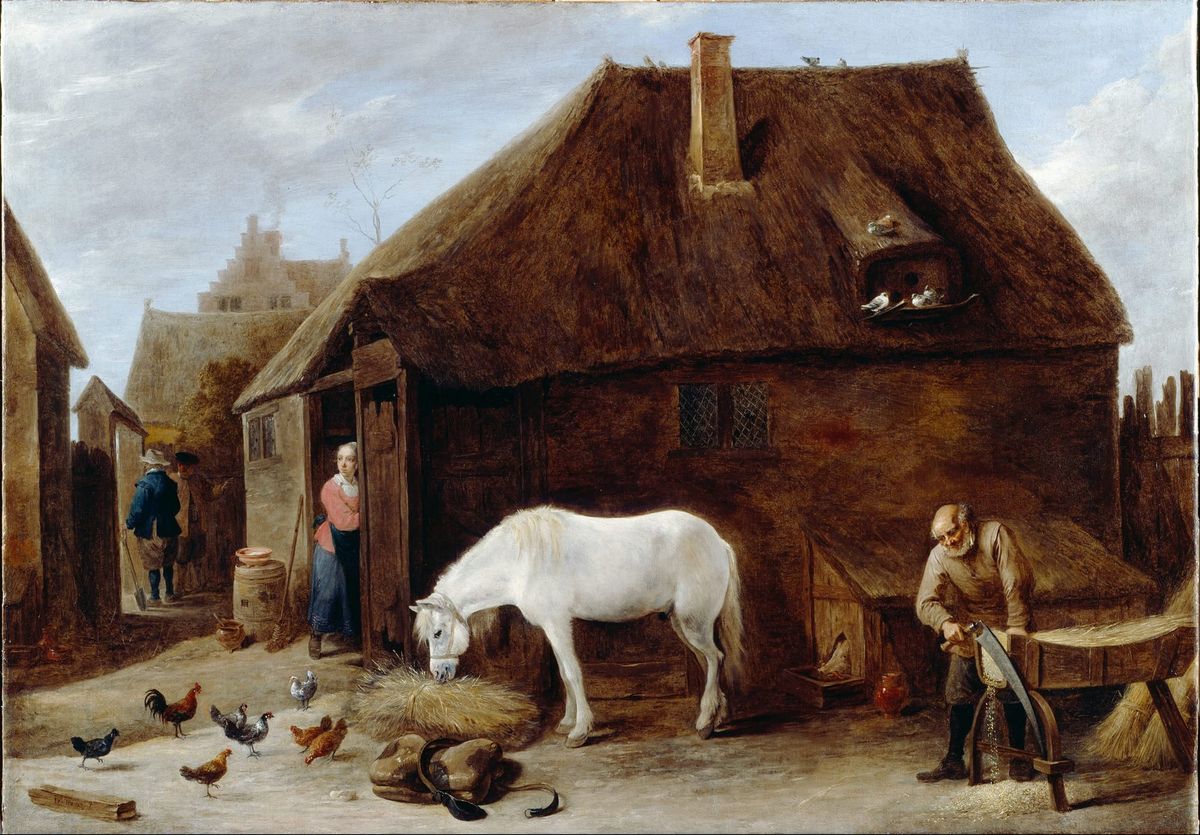
17세기 플랑드르 바로크 풍속화 및 농촌 일상화의 거장 소 다비드 테니어르스(David Teniers le Jeune, 1610–1690)가 1640년대 초중반 안트베르펜 전성기 시절에 완성한 기념비적 전원 풍속 유화 작두질하는 농부와 백마(The Chaff-cutter, 또는 여물 써는 사내와 백마, 네덜란드어: De hakselaar, 공식 소장품 등록번호: DPG46)는 56.5 cm × 85.1 cm 크기의 단정한 가로형 캔버스에 유채로 그린 대표적인 북유럽 일상 풍속화 최고 걸작입니다.
1811년 피터 프랜시스 부르주아 경(Sir Peter Francis Bourgeois)의 유서 깊은 유증을 통해 영국 최초의 공공 미술관으로 편입되었으며, 현재 영국 런던의 유서 깊은 덜위치 픽처 갤러리(Dulwich Picture Gallery, London)에 영구 소장되어 보존되어 오고 있습니다.
피터르 브뤼헐의 농촌 관찰과 가축과 인간의 노동 조화를 향한 화가의 고뇌
1640년대 플랑드르 화단을 주도하던 삼십 대의 테니어르스는, 시골 농가의 마당에서 묵묵히 이루어지는 일상 노동의 리듬과 가축을 돌보는 인간의 따뜻한 공존을 화폭에 구현하고자 깊이 몰두했습니다.
화가는 극적인 사건이나 화려한 귀족의 연회 대신, 햇빛이 내려앉은 마당에서 말먹이용 건초를 써는 노인의 고요한 집중력과 순백의 털을 빛내며 여물을 먹는 백마의 온순한 자태를, 어떻게 특유의 맑고 투명한 은빛 대기(Silvery manner)와 정교한 명암 속에 담아낼지 치열하게 번민했습니다.
덜위치 픽처 갤러리의 공식 소장 도록에 따르면, 화면 왼쪽 아래의 나무 명판에는 화가의 정품 서명(D. TENIERS. F.)이 뚜렷하게 새겨져 있으며, 초가지붕 처마에 설치된 비둘기집과 평화롭게 모이를 쪼는 닭들은 플랑드르 전통 농가의 풍요와 가정을 지키는 평온한 안식을 상징하는 도상학적 장치로 분석됩니다.
화가는 낡은 초가 헛간 앞마당에서, 각자의 자리에 서서 하루의 일과를 살아가는 사람들과 동물들의 생생하고 정겨운 순간을 화폭에 담았습니다.
화면 중앙에는 눈부시게 하얀 털을 가진 건강한 백마 한 마리가 고개를 숙이고 바닥에 놓인 건초 더미를 맛있게 뜯어먹고 있으며, 말의 발치 앞마당에는 벗어놓은 가죽 안장과 굴레가 자연스럽게 놓여 있습니다.
화면 오른쪽에서는 대머리에 흰 턱수염이 덥수룩한 노인이 나무 작두틀 위에 올라선 채, 긴 쇠날을 양손으로 쥐고 말에게 먹일 마른 짚단을 정성스레 썰어 내리고 있습니다.
헛간 문가에서는 분홍빛 겉옷과 푸른 치마를 입은 여인이 문틀을 잡고 서서 마당의 정경을 따뜻한 눈길로 바라보고 있으며, 왼쪽 먼 골목길에서는 삽을 든 푸른 옷의 사내와 이웃이 울타리 곁에서 다정하게 담소를 나누고 있습니다.
지붕 위 비둘기집 주위를 맴도는 흰 비둘기들과 마당에서 모이를 쪼는 붉은 닭들, 그리고 저 멀리 보이는 계단식 박공지붕 건물과 은빛 뭉게구름은 부지런한 노동 속에 깃든 평화와 생명의 온기를 손에 잡힐 듯 생생하게 웅변합니다.
눈부신 백마와 작두질하는 노인에서 문간의 여인과 푸른 창공으로, 시선의 심리적 여정
그림을 마주하는 순간 관람객의 무의식적 시선은 화면 한가운데에서 부드러운 햇살을 받아 화사한 은백색으로 빛나는 백마의 매끄러운 갈기와 둥근 등 곡선으로 가장 먼저 빨려 들어갑니다.
조용히 고개를 숙여 건초를 먹는 말의 온순한 몸짓과 당당한 체구는 보는 이에게 깊은 시각적 안정감과 함께 농가 마당의 평온한 휴식을 선사합니다.
이어 시선은 바닥에 흩어진 가죽 안장을 지나, 화면 오른쪽에서 허리를 굽히고 양손으로 무거운 작두 손잡이를 누르는 노인의 주름진 손과 썰려 나오는 여물 바구니로 이동합니다.
한평생 흙과 가축을 돌보며 살아온 노인의 성실한 노동의 손길을 확인하는 순간, 관람객은 마른 풀 냄새와 서걱거리는 작두 소리가 청명하게 울려 퍼지는 17세기 플랑드르 농가 마당 한복판 속으로 온몸이 빨려 들어가게 됩니다.
마지막으로 시선은 헛간 문간에 서서 마당을 내다보는 여인의 부드러운 분홍빛 옷자락을 거쳐, 마당을 자유롭게 거니는 닭들과 초가지붕 위 비둘기집, 그리고 저 멀리 보이는 벽돌집과 은빛 구름에 멈춥니다.
전면 가축과 일하는 농부의 조화로운 일상과 후면 농촌 가옥의 고즈넉한 풍경이 빚어내는 완벽한 공간적 균형을 마주하며, 관람객은 소박한 노동이 건네는 삶의 숭고한 평화와 거장 테니어르스가 건네는 묵직한 자연주의적 감동을 가슴 깊이 마주하게 됩니다.
17세기 플랑드르 농촌 풍속화의 정점과 조형미, 미술계의 평가
미술계와 덜위치 픽처 갤러리 공식 도록은 작두질하는 농부와 백마를 테니어르스가 동물 묘사의 뛰어난 생동감과 농촌의 서정적 일상을 가장 완벽한 조형미로 융합해 낸 대표적인 최고봉 마스터피스로 평가합니다.
단순한 가축 사육 장면을 넘어 인간과 동물이 나누는 교감과 노동의 가치를 완벽한 수평적 파노라마 구도 속에 배치했을 뿐만 아니라, 백마의 보드라운 털결, 낡은 초가지붕과 흙벽의 거친 질감, 나무 작두틀의 투박한 결, 마당 바닥의 흙먼지와 부드러운 대기감을 극도로 섬세한 북유럽 사실주의 유화 기법으로 완벽하게 구현했기 때문입니다.
가장 평범한 시골 마당의 노동을 가장 격조 높은 시각 서정시로 승화시킨 테니어르스의 이 걸작 화폭은, 오늘날까지도 전 세계 수많은 감상자들에게 깊은 감탄과 잊을 수 없는 시각적 안식을 전해주는 불멸의 명작으로 손꼽히고 있습니다.
The Chaff-cutter
Painted in the early to mid-1640s in Antwerp by the master of Flemish Baroque genre and rural landscape painting David Teniers the Younger (1610–1690), The Chaff-cutter (also titled A Chaff-cutter with a White Horse, Dutch: De hakselaar, Accession No. DPG46) is an expansive rural genre masterpiece in oil on canvas measuring 56.5 cm × 85.1 cm (22.2 in × 33.5 in).
Bequeathed in 1811 by Sir Peter Francis Bourgeois as part of the founding collection of England's first public art gallery, it is preserved today in the distinguished permanent collection of the Dulwich Picture Gallery in London, United Kingdom.
Bruegelian Agrarian Rhythm, Domestic Harmony, and Animal Husbandry
During the early 1640s in Antwerp, David Teniers the Younger captured the unhurried dignity of rural labor, exploring the quiet harmony between hardworking Flemish peasants and the domesticated animals that sustained their homesteads.
Moving beyond coarse peasant caricature, the master meditated deeply on how to portray the rhythmic focus of an aged laborer cutting fodder alongside the quiet presence of a luminous white horse, staging the scene within a sunlit farmyard bathed in his celebrated silvery atmosphere and delicate chiaroscuro.
According to academic records in the Dulwich Picture Gallery collection catalogue, the signed wooden block in the lower left (inscribed D. TENIERS. F.) anchors the composition, while the dovecote nestled in the thatch and the foraging poultry function as traditional iconographic emblems of domestic peace, agricultural abundance, and rural shelter.
Teniers staged the panoramic composition in the spacious dirt yard of a thatched barn.
In the center, a radiant white workhorse stands quietly in profile, lowering its head to graze upon a mound of golden hay, while its unfastened leather saddle and harness rest upon the ground before it.
To the right, a bald, bearded laborer leans over a wooden trough, gripping the curved lever of a mechanical chaff-cutter to slice dry straw into feed for the livestock.
At the half-open door of the barn, a woman in a pink bodice and blue skirt watches the yard with quiet contentment, while to the far left, two farmhands converse near the boundary gate under an open sky.
White doves perched beside the thatched dormer dovecote, chickens pecking in the foreground, and a stepped-gable Flemish brick house in the distance celebrate the industrious simplicity, natural companionship, and pastoral tranquility of 17th-century rural existence.
Subconscious Trajectory of the Gaze: From the White Steed to the Working Laborer
The observer's subconscious gaze is immediately magnetized by the center foreground, drawn to the luminous white coat, graceful neck, and gleaming mane of the feeding horse standing in clear daylight.
The animal’s placid posture, balanced anatomy, and gentle disposition establish an instant focal point of physical beauty, natural grace, and spatial equilibrium.
The visual path then shifts toward the lower right, following the discarded saddle across the sunlit ground to the stooped figure of the elderly chaff-cutter pressing the curved steel blade into the straw.
Taking in his furrowed brow, capable grip, and the rustic wooden machinery, the viewer directly experiences the authentic, rhythmic cadence of an afternoon Flemish farmyard.
Finally, the visual trajectory moves toward the left doorway, observing the watchful maidservant in pink and blue before traveling past the foraging poultry to the gatekeepers, the stepped-gable building, and the sweeping cumulus clouds drifting across the blue sky.
Observing the harmonious equilibrium between foreground animal portraiture, architectural structure, and precise Netherlandish draftsmanship, the spectator perceives the timeless nobility of agrarian life and the profound aesthetic brilliance Teniers embedded within the canvas.
The Monument of Flemish Farmyard Genre: Critical Legacy
Art historians revere the Dulwich Chaff-cutter as an exceptional achievement in Teniers’s oeuvre, illustrating his consummate ability to unite animal painting, mechanical rustic detail, and atmospheric farmyard architecture within an expansive landscape.
By orchestrating delicate textural contrasts between smooth equine hide, worn leather harnesses, dry straw fibers, weathered wooden planks, rough thatch, and radiant moisture-filled clouds within a unified perspectival space, Teniers transformed an everyday agricultural routine into an exquisite aesthetic treatise on peace and human industry.
This monumental historical canvas endures as an inspiring testament to the master's creative fortitude, celebrating the quiet poetry of everyday existence and the transformative grace of living art.
본 컨텐트의 저작권은 팔렛트제주에 있습니다. 허가없는 무단전제를 금지합니다.
Copyright © Palette Jeju. All rights reserved. Unauthorized reproduction or redistribution is strictly prohibited.