임종의 빅토르 위고 Victor Hugo on His Deathbed
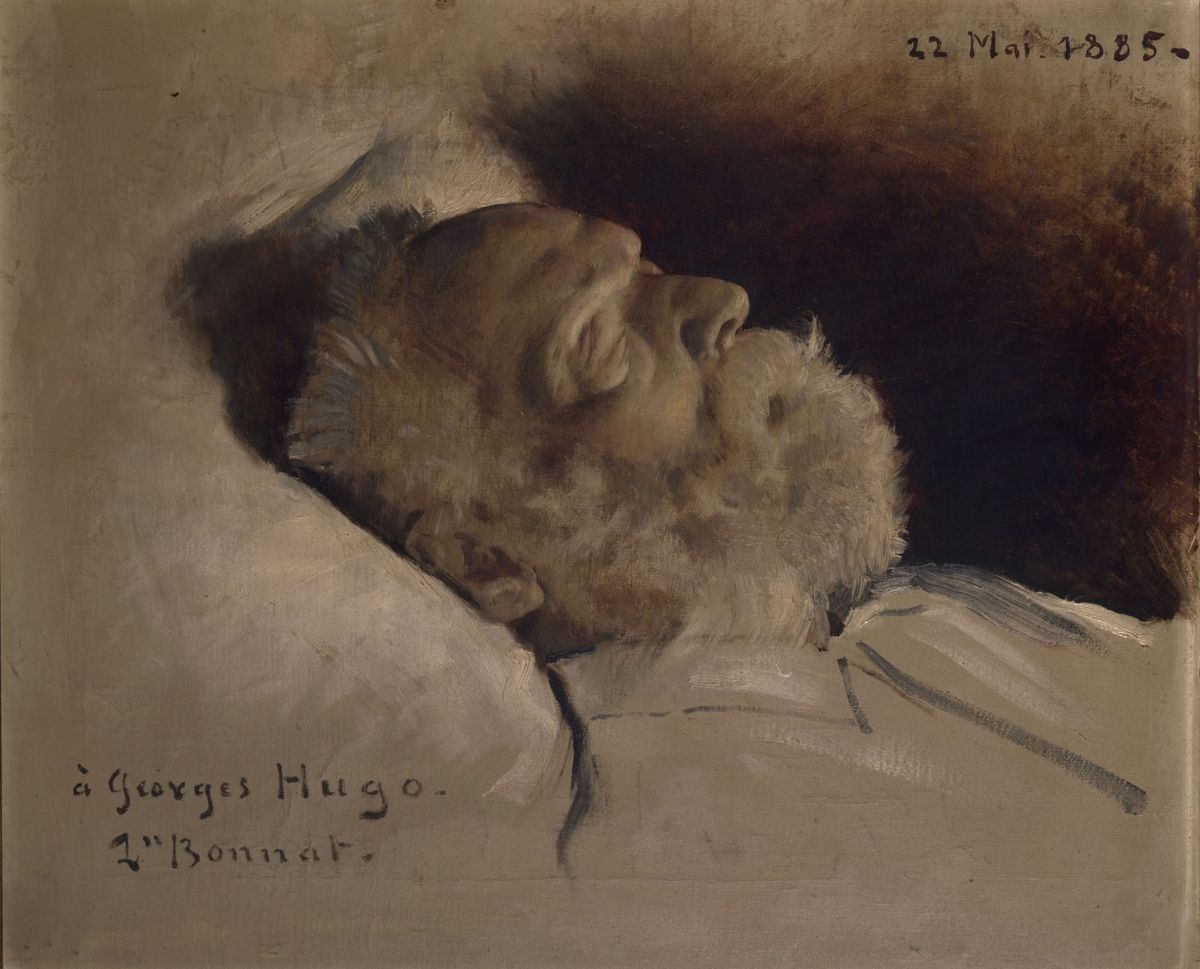
19세기 프랑스 사실주의 회화의 거장 레옹 보나가 1885년에 제작한 유채화 작품으로, 그는 인물의 내면을 꿰뚫어 보는 듯한 강렬한 필치와 엄격한 사실주의적 화풍으로 당대 프랑스 화단에서 가장 명망 높은 화가로 이름을 떨쳤습니다.
이 작품의 공식 소장품 등록번호는 219이며, 실제 실측 규격은 높이 38cm, 너비 46.5cm의 캔버스 위에 유채 기법으로 그려진 작품으로 현재 프랑스 파리의 빅토르 위고 기념관에 소장되어 있습니다.
당대 프랑스 문학계의 거장이자 국민적인 영웅이었던 빅토르 위고가 숨을 거둔 직후의 슬픔이 가시지 않은 침실에서, 작가는 차가운 공기가 감도는 고요한 방안에 홀로 앉아 거대한 영혼을 떠나보낸 허망함을 달래며 오직 캔버스 위를 스치는 붓끝에 의지하며 거친 숨을 골라야 했던 비장한 시대적 배경 속에서 이 명작을 탄생시켰습니다.
작가의 고뇌와 비하인드
당대 프랑스 사회는 위대한 작가의 죽음으로 인해 깊은 슬픔과 상실감에 빠져 있었으며, 보나는 세상을 떠난 위고의 마지막 얼굴을 화폭에 생생하게 담아내기 위해 단순한 기록을 넘어 한 시대의 정신적 거장이 지닌 숭고한 침묵을 재해석하는 깊은 예술적 구상을 거쳤습니다. 그러한 그의 구상은 화면 상단에 적힌 날짜인 1885년 5월 22일과 하단의 헌정 문구를 넘어 세속의 소음과 완전히 차단된 영원한 안식과 죽음의 절대적 존엄성을 상징합니다.
미술평론가 제리 솔츠(Jerry Saltz)는 보나와 같은 19세기 사실주의 거장들이 작품 속에 담아낸 강렬한 붓놀림과 심리적 진정성이 관람객의 내면 깊은 곳을 뒤흔든다고 평론한 바 있으며, 윌 곰퍼츠(Will Gompertz) 역시 당시 화가들이 구축한 극적인 명암 연출과 공간적 집중력이 단순한 기록을 넘어 인간 존재의 진정성을 이끌어낸다고 분석했습니다.
이 거장 사후의 순간을 포착한 부분 화면을 완성할 당시 작가는 위고의 유가족인 손자 조르주 위고에게 전하기 위해 슬픔을 억누르며 차가운 방안에 앉아 오직 캔버스 위를 스치는 붓끝에 의지하며 거친 숨을 골라야 했습니다.
화면 전면의 중심에는 하얀 베개에 기단처럼 기댄 채 평온하게 영면에 들 눈을 감은 빅토르 위고의 백발과 덥수룩한 수염의 측모가 자리하며, 그의 깃이 세워진 옷자락과 침상의 부드러운 텍스처가 묵직한 부피감을 더합니다.
중경에는 작고 아담한 캔버스 안에서 머리맡의 어두운 그림자와 베개의 밝은 천이 만들어내는 극적인 명암 대비가 인물의 윤곽을 더욱 선명하게 부각시킵니다.
원경으로는 작품 전체의 배경을 이루는 침대 머리의 어두운 톤과 우측 상단의 날짜 필적이 조화롭게 어우러지며 역사적 순간의 대기감을 극대화합니다. 작가는 이 전경과 중경 그리고 원경의 유기적인 구성을 통해 위대한 영혼의 마지막 순간을 시각적으로 완벽하게 구현해 냈습니다.
무의식 속 시선 및 심리 흐름
작품을 마주할 때 관람객의 시선은 가장 먼저 화면 중앙에 하얀 베개에 기댄 채 고요히 잠든 듯 누워 있는 빅토르 위고의 늙고 지친 얼굴 윤곽과 하얀 수염으로 자연스럽게 이끌립니다. 죽음의 침묵이 감도는 그의 평온한 표정은 인간의 시선을 즉각적으로 사로잡으며 깊은 경외감과 숙연함을 불러일으킵니다.
이어지는 시선은 인물의 깃든 옷깃과 베개의 부드러운 굴곡, 그리고 화면 구석에 새겨진 붉은 필적과 서명으로 확장되어 역사적 비장함의 현장으로 깊이 몰입하게 만듭니다.
마지막으로 시선은 화면 전체를 감싸는 묵직한 명암의 대비와 어두운 배경으로 향하게 됩니다. 이 과정에서 관람객은 거장의 마지막 모습에서 시작해 작가의 애도 어린 터치를 거쳐, 마침내 영원한 안식이 전하는 묵직한 여운으로 이어지는 심리적 여정을 온전히 경험하게 됩니다.
미술계의 평가 및 조형미
보나의 이 작품은 19세기 사실주의 초상화가 지닌 정교한 관찰력과 인물의 내면적 진실성을 담아내는 역량의 절정을 보여주는 위대한 예술적 성취로 평가받습니다. 수많은 유화 물감 층을 과감하게 덧바르며 완성한 깊이 있는 명암 대비와 섬세한 붓놀림은 빛을 머금은 듯한 영롱한 입체감을 부여하며 작품 전체에 살아 있는 생명력을 불어넣습니다.
인물의 피부 결가 베개의 부드러운 질감에서 드러나는 절제된 사실성은 당시 기록화의 수준을 한 단계 끌어올린 혁신적인 성취입니다. 화면을 대각선으로 가로지르는 안정적인 구도와 배경의 어두운 톤이 조화로운 대비를 이루며 시각적 안정감을 선사하고, 이로써 영원히 바래지 않는 역사적 초상 예술의 진수를 보여줍니다.
Victor Hugo on His Deathbed
Painted in 1885 by Léon Bonnat, a towering master of nineteenth-century French realism renowned for his penetrating psychological insight and rigorous academic precision, Victor Hugo on His Deathbed stands as a monumental achievement in commemorative portraiture.
It bears the official catalog number 219, measures 38 cm in height and 46.5 cm in width, executed in oil on canvas, and is currently housed in the Maison de Victor Hugo in Paris, France. As a prominent artist mourning the loss of France's greatest literary icon, Bonnat frequently sought refuge from public grief, retreating into the quiet, chilly solitude of the death chamber where he could catch his breath before the canvas while capturing the final repose of his dear friend.
The Artist's Agony and Behind-the-Scenes
During a national moment of profound mourning following the passing of Victor Hugo, Bonnat wrestled intensely with how to translate the quiet dignity and monumental presence of the deceased poet into visual reality. His artistic vision is symbolized by the inscribed date of May 22, 1885, and the heartfelt dedication to the writer's grandson, which transcend simple documentary record to evoke an absolute atmosphere of serene eternity divorced from the secular noise of the city.
Renowned art critic Jerry Saltz has praised the intense psychological tension and rigorous execution of nineteenth-century realism, noting how the dramatic force of such works resonates deeply within the viewer's psyche, while Will Gompertz has analyzed how the theatrical composition and spatial clarity of these masters evoke a profound sense of human authenticity.
As he worked tirelessly to complete this poignant deathbed portrait, Bonnat had to manage heavy emotional and professional responsibilities in the hushed room. Sitting quietly before the small canvas while catching his breath amidst the lingering shadows, the artist's focused and demanding physical environment naturally permeated the profound depth of the work.
In the foreground, the distinguished profile of Victor Hugo rests peacefully against a white pillow, featuring his characteristic white hair and flowing beard rendered with striking realism.
Moving into the midground, the subtle play of shadow across the pillow and the crisp lines of his collar establish a compelling sense of volumetric presence and spatial depth.
In the background, the rich tonal graduation and dark drapery harmonize to maximize a sense of atmospheric focus. Bonnat perfectly and visually realized the solemn tribute through this organic composition of the foreground, midground, and background.
Unconscious Gaze and Psychological Flow
Encountering the piece for the first time immediately draws the eye to the sitter's serene profile and illuminated white beard, whose quiet features capture the viewer's psychological focus with arresting gravity.
From there, attention naturally sweeps toward the inscribed dedication and the soft folds of the pillow, drawing the observer deeper into the expressive theater of the canvas.
Finally, the gaze moves toward the deep shadows framing the composition. This visual trajectory choreographs an inner pilgrimage from sharp psychological realism down to atmospheric resonance across a harmoniously layered space.
Art Historical Evaluation and Formal Beauty
Bonnat's work stands as a vital masterpiece connecting nineteenth-century academic realism to a powerful psychological immediacy through its masterly handling of light, shadow, and texture. The rich chromatic depth achieved by layering confident oil glazes maximizes reflective luminance to envelop the scene in a dignified, melancholic aura.
Subtle psychological nuances expressed through facial features and natural repose reveal a level of realism rarely seen in period portrait painting. From a formal standpoint, the striking diagonal composition and expressive brushwork create a stable yet deeply dramatic framework. This canvas remains an enduring testament to Bonnat's unrivaled genius and holds a permanent place of honor in the history of art.
본 컨텐트의 저작권은 팔렛트제주에 있습니다. 허가없는 무단전제를 금지합니다.
Copyright © Palette Jeju. All rights reserved. Unauthorized reproduction or redistribution is strictly prohibited.