일렁이는 코발트빛 밤하늘과 왜곡된 성소의 고독, 오베르의 교회 The Church at Auvers
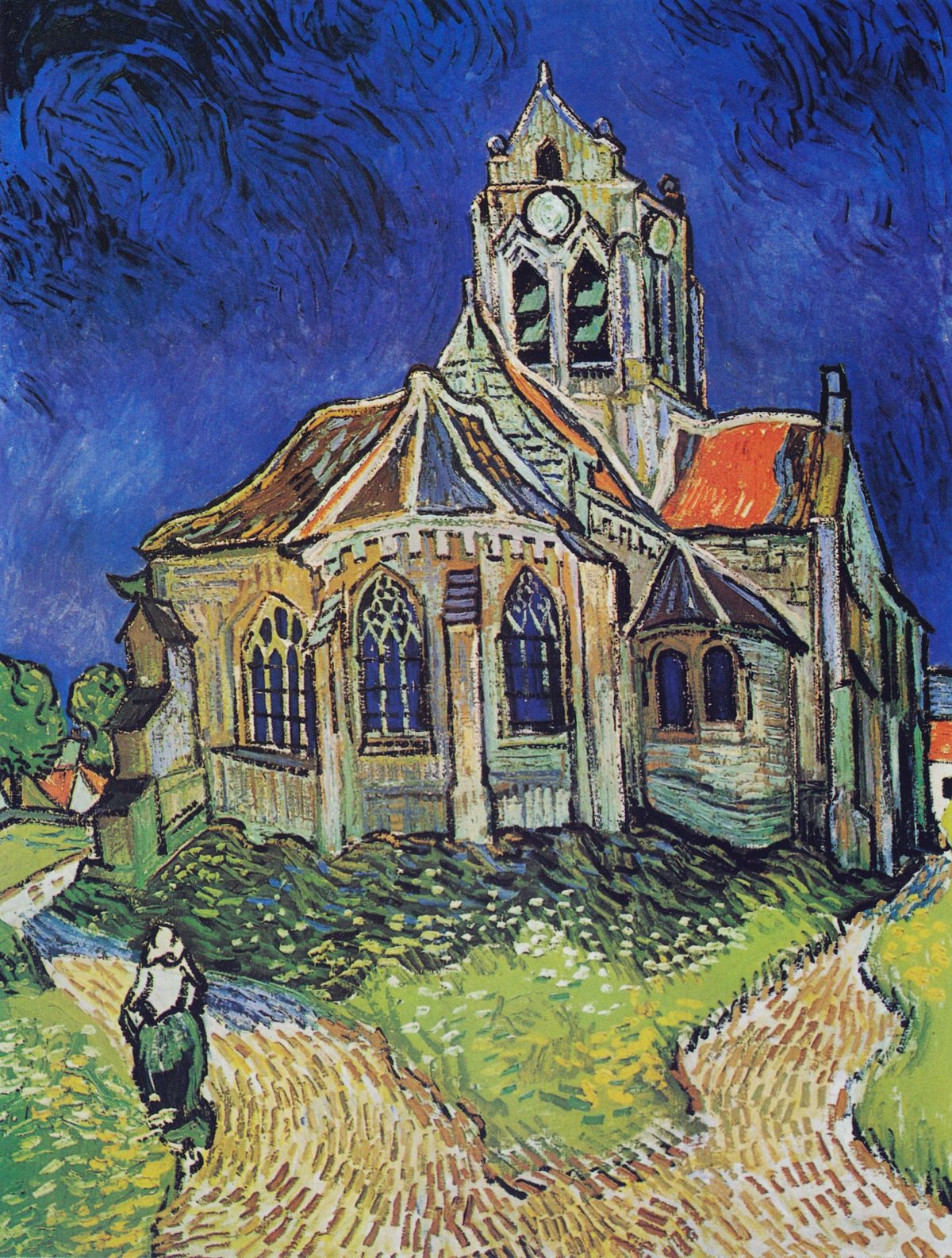
네덜란드의 후기 인상주의 거장 빈센트 반 고흐(Vincent van Gogh, 1853–1890)가 생애 마지막 해인 1890년 6월 초 프랑스 오베르 쉬르 우아즈(Auvers-sur-Oise)에서 완성한 유화 《오베르의 교회(The Church at Auvers)》는 94.0 cm × 74.0 cm 크기의 캔버스에 유채로 그린 대표작으로, 현재 프랑스 파리의 오르세 미술관(Musée d'Orsay)에 영구 소장되어 있습니다.
오베르의 고요 속에서 되살아난 유년의 기억과 종교적 갈등
1890년 5월, 남프랑스 생레미 요양원을 떠나 파리 근교의 오베르 쉬르 우아즈에 도착한 고흐는 마을 중심부 언덕에 우뚝 솟은 13세기 고딕 양식의 노트르담 성당(Notre-Dame de l'Assomption)에 강렬하게 매료되었습니다. 그는 이 건축물을 마주하며 네덜란드 뉘에넌(Nuenen) 시절 목사였던 아버지의 그늘 아래 그렸던 옛 교회 풍경들을 떠올렸습니다.
여동생 빌레미엔에게 보낸 편지에서 고흐는 "순수한 코발트블루로 칠해진 깊은 밤하늘을 배경으로 성당의 건물이 보랏빛 덩어리로 솟아 있다. 뉘에넌의 오래된 탑과 묘지를 그리던 시절의 연구가 다시 떠오른다"고 적었습니다. 하지만 화면 속 교회는 출입문이 보이지 않고 창문은 짙은 청색으로 닫혀 있으며, 이는 제도권 종교로부터 거부당했던 화가의 해묵은 상처와 진정한 영적 구원을 향한 갈망 사이의 복합적인 내면을 드러냅니다.
무의식 속 시선의 갈래와 심리적 불안의 궤적
감상자의 시선은 화폭 하단에서 양옆으로 갈라지는 두 갈래의 황토빛 흙길을 마주하며 깊은 무의식적 방황을 경험합니다. 길은 교회의 입구로 통하지 않고 성당 양옆의 어둠 속으로 빠져나가며, 왼쪽 길을 따라 걸어가는 농촌 여인의 뒷모습은 보는 이의 시선을 고독한 정적 속으로 인도합니다.
이어 시선은 풀밭의 거친 붓질을 타고 꿈틀거리듯 왜곡된 성당의 외벽과 뾰족한 첨탑으로 급격히 상승합니다. 마치 살아 움직이는 유기체처럼 뒤틀린 건물 구조와 낮인지 밤인지 알 수 없는 짙푸른 암청색 하늘의 압도적인 무게감은 시각적 긴장감을 극대화합니다. 지상의 따뜻한 황금빛 모래흙과 하늘의 차가운 울트라마린이 빚어내는 보색 충돌 속에서, 관람자는 의식하지 못하는 사이 인간 존재의 근원적 불안과 성스러운 침묵이 주는 묵직한 울림에 깊이 빠져들게 됩니다.
형태의 왜곡과 감정의 폭발, 미술사적 성취
미술계는 《오베르의 교회》를 19세기 사실주의와 인상주의의 시각적 규범을 완전히 해체하고 20세기 현대 표현주의의 서막을 연 최고의 걸작으로 평가합니다.
원근법과 고정된 건축적 비례를 무너뜨리고, 굵고 리드미컬한 임파스토와 강렬한 원색 대비를 통해 화가의 내적 고뇌를 건물 자체에 투영했습니다. 건물을 단순한 무기물이 아닌 감정을 분출하는 거대한 영적 초상으로 재탄생시킨 이 작품은, 반 고흐가 지상에 남긴 가장 웅장하고도 비극적인 예술적 기념비로 빛나고 있습니다.
Pulsating Cobalt Heavens and the Distortion of the Sacred, The Church at Auvers
Painted in early June 1890 during his final weeks in Auvers-sur-Oise by Vincent van Gogh (1853–1890), The Church at Auvers is an oil on canvas measuring 94.0 cm × 74.0 cm (37.0 in × 29.1 in), preserved in the permanent collection of the Musée d'Orsay in Paris, France.
Memory, Spiritual Crisis, and the Gothic Relic of Auvers
Arriving in Auvers-sur-Oise in May 1890, Van Gogh was immediately drawn to the 13th-century church of Notre-Dame de l'Assomption standing atop the village hill. The ancient Gothic edifice rekindled poignant memories of his youth in Nuenen, where he had once painted the local village church under the spiritual shadow of his pastor father.
Writing to his sister Willemien, Vincent noted that the painting featured the building rising like a violet mass against a simple sky of deep, pure cobalt blue, evoking his earlier Dutch studies of rustic churchyards. Yet in this Auvers rendering, the monumental facade lacks an accessible doorway, and the stained-glass lancets remain impenetrable and dark—a subtle yet profound manifestation of the artist’s estrangement from institutional religion and his solitary pursuit of spiritual transcendence.
Psychological Trajectory of the Gaze and the Fractured Path
The observer’s subconscious gaze enters through the lower foreground, immediately confronted by a fork in the ochre-tinted pathways. Neither path leads toward an entrance; instead, they divert visual momentum around the perimeter, while the diminutive silhouette of a peasant woman walking along the left trail reinforces a powerful sense of isolation.
From the divided earth, visual perception surges upward across the undulating grassy mound and climbs the warped, serpentine masonry of the church walls and bell tower. The fluid distortion of the architecture, juxtaposed against the heavy, nocturnal sky, produces an acute psychological tension. Navigating between the warm, textured strokes of the foreground and the abyssal blue expanse above, the viewer instinctively internalizes the immense spiritual pressure and existential vulnerability that gripped the painter’s final days.
Monument of Modern Expressionism: Critical Significance
Art historians revere The Church at Auvers as a supreme pinnacle of Post-Impressionist painting, signaling the decisive transition toward modern Expressionism.
By subordinating photographic accuracy and architectural stability to subjective emotional truth, Van Gogh liberated form and color from academic constraints. The pulsating, muscular impasto transforms the stone sanctuary into a living, breathing emotional vessel, securing this canvas as one of the most sublime and spiritually resonant monuments in Western art history.
Copyright © Palette Jeju. All rights reserved. Unauthorized reproduction or redistribution is strictly prohibited.
본 컨텐트의 저작권은 팔렛트제주에 있습니다. 허가없는 무단전제를 금지합니다.