이집트의 성가족 The Holy Family in Egypt
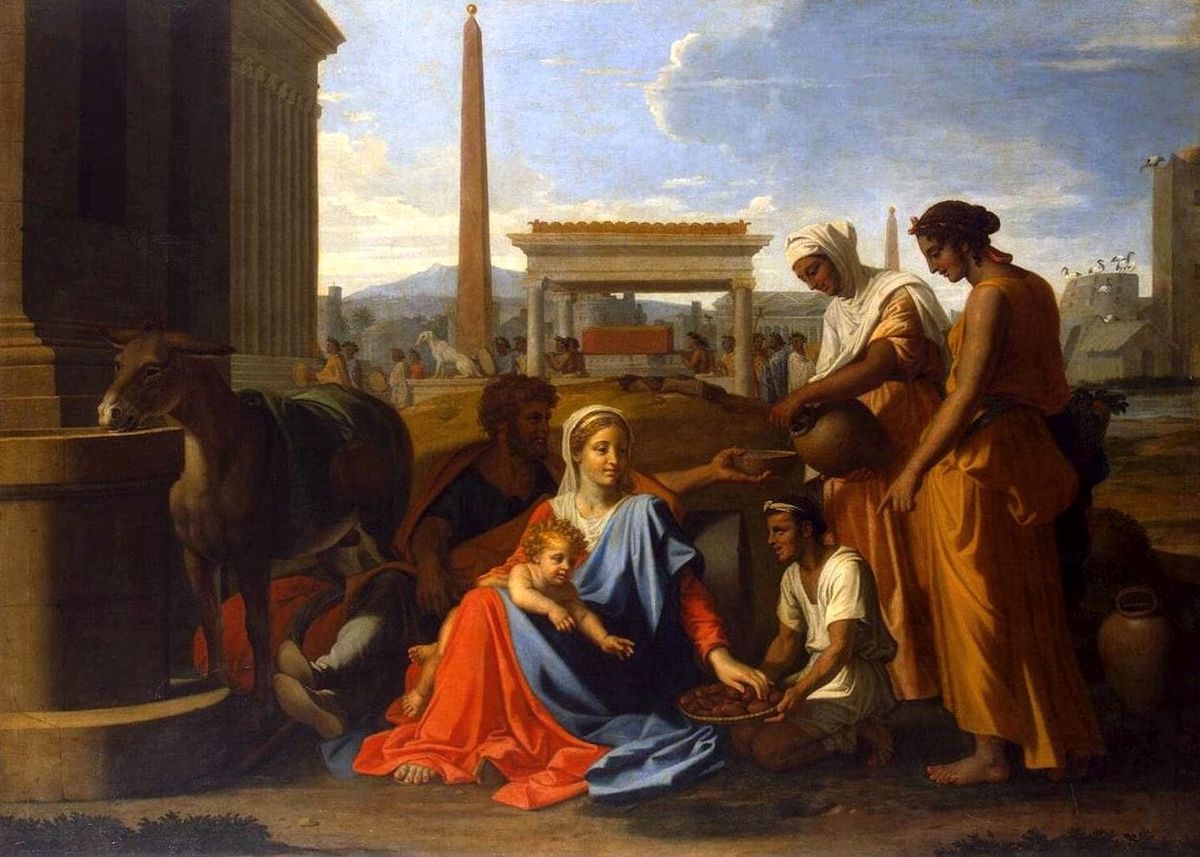
17세기 프랑스 고전주의 회화의 시조이자 서양 미술사 불멸의 거장 니콜라 푸생(Nicolas Poussin, 1594–1665)이 1655년에서 1657년경 만년에 완성한 기념비적 성가족 유화 이집트의 성가족(The Holy Family in Egypt, 또는 이집트 피신 중의 휴식, 프랑스어: La Sainte Famille en Égypte, 소장품 번호: 1954.10)은 105.0 cm × 145.0 cm 크기의 웅장한 가로형 캔버스에 유채로 그린 대표적인 기독교 신약성화 최고 걸작입니다.
현재 러시아 상트페테르부르크의 예르미타시 미술관(Hermitage Museum, Saint Petersburg)에 소장되어 있습니다.
헤롯의 박해를 피해 도착한 이방의 땅과 고대 이집트 문명을 향한 화가의 고뇌
1650년대 중반 로마에서 고대 문명과 고고학 연구에 깊이 몰두하던 노년의 푸생은, 헤롯 왕의 잔혹한 영아 학살을 피해 머나먼 이집트 땅으로 피신했던 성가족의 고달픈 여정을 화폭에 담기로 결심했습니다.
당시 화가는 손 떨림 증세와 노환으로 고통받으면서도, 고대 그리스 로마의 문헌과 고고학 유물들을 철저하게 고증하여 실제 고대 이집트의 풍경과 건축을 회화 속에 완벽한 고전적 비례로 재현하고자 치열하게 번민했습니다.
성경 마태오 복음에 기록된 이집트 피신 일화 속에서, 화가는 타향에 도착해 목을 축이며 잠시 숨을 돌리는 성가족과 이들을 따뜻하게 맞이하는 이집트 현지인들의 자비로운 모습을 포착했습니다.
화면 중앙에는 붉은 옷과 푸른 망토를 우아하게 두른 성모 마리아가 어린 아기 예수를 무릎에 앉히고 온화한 미소를 짓고 있습니다.
그 앞에서는 흰 옷을 입은 이집트 청년이 무릎을 꿇고 대추야자가 담긴 바구니를 정성스레 바치고 있으며, 황금빛 옷을 입은 아름다운 이집트 여인들은 토기 항아리에서 시원한 물을 따라 건네고 있습니다.
화면 왼쪽에서는 지친 나귀가 둥근 석조 우물가에서 물을 마시고 있고, 성 요셉은 그늘 아래 앉아 물그릇을 내밀며 감사함을 표합니다.
배경 뒤편으로 솟아오른 붉은 화강암 오벨리스크와 고대 신전, 그리고 강가에서 거행되는 이시스 여신의 종교 행렬은 이방의 고대 문명 속에서도 평화롭게 보호받는 성가족의 거룩한 운명을 손에 잡힐 듯 생생하게 웅변합니다.
자애로운 성모의 눈빛에서 대추야자를 바치는 청년과 거대한 오벨리스크로, 시선의 심리적 여정
그림을 마주하는 순간 관람객의 무의식적 시선은 화면 중앙 아래에서 부드러운 아침 햇살을 받아 화사하게 빛나는 성모 마리아의 온화한 옆얼굴과 무릎 위 아기 예수의 사랑스러운 눈빛으로 가장 먼저 빨려 들어갑니다.
어머니의 품에 기대어 대추야자 바구니를 호기심 어린 표정으로 바라보는 아기 예수의 천진난만한 모습과 성모의 단아한 자태는 보는 이에게 깊은 시각적 온기와 함께 피난길의 고단함을 잊게 만드는 거룩한 평안을 선사합니다.
이어 시선은 성모의 옷자락을 따라 화면 오른쪽으로 이동하여, 무릎을 꿇고 공손하게 과일을 건네는 흰 옷의 청년과 황금빛 드레스를 입고 우아하게 서서 물을 따르는 이집트 여인들의 자비로운 손길로 옮겨갑니다.
이방인을 박해하지 않고 따스한 환대로 맞이하는 현지인들의 너그러운 표정과 섬세한 손짓을 확인하는 순간, 관람객은 문명과 국경을 초월하여 흐르는 순수한 인간애의 감동 한복판 속으로 온몸이 빨려 들어가게 됩니다.
마지막으로 시선은 화면 왼쪽 석조 우물가에서 목을 축이는 충직한 나귀와 물그릇을 쥔 성 요셉의 그윽한 눈빛을 지나, 화면 중앙 뒤편으로 높게 솟아오른 고대 오벨리스크와 신전 건축물, 그리고 맑고 푸른 이집트의 하늘에 멈춥니다.
수직의 오벨리스크와 수평의 건축선이 빚어내는 완벽한 기하학적 균형을 마주하며, 관람객은 험난한 방랑 속에서도 피어나는 거룩한 섭리와 노거장 푸생이 건네는 묵직한 영혼의 위로를 가슴 깊이 마주하게 됩니다.
17세기 프랑스 고전주의 고고학적 성화의 정점과 조형미, 미술계의 평가
미술계는 예르미타시 미술관의 이집트의 성가족을 푸생이 만년에 도달한 고고학적 고증과 고전주의 조형 질서의 최고 절정을 보여주는 불멸의 명작으로 평가합니다.
단순한 종교 성화를 넘어 고대 이집트의 실제 오벨리스크 비례와 이시스 제례 의식을 철저한 역사적 고증으로 화면에 재현했을 뿐만 아니라, 성모의 붉은색과 푸른색, 여인의 황금빛 옷감이 빚어내는 삼원색의 조화로운 분배와 대리석 건축물의 묵직한 공간감을 극도로 세련된 고전주의 명암법으로 완벽하게 구현했기 때문입니다.
성스러운 구원의 여정을 가장 품격 높은 시각 서사시로 승화시킨 푸생의 이 걸작 화폭은, 오늘날까지도 전 세계 수많은 감상자들에게 깊은 감탄과 잊을 수 없는 시각적 안식을 전해주는 명작으로 손꼽히고 있습니다.
The Holy Family in Egypt
Painted between 1655 and 1657 in Rome by the founder of French classicism and immortal master Nicolas Poussin (1594–1665), The Holy Family in Egypt (also titled The Rest on the Flight into Egypt, French: La Sainte Famille en Égypte, Inventory No. 1954.10) is a late devotional oil on canvas measuring 105.0 cm × 145.0 cm (41.3 in × 57.1 in).
It is preserved in the distinguished permanent collection of the Hermitage Museum in Saint Petersburg, Russia.
The Flight from Herod, Archaeological Accuracy, and the Solace of Hospitality
During the mid-1650s in Rome, despite battling progressive physical infirmities and trembling hands, the aging Nicolas Poussin immersed himself in the deep study of ancient Greco-Roman antiquities and Egyptian archaeology.
Poussin sought to translate the biblical narrative of the Flight into Egypt—where the Holy Family fled King Herod's massacre of the innocents—into an authentic historical landscape governed by absolute geometric harmony and Stoic dignity.
The master staged a serene resting scene set against an authentic Egyptian architectural backdrop.
In the center, the Virgin Mary is seated in sweeping robes of lapis lazuli and vibrant scarlet, holding the infant Christ upon her lap with maternal serenity.
Before them, a kneeling Egyptian youth dressed in crisp white linen offers a woven basket laden with dates, while statuesque local maidens in luminous saffron garments pour refreshing water from a terracotta amphora.
To the left, the faithful donkey drinks calmly from a circular stone basin as Saint Joseph reaches forward with a bowl in grateful acceptance of this unexpected charity.
In the background, a monumental granite obelisk, a classical temple peristyle, and a sacred procession of Isis along the river establish a profound archaeological realism, celebrating the divine sanctuary found within a foreign land.
Subconscious Trajectory of the Gaze: From the Infant Christ to the Granite Obelisk
The observer's subconscious gaze is immediately magnetized by the lower-central register, drawn to the luminous, porcelain skin and lively countenance of the infant Jesus nestled in Mary’s lap.
His curious gaze directed toward the basket of fruit, combined with Mary's serene profile and majestic drapery, establishes an instant focal point of maternal warmth, divine innocence, and spiritual tranquility.
The visual path then follows the diagonal direction of Mary’s outstretched hand toward the kneeling youth and the statuesque maidens draped in golden-ochre on the right.
Taking in their hospitable gestures, the tilt of the terracotta water jug, and their dignified antique profiles, the viewer directly experiences the profound moral beauty of compassion, generosity, and cross-cultural grace.
Finally, the visual trajectory moves past Saint Joseph and the drinking donkey on the left, ascending across the soaring vertical axis of the Romanized obelisk and classical colonnades into the luminous blue sky.
Observing the harmonious equilibrium between rigorous linear perspective, balanced primary colors, and antique draftsmanship, the spectator perceives the timeless nobility of sacred destiny and the profound aesthetic solace Poussin embedded within the canvas.
The Monument of Late French Classical Devotion: Critical Legacy
Art historians revere the Hermitage Holy Family in Egypt as a supreme pinnacle of Poussin’s late historical style, illustrating his complete mastery of archaeological authenticity and philosophical balance.
By orchestrating delicate textural contrasts between polished marble masonry, sunlit terracotta, heavy woolen draperies, and the radiant expanse of the Egyptian atmosphere within a unified geometric scheme, Poussin elevated a traditional biblical episode into an exquisite aesthetic treatise on cosmic providence and human kindness.
This grand historical canvas endures as an inspiring testament to the master's creative fortitude, celebrating the triumph of sacred resilience and the transformative grace of living art.
본 컨텐트의 저작권은 팔렛트제주에 있습니다. 허가없는 무단전제를 금지합니다.
Copyright © Palette Jeju. All rights reserved. Unauthorized reproduction or redistribution is strictly prohibited.