이젤 앞의 자화상 - Self-Portrait at the Easel (Self-Portrait with Dark Felt Hat at the Easel)
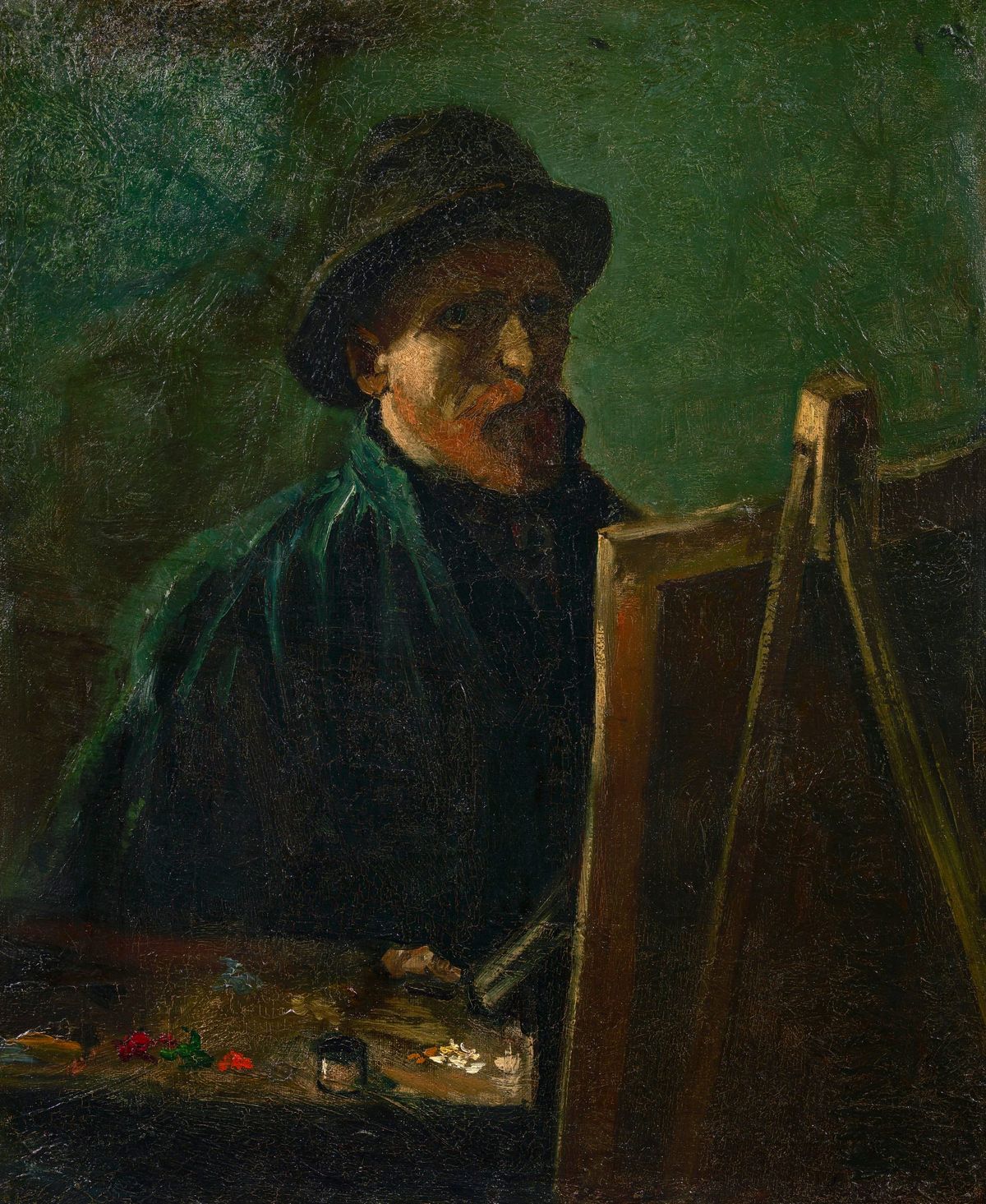
빈센트 반 고흐(Vincent van Gogh, 1853–1890)가 1886년 가을에서 겨울 사이 프랑스 파리 체류 시절 완성한 '이젤 앞의 자화상(Self-Portrait at the Easel)'은 캔버스에 유채(Oil on canvas)로 제작된 인물화입니다. 작품의 실제 규격은 세로 46.5cm, 가로 38.5cm이며, 현재 네덜란드 암스테르담의 반 고흐 미술관(Van Gogh Museum)에 영구 소장되어 있습니다.
고흐는 이 작품에서 어두운 숲속을 연상시키는 짙은 암녹색 배경 위에 단단한 형태감의 이젤과 화가 자신의 모습을 극적인 명암 대비(Chiaroscuro)로 배치했습니다. 챙이 넓은 어두운 펠트 모자 아래로 드리운 깊은 그림자 속에서 이마와 뺨, 코끝을 때리는 날카로운 하이라이트와 붉은빛 턱수염은 두터운 임파스토(Impasto) 기법으로 표현되었으며, 화면 하단의 나무 팔레트 위에 짜 놓은 순도 높은 원색 물감 덩어리들은 어두운 화면 전체에 생생한 시각적 활력을 불어넣습니다.
이 그림에는 파리에 갓 입성한 무명 화가 반 고흐가 자신의 예술가적 정체성을 확립하기 위해 겪었던 치열한 고투와 인간적인 에피소드가 깃들어 있습니다. 1886년 봄, 네덜란드를 떠나 파리 몽마르트르에 있던 동생 테오의 아파트에 짐을 푼 고흐는 페르낭 코르몽(Fernand Cormon)의 아틀리에에 등록해 정규 수업을 듣기 시작했습니다. 당시 아틀리에에서 함께 공부하던 앙리 드 툴루즈 로트레크와 에밀 베르나르는 낡은 코트에 펠트 모자를 푹 눌러쓰고 나타나 말없이 거친 숨을 몰아쉬며 캔버스에 달려드는 이 붉은 수염의 네덜란드인을 경외와 호기심 어린 시선으로 바라보았습니다.
당시 고흐는 지독하게 가난하여 파리의 비싼 모델을 고용할 여유가 없었습니다. 그는 몽마르트르의 벼룩시장에서 구해온 작은 거울을 이젤 옆에 세워두고, 작업복을 걸친 채 거울 속 자신을 끝없이 응시하며 붓을 쥐었습니다. 고흐는 동생 테오에게 보낸 편지에서 "나는 모델이 없을 때마다 내 얼굴을 그린다. 나 자신을 아는 것도 어렵지만, 화가로서의 내 영혼과 손길을 캔버스 위에 증명하는 것은 내게 가장 정직한 훈련이다"라고 고백했습니다.
특히 화면 하단 팔레트 위에 정성스럽게 찍어 바른 빨간색, 파란색, 흰색, 노란색 물감 알갱이들은 당시 고흐가 네덜란드의 칙칙한 암갈색 톤을 벗어던지고 파리의 인상주의와 점묘주의 화가들이 쓰던 찬란한 원색의 세계로 막 발을 들이기 시작했음을 보여주는 결정적인 상징입니다. 훗날 X선 정밀 분석 결과, 이 캔버스 뒷면 역시 돈을 아끼기 위해 이전에 그렸던 여인의 초상화 스케치 위에 덧그려진 것으로 확인되어, 극한의 생활고 속에서도 붓을 꺾지 않았던 청년 고흐의 처절한 집념을 증명하고 있습니다.
후대의 미술사학자들과 평단은 이 작품을 반 고흐가 어둡고 무거운 네덜란드 리얼리즘 화풍에서 벗어나 '파리의 혁신적인 화가'로 거듭나던 결정적 과도기의 기념비적인 선언으로 평가합니다. 캔버스를 향해 비스듬히 몸을 돌린 채 번뜩이는 눈빛으로 관람자를 응시하는 화가의 모습은, 가난과 세상의 냉대 속에서도 예술이라는 절대적인 소명을 결코 타협하지 않았던 불멸의 거장의 숭고한 결의를 웅변하고 있습니다.
관람자의 시선은 가장 먼저 어두운 펠트 모자 그늘 아래에서 번뜩이는 고흐의 서늘하고 강렬한 눈빛과 붉은빛 턱수염의 거친 질감에 사로잡힙니다. 이어 화면 우측을 묵직하게 가로막고 선 나무 이젤의 견고한 사선 구조를 따라 내려온 뒤, 하단 팔레트 위에 얹힌 선명한 원색 물감 덩어리들의 보석 같은 광채에 머물게 됩니다. 마지막으로 인물의 어깨를 감싸는 짙푸른 작업복과 배경의 깊은 암녹색 붓 터치를 따라 화면 전체로 유려하게 순환하게 됩니다.
심리적으로 관람자는 어둠 속에서도 꺾이지 않고 정면을 쏘아보는 화가의 결연한 눈빛과 팔레트 위의 찬란한 물감 빛에서 깊은 전율과 함께 내적 집중력을 경험하게 됩니다. 곤궁한 현실 속에서도 붓을 쥐고 자신의 길을 묵묵히 걸어갔던 예술가의 진솔한 열정은 현대인의 마음에 자리한 방황과 불안을 차분하게 가라앉혀 주며, 어떤 시련 속에서도 자신의 중심을 잃지 않는 단단한 자아와 삶을 향한 창조적 용기를 풍성하게 채워줍니다.
Self-Portrait at the Easel (Self-Portrait with Dark Felt Hat at the Easel)
Painted by Vincent van Gogh (1853–1890) in Paris between the autumn and winter of 1886, Self-Portrait at the Easel is an iconic oil on canvas masterpiece measuring 46.5 cm in height and 38.5 cm in width. This historic portrait is permanently preserved in the renowned collection of the Van Gogh Museum in Amsterdam, Netherlands.
Van Gogh constructed the composition through dramatic chiaroscuro, setting his bust and the architectural framework of the wooden easel against a brooding, deep-green atmospheric background. Beneath the wide brim of his dark felt hat, sharp impasto highlights strike the ridge of the brow, nose, and cheekbone, contrasting with the warm ochre of his beard. In the lower left, pure, unmixed dollops of red, blue, white, and yellow pigment rest upon the artist's wooden palette, introducing vibrant chromatic sparks into the shadowed interior.
The canvas holds an intimate history of artistic discipline and professional reinvention. In the spring of 1886, having arrived in Paris to live with his brother Theo, Van Gogh briefly entered the studio of Fernand Cormon to study alongside young radicals like Henri de Toulouse-Lautrec and Émile Bernard. Fellow students marveled at the intense, red-bearded Dutchman who painted with ferocious speed and unyielding earnestness.
Lacking the financial means to hire studio models, Van Gogh set up a modest mirror beside his easel to conduct rigorous anatomical and chromatic experiments on himself. Writing to Theo, he reflected: "I deliberately bought a good enough mirror to work from myself in default of a model... if I can manage to paint the coloring of my own head, which is not without some difficulty, I shall also be able to paint the heads of other good souls."
The brilliant pigments displayed upon the palette serve as historical evidence of Van Gogh’s pivotal transition, capturing the exact moment he began incorporating the luminous color theories of Impressionism into his earthy Northern technique. Furthermore, scientific analysis revealed that this canvas was painted over an earlier composition, underscoring the extreme financial constraints and relentless resourcefulness that defined his Parisian residency.
Modern art historians celebrate this masterpiece as a foundational declaration of Van Gogh’s identity as a modern master. By depicting himself actively engaged at the easel with his tools in hand, Van Gogh established an uncompromising visual manifesto of artistic devotion that directly foreshadowed the expressive breakthroughs of his later periods.
A viewer’s gaze is instantaneously captured by the piercing, concentrated eyes peering from beneath the shadow of the felt hat. The eyes then track along the rugged contours of the nose and fiery beard down to the bold diagonal of the wooden easel on the right, before settling upon the vibrant array of oil paints glistening on the palette below. Finally, the gaze circulates effortlessly through the deep, textured green currents of the background.
Psychologically, the contrast between the shadowy setting and the radiant clarity of the artist's gaze induces an immediate sense of grounded fortitude and emotional clarity. Confronting the painter's unwavering professional conviction dispels internal hesitation and mental exhaustion, enveloping the observer in an enduring atmosphere of purpose, creative resilience, and restorative peace.
본 리뷰에서 작품을 제외한 컨텐츠의 저작권은 팔렛트제주에 있습니다.
"퍼블릭도메인 고전명화"를 제외한 모든 창작 콘텐츠는 저작권법 제4조 및 제10조에 의거하여 보호됩니다. 무단 도용시 저작권법 제136조(벌칙)에 의거, 당사의 사전 서면 승인 없는 저작권 침해 행위를 금지합니다.