휴식을 취하는 여인들 (Jeunes paysannes au repos, 1891)
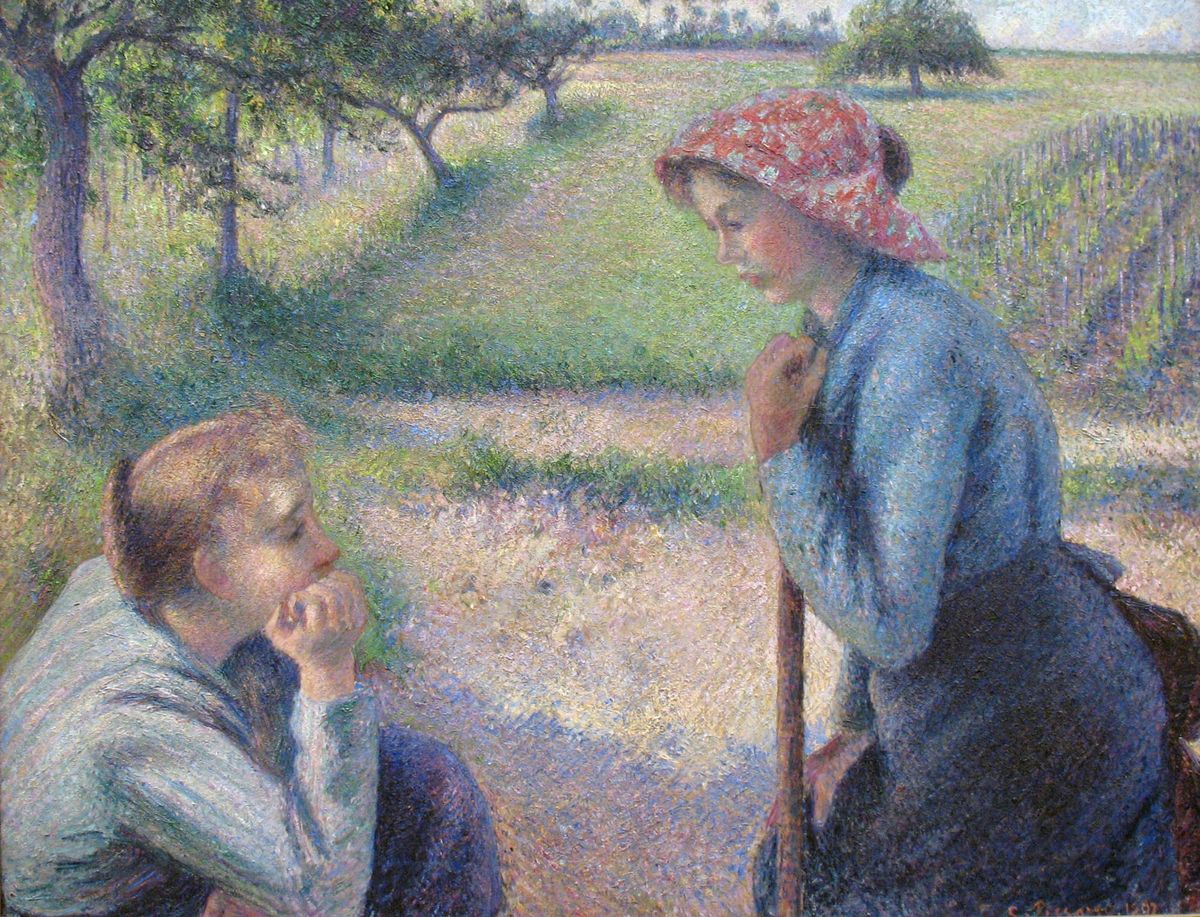
1880년대 후반 조르주 쇠라와 함께 신인상주의 점묘 기법을 깊이 탐구했던 카미유 피사로는 1890년대 초반에 이르러 점묘의 엄격하고 기계적인 분할에서 벗어나, 형태의 견고함과 풍부한 인간미를 함께 살려내는 독창적인 회화 기법을 정립했습니다.
노르망디의 전원 마을 에라니 쉬르 엡트에 머물던 그는 농촌의 고단한 노동을 비극적으로 묘사하기보다는, 노동 중간에 찾아오는 휴식의 평화로움과 두 소녀 사이에 흐르는 다정한 교감을 따뜻한 시선으로 포착했습니다. 가로 81.3cm, 세로 65.4cm 크기의 캔버스에 유채로 완성된 이 작품은 치밀하게 직조된 색채 점들과 단단한 인물 소묘가 완벽한 조화를 이루는 피사로의 대표적인 농촌 인물화 걸작입니다.
관람자의 시각 인지 체계는 화면 우측 상단에서 붉은 꽃무늬 보닛을 쓰고 서 있는 소녀의 얼굴과 푸른빛 작업복의 선명한 채도 대비에 가장 먼저 닻을 내립니다. 형태의 명확한 윤곽과 보닛의 화사한 색채소는 시각 피질의 중심와를 즉각적으로 자극하며 화면의 중심축을 확립합니다.
이어서 시선은 서 있는 소녀의 따뜻한 눈길을 매개체 삼아 화면 좌측 하단에서 턱을 괴고 골똘히 생각에 잠긴 앉아 있는 소녀의 얼굴로 부드러운 대각선 궤적을 그리며 이동합니다.
두 인물의 정서적 시선 교환을 확인한 시선은, 소녀들의 발치에 드리운 부드러운 그림자를 스쳐 중경의 완만한 연둣빛 들판과 과수원의 나무들, 그리고 아득한 지평선으로 확장되는 도약 안구 운동을 진행합니다.
무수히 중첩된 미세한 색채 입자들이 망막 위에서 온화한 여름날의 대기광으로 융합되는 순간, 관조자는 번잡한 일상의 긴장을 내려놓고 순박한 시골 소녀들의 대화 속에 조용히 동참하는 듯한 깊은 심리적 안도감과 서정적인 평온에 도달하게 됩니다.
이 그림을 그릴 당시 피사로는 전설적인 미술상 폴 뒤랑뤼엘의 파리 갤러리에서 대규모 개인전을 앞두고 있었으며, 쇠라의 갑작스러운 죽음 이후 점묘주의의 한계를 극복하기 위해 밤낮없이 캔버스와 씨름하고 있었습니다.
그는 아들 뤼시앵에게 보낸 편지에서 "나는 점묘의 과학적 질서를 유지하면서도 자연의 자유로운 숨결과 인물의 영혼을 생생하게 담아내기 위해 붓질 하나하나에 온 힘을 쏟고 있다"고 기록했습니다. 실제로 완성된 작품을 본 프랑스 시인이자 평론가 옥타브 미르보는 "피사로는 대지의 단순한 겉모습이 아니라 그 안에서 일하는 인간의 숭고한 존엄을 가장 깊이 있게 표현해 낸 화가"라며 극찬을 아끼지 않았습니다.
대지의 호흡 속에 녹아든 평범한 삶의 숭고함을 치밀한 색채 조직과 따스한 휴머니즘으로 완성해 낸 피사로의 이 농촌 인물화는, 현대 미술사에서 후기 인상주의가 감각적 빛의 묘사를 넘어 인간 실존에 대한 깊은 성찰로 나아간 위대한 이정표로 확고하게 평가받고 있습니다.
Young Peasant Girls Resting (Jeunes paysannes au repos, 1891)
Having rigorously explored the optical principles of Neo-Impressionist divisionism alongside Georges Seurat throughout the late 1880s, Camille Pissarro evolved his method in the early 1890s to synthesize disciplined color division with tactile human warmth.
Living in the rural sanctuary of Éragny-sur-Epte, the master favored quiet moments of pastoral rest over the strenuous mechanics of field labor, celebrating the tender, silent intimacy shared between two country maidens. Measuring 65.4 by 81.3 cm, this exquisite oil on canvas stands as a crowning achievement of Pissarro's figurative oeuvre, weaving thousands of vibrating brushstrokes into a monumental tribute to agrarian youth.
The viewer's perceptual apparatus naturally anchors upon the vibrant chromatic resonance of the standing girl on the right, whose floral red bonnet and cobalt blouse immediately stimulate the fovea. This solid structural mass establishes an intuitive focal nexus, organizing the surrounding pastoral expanse.
From this standing figure, the ocular trajectory tracks the warmth of her downward gaze, drifting along a natural diagonal toward the seated maiden in the lower left, who rests her chin upon her hand in quiet contemplation.
After absorbing this poignant emotional exchange, the gaze glides across the sun-dappled foreground soil toward the undulating green pastures and soft orchard trees ascending into the distant horizon.
As the visual cortex integrates these densely woven, shimmering touches of pigment into a cohesive atmospheric reality, active visual navigation transforms into profound contemplative repose, gently immersing the observer in the unhurried cadence of rural life.
While finalizing this canvas ahead of a major retrospective at Paul Durand-Ruel's gallery in Paris, Pissarro was tirelessly refining his technique following Seurat's untimely death, seeking to liberate Pointillism from mechanical rigidity.
In letters to his son Lucien, he reflected on the tremendous effort required to marry rigorous chromatic division with the authentic breath of the living earth and the inner spirit of his subjects. The renowned critic Octave Mirbeau ardently championed the resulting work, declaring that Pissarro had captured the profound moral dignity and essential truth of the peasant soul without decorative artifice.
Masterfully uniting structured optical brilliance with profound humanist empathy, Pissarro's depiction of young peasant women resting remains celebrated across art history as a timeless masterpiece of late Impressionist figurative art.
본 콘텐츠의 저작권은 저작권자에게 있으며, 무단 전재 및 재배포를 금합니다.