환자를 진료하는 마을 의사 Village Doctor visiting a Patient
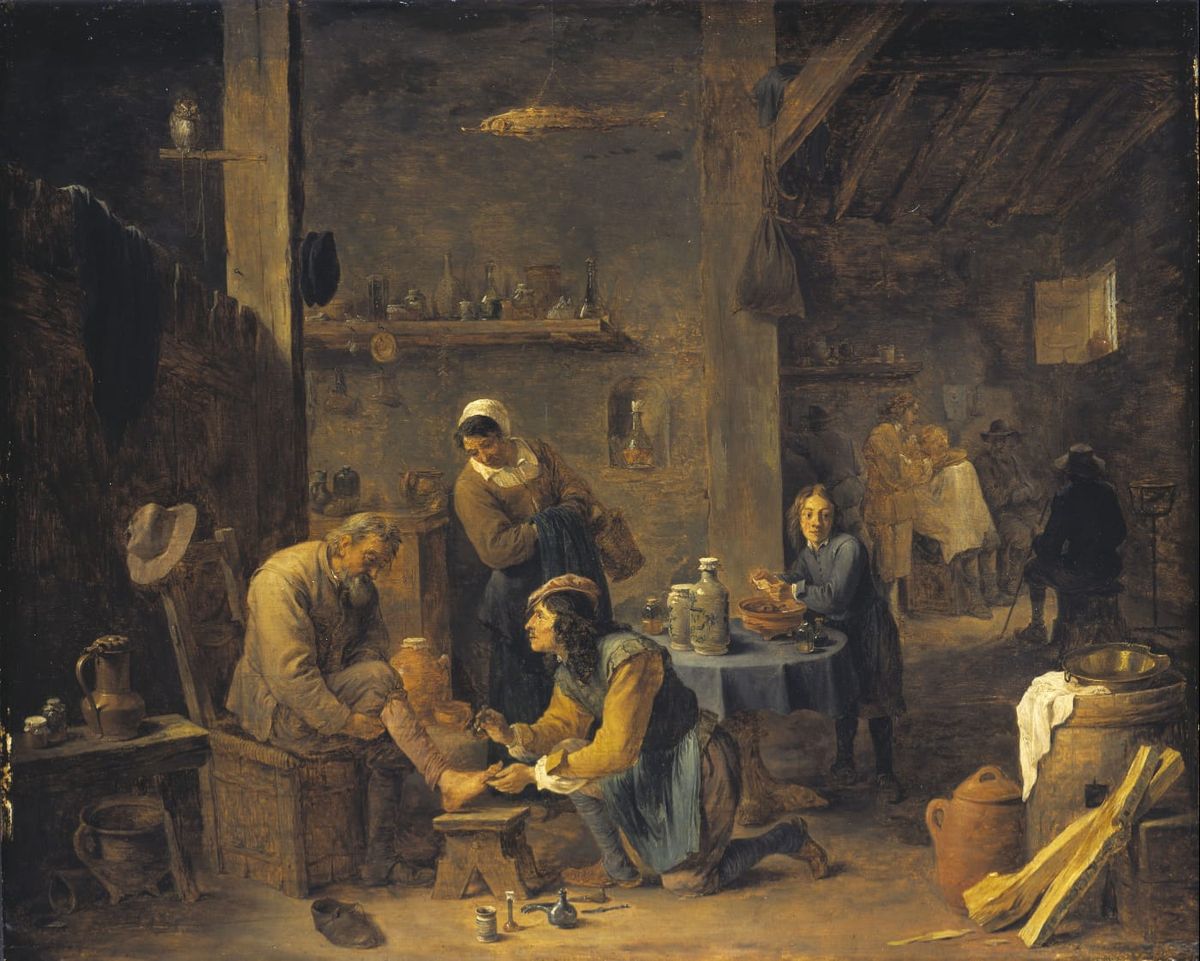
17세기 플랑드르 바로크 풍속화 및 의학 실내화의 거장 소 다비드 테니어르스(David Teniers le Jeune, 1610–1690)가 1640년대 중후반 안트베르펜 시기에 완성한 기념비적 실내 의료 풍속화 유화 환자를 진료하는 마을 의사(Village Doctor visiting a Patient, 또는 시골 이발소 외과의사의 진료실, 프랑스어: Le médecin de village soignant un malade, 네덜란드어: De dorpsdokter)는 58.0 cm × 73.5 cm 크기의 가로형 패널(목판)에 유채로 그린 대표적인 북유럽 의료 풍속 정물화 최고 걸작입니다.
유럽 유수의 명문 귀족 컬렉션을 거쳐 벨기에 브뤼셀의 벨기에 왕립미술관(Royal Museums of Fine Arts of Belgium, Brussels)에 영구 소장되어 보존되어 오고 있습니다.
오감 중 촉각의 우의와 서민 치료 현장의 인간미를 향한 화가의 고뇌
1640년대 안트베르펜 화단을 이끌던 삼십 대의 테니어르스는, 당시 유행하던 오감(Five Senses) 알레고리 중 아픔과 치유가 직접적으로 맞닿는 촉각(Feeling, Touch)의 테마를 시골 외과의사의 진료 현장으로 생생하게 풀어내고자 했습니다.
화가는 당대 시골 의사들을 돈만 밝히는 사기꾼이나 돌팔이로 조롱하던 선배 화가들의 거친 풍자에서 벗어나, 고통받는 환자의 발을 정성스럽게 치료하는 시골 외과의사와 이를 지켜보는 가족들의 따뜻한 인간미를 어떻게 맑은 은빛 대기(Silvery manner)와 정밀한 의학 기구 정물 속에 담아낼지 치열하게 번민했습니다.
당시 시골 외과의사는 이발사를 겸하며 발의 티눈이나 상처를 째고 붕대를 감아주며 서민들의 고통을 덜어주는 가장 친숙한 동네 치료자였습니다.
화가는 천장에 매달린 말린 박제 생선과 약병들이 즐비한 어두운 진료실 안에서, 짚 의자에 앉은 노인의 아픈 발을 조심스럽게 수술하는 젊은 의사의 긴장된 순간을 화폭에 담았습니다.
화면 왼쪽 짚으로 짠 의자에 앉은 흰 수염의 노인은 바지를 걷어 올린 채 발을 나무 받침대에 얹고, 찌릿하게 밀려오는 통증을 참으며 의사의 손끝을 애타게 내려다보고 있습니다.
노란 소매에 푸른 옷을 입은 젊은 의사는 한쪽 무릎을 꿇고 앉아 날카로운 수술 도구로 노인의 발가락 상처를 정성스레 치료하고 있으며, 그 곁에 선 여인은 옷을 챙겨 든 채 걱정 어린 눈빛으로 치료 과정을 지켜보고 있습니다.
화면 오른쪽 둥근 테이블에서는 조수가 약사발을 저으며 연고를 준비하고 있고, 뒤편 방에서는 면도를 받거나 차례를 기다리는 손님들이 보입니다.
기둥 위에 앉아 침묵을 지키는 부엉이와 바닥에 정갈하게 놓인 유리 약병, 그리고 기름먹인 헝겊 붕대는, 고통과 치유가 교차하는 17세기 플랑드르 서민들의 진솔한 삶을 손에 잡힐 듯 생생하게 웅변합니다.
조심스러운 의사의 칼끝에서 고통을 참는 노인과 약사발을 젓는 조수로, 시선의 심리적 여정
그림을 마주하는 순간 관람객의 무의식적 시선은 화면 왼쪽 아래 짙은 그늘 속에서 집중된 자연광을 받아 밝게 빛나는 젊은 의사의 노란 옷소매와 노인의 하얀 맨발로 가장 먼저 빨려 들어갑니다.
작은 나무 의자에 얹힌 발가락 상처를 향해 조심스레 도구를 대는 의사의 다부진 손끝과 긴장된 눈빛은 보는 이에게 깊은 시각적 집중과 함께 손끝이 저릿해지는 촉각적 긴장감을 선사합니다.
이어 시선은 바지를 걷어쥐고 고통스러운 표정으로 자신의 발을 내려다보는 노인의 주름진 이마와, 그 뒤에서 바구니를 들고 서서 근심 어린 표정을 짓는 여인의 다정한 얼굴로 이동합니다.
아픔을 견디는 환자와 이를 안타깝게 바라보는 가족의 진솔한 표정을 확인하는 순간, 관람객은 약초 냄새와 소독약 기운이 감도는 17세기 플랑드르 시골 진료소 한복판 속으로 온몸이 빨려 들어가게 됩니다.
마지막으로 시선은 바닥에 놓인 작은 약병들과 연고 항아리를 지나, 둥근 탁자에서 약을 빻고 있는 푸른 옷 조수의 또렷한 눈망울과 저 멀리 안쪽 방에서 면도를 받는 손님들의 실루엣, 그리고 기둥 위의 박제 부엉이에 멈춥니다.
전면의 정교한 의료 행위와 후면의 분주한 일상이 빚어내는 완벽한 공간적 깊이를 마주하며, 관람객은 인간의 고통을 어루만지는 따스한 연민과 거장 테니어르스가 건네는 묵직한 서민적 위로를 가슴 깊이 마주하게 됩니다.
17세기 플랑드르 의료 풍속 정물화의 정점과 조형미, 미술계의 평가
미술계는 벨기에 왕립미술관의 환자를 진료하는 마을 의사를 테니어르스가 인물의 심리 묘사와 촉각의 알레고리, 그리고 정밀한 약제 도구 정물을 가장 완벽한 기량으로 결합해 완성한 대표적인 최고봉 명작으로 평가합니다.
단순한 치료 장면을 넘어 서민들의 의료 문화와 인간적인 유대감을 완벽한 원근법 속에 조화시켰을 뿐만 아니라, 도자기 약병의 매끄러운 유약 광택, 짚 의자의 거친 엮임, 천장에 매달린 박제 물고기의 메마른 질감, 어두운 진료실을 감싸는 은빛 명암법을 극도로 섬세한 북유럽 사실주의 유화 기법으로 완벽하게 구현했기 때문입니다.
서민들의 아픔을 치유하는 따스한 순간을 가장 품격 높은 시각 드라마로 완성해 낸 테니어르스의 이 걸작 화폭은, 오늘날까지도 전 세계 수많은 감상자들에게 깊은 감탄과 잊을 수 없는 시각적 안식을 전해주는 불멸의 명작으로 손꼽히고 있습니다.
Village Doctor visiting a Patient
Painted in the mid-to-late 1640s in Antwerp by the master of Flemish Baroque genre and medical interior painting David Teniers the Younger (1610–1690), Village Doctor visiting a Patient (also titled The Village Barber-Surgeon, French: Le médecin de village soignant un malade, Dutch: De dorpsdokter) is an intimate interior genre masterpiece in oil on panel measuring 58.0 cm × 73.5 cm (22.8 in × 28.9 in).
Preserved across distinguished European royal and noble collections, it is housed today in the permanent collection of the Royal Museums of Fine Arts of Belgium in Brussels.
The Allegory of Touch, the Barber-Surgeon, and Compassionate Care
During the 1640s in Antwerp, David Teniers the Younger refined his celebrated ability to capture domestic and occupational interiors, frequently interpreting the traditional Allegory of the Five Senses—specifically the Sense of Touch (Tactus)—through the intimate practice of rustic medicine.
Rather than portraying rural healers as deceitful quacks or cruel charlatans, the master meditated deeply on the quiet dignity, compassionate care, and mutual trust between a barber-surgeon and his humble patients, translating physical vulnerability and healing into a harmonious chamber scene bathed in delicate silvery chiaroscuro.
Teniers staged the operation within a spacious rustic surgery adorned with apothecary shelves, stuffed dried fish hanging from the rafters, and medical apparatus.
In the left foreground, an elderly peasant seated upon a woven wicker armchair rolls up his breeches, resting his bare foot on a low wooden stool while watching the surgeon with stoic endurance.
Kneeling before him, the skilled young doctor dressed in a yellow doublet and blue tunic carefully operates upon the patient's foot with a delicate surgical blade, flanked by a sympathetic woman carrying garments.
To the right, an apprentice at a round table prepares healing unguents in a mortar, while in the rear chamber, patrons wait their turn and undergo shaving, celebrating the sensory richness, communal warmth, and therapeutic routine of 17th-century village life.
Subconscious Trajectory of the Gaze: From the Surgeon's Blade to the Apothecary Table
The observer's subconscious gaze is immediately magnetized by the central-left foreground, drawn to the radiant highlights illuminating the surgeon’s vibrant yellow sleeves and the exposed white foot resting on the wooden bench.
His delicate handling of the scalpel, poised fingers, and intense concentration establish an instant focal point of tactile precision, narrative suspense, and professional focus.
The visual path then ascends to the weathered countenance of the elderly patient grasping his leg, taking in his furrowed brow, greying beard, and quiet resilience in the face of physical pain.
Absorbing the authentic atmosphere of rustic healing and familial concern, the viewer directly experiences the sensory reality and human empathy of a 17th-century medical consultation.
Finally, the visual trajectory moves toward the right, following the assistant grinding herbs at the draped table, before sweeping past the glazed Delftware ointment jars into the sunlit background where villagers converse by the doorway.
Observing the harmonious equilibrium between focused domestic chiaroscuro, intricate still-life arrangement, and precise Netherlandish draftsmanship, the spectator perceives the timeless nobility of compassionate labor and the profound aesthetic solace Teniers embedded within the panel.
The Monument of Flemish Medical Genre: Critical Legacy
Art historians revere the Brussels Village Doctor visiting a Patient as an extraordinary achievement in Teniers’s oeuvre, illustrating his consummate ability to unite still-life accuracy, character psychology, and occupational atmosphere on a substantial wooden panel.
By orchestrating delicate textural contrasts between smooth glazed pharmacy jars, rough wicker weaves, coarse woolen jackets, dried biological specimens, and crumbling plaster masonry within a unified interior space, Teniers elevated a medical procedure into an exquisite aesthetic treatise on human vulnerability and care.
This precious historical panel endures as an inspiring testament to the master's creative fortitude, celebrating the quiet poetry of everyday existence and the transformative grace of living art.
본 컨텐트의 저작권은 팔렛트제주에 있습니다. 허가없는 무단전제를 금지합니다.
Copyright © Palette Jeju. All rights reserved. Unauthorized reproduction or redistribution is strictly prohibited.