환호와 열기 속 아를의 군중, 아를의 원형경기장 The Arena at Arles
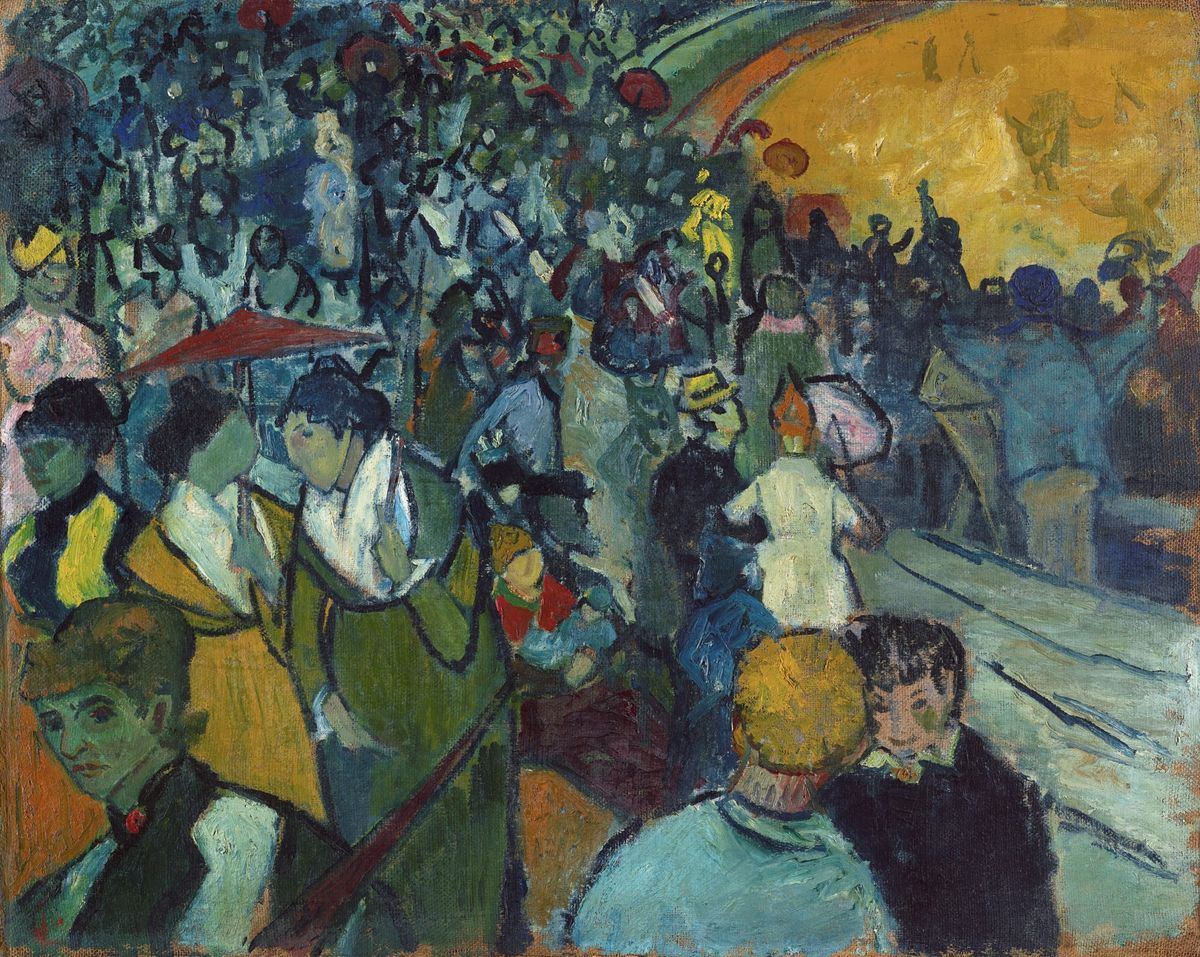
네덜란드의 후기 인상주의 거장 빈센트 반 고흐(Vincent van Gogh, 1853–1890)가 1888년 12월 프랑스 아를(Arles)에서 완성한 유화 《아를의 원형경기장(The Arena at Arles, 또는 아를 원형경기장의 관중들)》은 73.0 cm × 92.0 cm 크기의 캔버스에 유채로 그린 대작으로, 현재 러시아 상트페테르부르크의 에르미타주 미술관(State Hermitage Museum)에 영구 소장되어 있습니다.
투우장의 환호 속에서 기억으로 길어 올린 아를의 얼굴들
1888년 늦가을, 아를의 '노란 집'에서 폴 고갱과 동거하며 치열한 예술적 교류를 나누던 고흐는 로마 시대의 유적인 아를 원형경기장에서 열린 투우 경기를 관람했습니다. 프로방스 전통 투우는 소를 죽이지 않고 뿔에 달린 리본을 낚아채는 민속 축제였으며, 고흐는 경기 자체보다 경기장을 가득 메운 군중들의 화려한 전통의상과 역동적인 에너지에 깊은 인상을 받았습니다.
고흐는 이 작품을 현장에서 그리지 않고, 고갱이 강조했던 '기억과 상상력을 통한 재구성' 방식을 적극 도입하여 작업실에서 완성했습니다. 경기장 관람석 전면에는 아를의 전통 의상인 아를레지엔(Arlésienne)을 입은 여인들과 함께 고흐의 절친한 친구였던 우체부 조셉 룰랭(Joseph Roulin) 일가의 특징적인 얼굴들이 배치되어 있습니다. 투우장의 열기 속에서도 화가는 단순한 구경꾼의 시선을 넘어, 낯선 남프랑스 땅에서 자신에게 따뜻한 온기를 나누어 준 이웃들의 모습을 기억의 캔버스 위에 헌정하듯 새겨 넣었습니다.
무의식 속 시선의 공간 이동과 심리적 진동
감상자의 시선은 화폭 전면 좌측과 하단에 굵은 윤곽선으로 도드라진 인물들의 다채로운 옆모습으로 가장 먼저 이끌립니다. 녹색과 노란빛의 전통 의상, 붉은 양산, 그리고 노란 머리칼을 한 인물들의 묵직한 존재감은 시선을 화면 앞쪽에 단단히 묶어두며 친밀한 현장감을 자아냅니다.
이어 시선은 관람석을 가득 채운 수많은 군중의 점묘풍 푸른 실루엣을 타고 화면 우측 상단의 눈부신 황금빛 투우 모래사장으로 빠르게 뻗어나갑니다. 빽빽하고 어두운 관람석의 차가운 청록색과 빛으로 가득 찬 경기장의 눈부신 노란색이 이루는 대담한 대비는 보는 이의 무의식 속에 강렬한 시각적 해방감을 선사합니다. 관람자는 의식하지 못하는 사이 군중들의 웅성거림과 투우장의 뜨거운 열기, 그리고 활기찬 축제 한가운데서 화가가 느꼈던 미묘한 이방인으로서의 고독감을 동시에 체감하게 됩니다.
클루아조니슴의 정점과 종합주의적 혁신, 미술사적 평가
미술계는 《아를의 원형경기장》을 반 고흐와 고갱의 예술적 협업이 낳은 가장 눈부신 종합주의(Synthetism) 걸작 중 하나로 평가합니다. 대상을 사실적으로 재현하는 전통적 원근법을 과감히 축소하고, 평면적인 색면과 굵고 짙은 외곽선으로 대상을 구획하는 클루아조니슴(Cloisonnism) 기법을 탁월하게 구사했습니다.
일본 우키요에 판화의 구도적 영향과 고갱의 상징주의적 미학을 자신만의 폭발적인 색채 감각으로 녹여낸 이 작품은, 구상 회화의 틀을 깨고 20세기 모더니즘과 야수파로 나아가는 중요한 전환점의 걸작으로 확고히 자리 잡고 있습니다.
Pulsating Crowds and Spectacle in the Roman Arena, The Arena at Arles
Painted in December 1888 during his celebrated Arles period by Vincent van Gogh (1853–1890), The Arena at Arles (also known as Spectators in the Arena at Arles) is an oil on canvas measuring 73.0 cm × 92.0 cm (28.7 in × 36.2 in), preserved in the permanent collection of the State Hermitage Museum in Saint Petersburg, Russia.
Festive Resonances in Provence: Memory, Companionship, and the Bullring
In late 1888, while sharing the Yellow House in Arles with Paul Gauguin, Van Gogh attended the traditional Provençal bullfights held within the ancient Roman amphitheater. Unlike the fatal spectacles of Spain, the Provençal course camarguaise focused on agile bullfighters snatching rosettes from the horns of racing bulls, yet Vincent found himself far more captivated by the bustling, vibrant tapestry of the spectators than the arena floor itself.
Embracing Gauguin’s method of painting from memory rather than direct outdoor observation, Van Gogh composed this expansive scene inside his studio. In the foreground, he depicted women wearing traditional Arlésienne headdresses alongside stylized likenesses of his dearest local companions, including members of the Roulin family. Surrounded by the roaring crowd, Vincent transformed a communal festival into an affectionate chronicle of the working-class community that had offered him warmth in the south of France.
Psychological Trajectory of the Gaze and the Dynamic Spectrum of Light
The observer’s subconscious gaze is immediately grounded in the lower left foreground, anchored by the bold, stylized silhouettes of local figures in profile. The tactile interplay of deep greens, ochres, scarlet parasols, and bright blonde contours creates an intimate and lively human barrier that arrests initial visual attention.
From this dense crowd, the gaze ascends diagonally across the sweeping terraces filled with impressionistic dabs of blue and teal spectators, bursting finally into the radiant, golden expanse of the sun-drenched arena floor on the upper right. The dramatic juxtaposition between the cool, shaded human mass and the blazing yellow sand instills a powerful optical release. Beneath conscious awareness, the viewer internalizes the collective auditory roar of the stadium and the fleeting warmth of belonging experienced by an artist who remained an introspective observer among the festive throng.
Cloisonnism and the Triumph of Synthetism: Critical Legacy
Art historians celebrate The Arena at Arles as a paramount triumph of Synthetism and Cloisonnism, marking one of the most intellectually fertile periods of the Van Gogh-Gauguin collaboration. By compressing spatial depth and defining flat color planes with heavy, sinuous outlines, Van Gogh demonstrated an extraordinary absorption of Japanese woodblock aesthetics and avant-garde color theories.
This radical departure from academic perspective in favor of chromatic resonance and emotional memory directly anticipated the expressive breakthroughs of Fauvism and early Modernism, securing the painting’s reputation as an indispensable monument in Post-Impressionist history.
Copyright © Palette Jeju. All rights reserved. Unauthorized reproduction or redistribution is strictly prohibited.
본 컨텐트의 저작권은 팔렛트제주에 있습니다. 허가없는 무단전제를 금지합니다.