화가의 딸 잔 피사로의 초상 (The Artist's Daughter, Jeanne Pissarro, 1872)
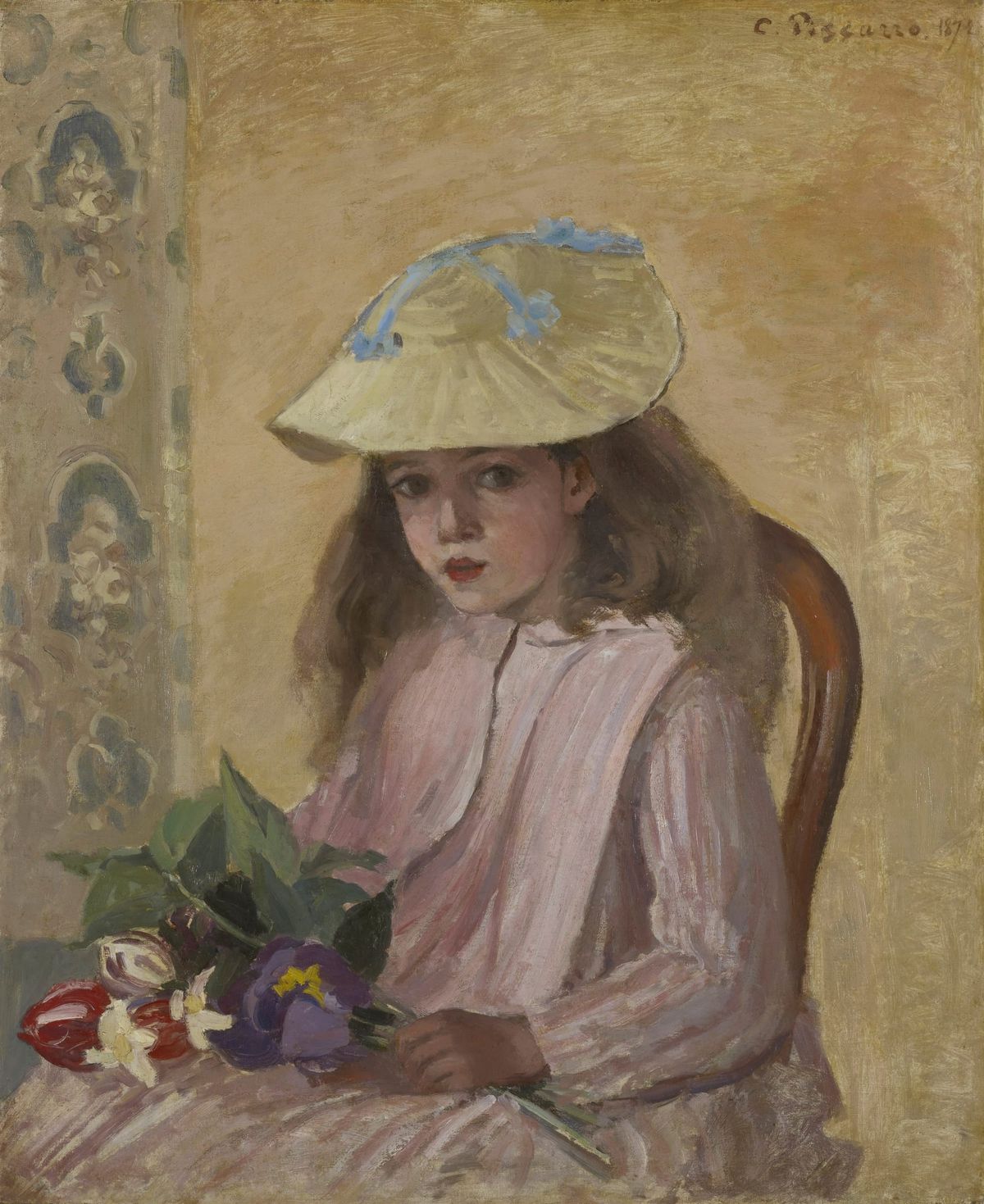
1872년 퐁투아즈의 평온한 아틀리에에서 카미유 피사로는 자신의 장녀 잔-라셸(애칭 '미네트')의 맑고 우수 어린 모습을 화폭에 정성스럽게 담았습니다.
당시 일곱 살이었던 미네트는 안타깝게도 이 그림이 그려지고 불과 2년 뒤인 1874년 봄, 결핵성 질환으로 아홉 살의 어린 나이에 세상을 떠났기에 이 작품은 아버지 피사로의 가장 애틋한 부정과 슬픈 가족사가 응축된 매우 소중한 기록입니다. 가로 59.7cm, 세로 72.7cm 크기의 캔버스에 유채로 완성되어 현재 미국 워싱턴 국립 미술관(National Gallery of Art)에 소장된 이 걸작은, 은은한 살구빛 톤과 섬세한 직조형 붓질을 통해 유년의 연약함과 찰나의 순수함을 따스한 시선으로 승화시킨 피사로의 대표적인 가족 초상화입니다.
관람자의 시각 인지 체계는 화면 상단에서 비스듬히 얹힌 짚모자의 부드러운 노란빛과 그 모자챙 아래로 정면을 응시하는 소녀의 깊고 맑은 눈동자에 가장 먼저 닻을 내립니다. 푸른 리본 장식이 달린 모자의 밝은 명도와 아이의 발그레한 입술, 그리고 투명한 이마의 온화한 피부 톤은 시각 피질의 중심와를 즉각 포획하며 화면의 서정적 구심점을 확립합니다.
이어서 시선은 어깨 위로 풍성하게 흘러내리는 짙은 갈색 곱슬머리의 부드러운 결을 타고 내려와, 분홍빛 줄무늬 드레스의 은은한 주름을 거쳐 무릎 위에 가지런히 놓인 꽃다발로 자연스러운 도약 안구 운동을 진행합니다.
소녀의 작은 손에 쥐어진 보랏빛 붓꽃과 붉은 튤립, 그리고 짙푸른 잎사귀들의 생생한 색채 대비를 확인한 눈길은, 화면 좌측 배경에 세로로 길게 늘어선 고풍스러운 푸른빛 아라베스크 벽지 문양과 우측의 갈색 목조 의자 등받이로 이어지며 캔버스 전체의 온화한 황금빛 공간 속으로 부드럽게 확장됩니다.
부드럽게 흩뿌려진 실내 자연광과 정물처럼 순수한 소녀의 자태가 망막 위에서 하나의 조화로운 온기로 통합되는 순간, 관조자는 번잡한 일상의 긴장을 내려놓고 유년 시절의 따스한 안식처에 머무는 듯한 깊은 심리적 안도감과 뭉클한 내면의 평온을 마주하게 됩니다.
이 그림을 그릴 당시 피사로는 보불전쟁의 피란을 마치고 퐁투아즈에 정착하여 에드가 드가, 피에르 오귀스트 르누아르 등과 함께 인물의 심리적 깊이와 장식적인 실내 공간의 조화를 실험하고 있었습니다.
그는 당시 살롱 화가들이 즐겨 쓰던 인위적인 귀족풍 포즈나 도식적인 감상성을 과감히 배제하고, 아픈 딸을 바라보는 아버지의 정직하고 따뜻한 시선만을 캔버스 위에 직조하듯 쌓아 올렸습니다. 손에 쥐어진 꽃송이들은 피어남과 덧없음을 동시에 지닌 연약한 생명의 비유이자, 딸을 향한 영원한 사랑의 서정적 상징으로 읽힙니다.
미술계와 평론가들은 화려한 과장 없이 인간 내면의 진실을 가장 투명하게 건져 올린 피사로의 이 초상화를 두고 "인상주의가 낳은 가장 고결하고 눈물겨운 가족애의 승리"라며 높은 찬사를 보냈습니다.
어린 딸의 무구한 눈빛과 거장의 숭고한 부성애를 단단한 조형미와 섬세한 빛의 조화로 완성해 낸 피사로의 잔 초상화는, 현대 미술사에서 인상주의 인물화가 도달한 가장 순수하고 감동적인 휴머니즘의 정점으로 영원히 자리매김하고 있습니다.
Portrait of the Artist's Daughter, Jeanne Pissarro (The Artist's Daughter, Jeanne Pissarro, 1872)
In the quiet sanctuary of his Pontoise studio during 1872, Camille Pissarro turned his contemplative gaze upon the tender, melancholic presence of his eldest daughter, Jeanne-Rachel (affectionately known as "Minette").
Tragically destined to succumb to respiratory illness in 1874 at the fragile age of nine, the seven-year-old child was immortalized by her father in this extraordinarily moving domestic portrait. Measuring 72.7 by 59.7 cm and preserved within the National Gallery of Art in Washington, D.C., this vertical oil on canvas employs muted pastel harmonies and delicate, interwoven brushstrokes to capture the fleeting innocence of youth through profound paternal devotion and structural equilibrium.
The observer’s perceptual framework instantly grounds itself upon the soft, angled straw bonnet trimmed with delicate blue ribbons, descending directly to the wide, searching eyes of the young girl looking outward. The warm, luminous flush of her cheeks and the subtle clarity of her forehead arrest the fovea, establishing an intuitive and emotionally poignant nucleus for the entire composition.
From this delicate focal center, the ocular trajectory tracks downward along the rich cascade of chestnut curls, sweeping across the pale rose striped smock before settling upon the vibrant bouquet resting upon her lap.
Laden with velvety purple irises, scarlet tulips, and deep emerald foliage, the bouquet commands the lower foreground, leading the gaze toward the decorative blue-gray arabesque wallpaper panel on the left and the warm wooden curve of the chair frame on the right.
As the quiet domestic light and the tender permanence of the child's presence coalesce into a unified visual harmony within the visual cortex, active visual scanning dissolves into profound contemplative stillness, wrapped in the restorative and nostalgic sanctuary of childhood memory.
While executing this canvas, Pissarro was engaged in dynamic creative dialogues with Edgar Degas and Pierre-Auguste Renoir, investigating how to weave psychological realism into structured interior compositions.
Completely rejecting the artificial grandeur and sentimental parlor tropes of academic salon painting, the master recorded his daughter with unvarnished sincerity, letting the delicate blossoms symbolize both the fragility and timeless beauty of early life.
Contemporary peers and modern scholars ardently celebrate the portrait, praising Pissarro’s singular capacity to transform personal familial vulnerability into an enduring monument of humanist empathy and aesthetic integrity.
Masterfully harmonizing structural weight with delicate emotional warmth, Pissarro's portrait of his daughter Jeanne remains celebrated across art history as an irreplaceable pinnacle of nineteenth-century figurative Impressionism.
본 콘텐츠의 저작권은 저작권자에게 있으며, 무단 전재 및 재배포를 금합니다.