회색 펠트 모자를 쓴 자화상 - Self-Portrait with Grey Felt Hat
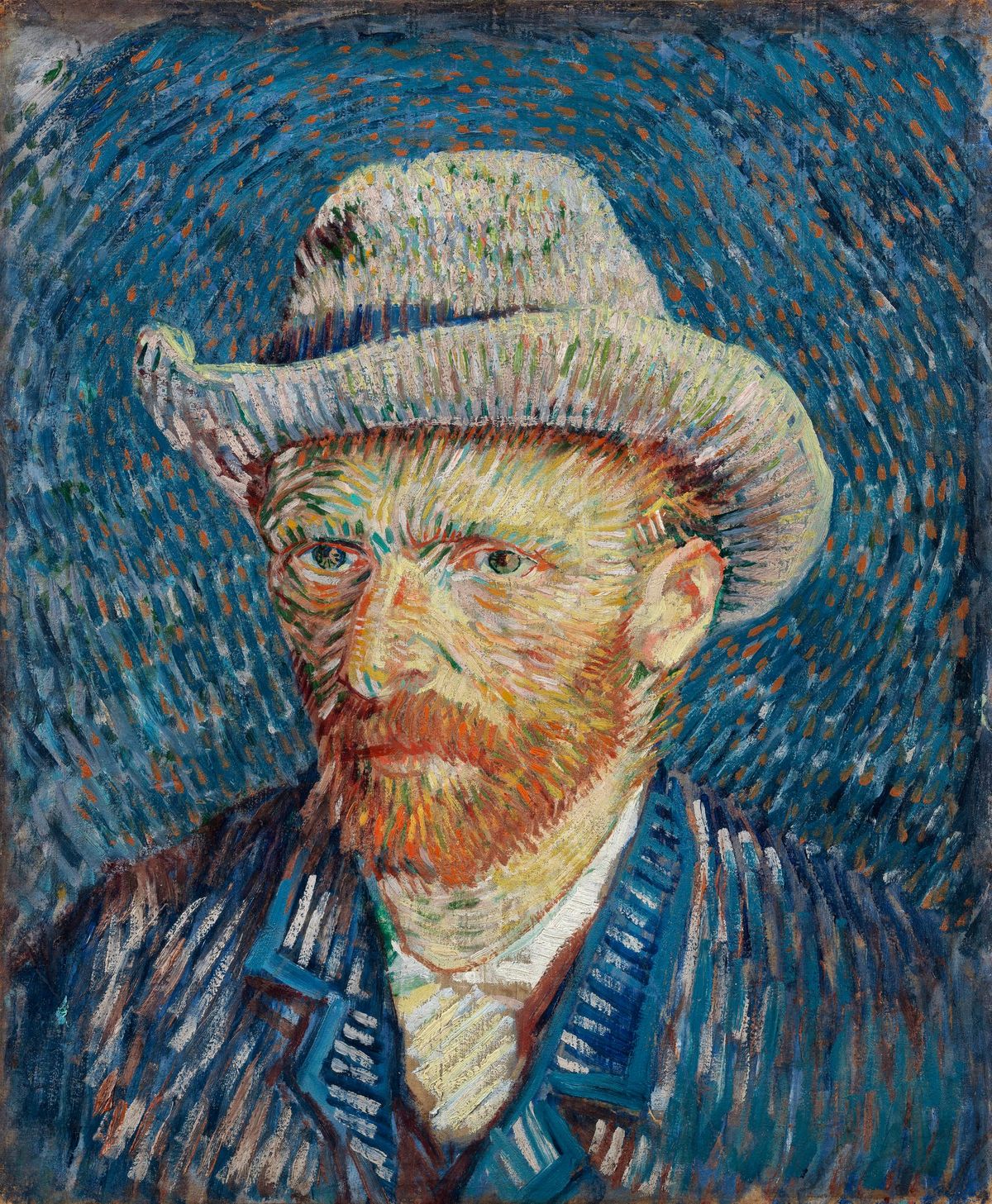
빈센트 반 고흐(Vincent van Gogh, 1853–1890)가 1887년 겨울 프랑스 파리 체류 시절 완성한 '회색 펠트 모자를 쓴 자화상(Self-Portrait with Grey Felt Hat)'은 판지 위에 유채(Oil on cardboard)로 제작된 인물화입니다. 작품의 실제 규격은 세로 44.0cm, 가로 37.5cm이며, 현재 네덜란드 암스테르담의 반 고흐 미술관(Van Gogh Museum)에 영구 소장되어 있습니다.
고흐는 이 작품에서 화면 전체를 소용돌이치듯 회전하는 짙은 코발트 블루 배경 위에 회색 펠트 모자를 깊게 눌러쓴 자신의 모습을 독창적인 점묘적 분할 필치로 구현했습니다. 뺨과 이마, 그리고 붉은 오렌지빛 턱수염을 따라 빗살무늬처럼 교차하는 보색의 선들은 인물의 입체감과 팽팽한 긴장감을 조각하듯 드러냅니다. 특히 모자챙 아래에서 관람자를 꿰뚫어 보는 서늘하고 강렬한 눈매는 짧고 결연한 임파스토(Impasto) 터치로 조각되어 파리 시절 고흐가 도달한 색채 해방의 정점을 보여줍니다.
이 그림에는 파리라는 거대한 예술의 심장부에서 '현대 회화의 선구자'로 거듭나고자 했던 청년 고흐의 치열한 실험과 가슴 뭉클한 인간적 에피소드가 깊게 배어 있습니다. 1886년 봄 파리에 상경한 고흐는 조르주 쇠라와 폴 시냐크의 점묘주의에 큰 충격을 받았으나, 기계적이고 차가운 점묘법 대신 자신의 격정적인 감정을 뿜어낼 수 있는 '살아 꿈틀거리는 선묘적 점묘'를 새롭게 창안해 냈습니다.
당시 고흐는 지독한 가난 탓에 전문 모델은커녕 리넨 캔버스를 살 돈조차 없었습니다. 그는 몽마르트르 화방에서 버려진 값싼 두꺼운 종이 판지(Cardboard)를 구해와 거울 앞에 섰습니다. 단정한 도시풍 재킷과 펠트 모자를 차려입고 거울 속 자신을 몇 시간씩 뚫어지게 응시하던 고흐는, 동생 테오에게 보낸 편지에서 "나는 모델이 없을 때마다 내 얼굴을 그린다. 점과 선들이 부딪치며 만들어내는 색채의 진동은 내 영혼이 갈망하던 진정한 빛의 하모니다. 남들이 나를 괴짜라 부를지라도 나는 이 붓질을 멈출 수 없다"고 털어놓았습니다.
특히 이 작품은 훗날 보존 처리 과정에서 판지 뒷면에 이전 네덜란드 시절에 그렸던 《감자 껍질을 벗기는 여인》 유화 습작이 그려져 있는 것이 확인되었습니다. 새 화구를 살 돈이 없어 판지의 앞뒤를 모두 활용해 그림을 그려야 했던 무명 화가 고흐의 처절한 가난과 불굴의 창작 집념을 증명하는 생생한 흔적입니다.
후대의 미술사학자들과 평단은 이 1887년 겨울 회색 펠트 모자 자화상을 반 고흐가 파리 시기에 이룩한 색채 혁명의 최고 정점이자 20세기 표현주의 초상화의 영원한 이정표로 평가합니다. 빛과 그림자를 인습적인 명암법이 아닌 순수 원색의 파동과 회전하는 선으로 환원한 이 조형적 성취는 훗날 아를과 생레미에서 폭발할 불멸의 걸작들의 탄탄한 모태가 되었습니다.
관람자의 시선은 가장 먼저 화면 상단에서 부드러운 양감으로 감싸는 회색 펠트 모자의 세련된 챙 곡선과 그 아래로 드리운 빛의 결에 안착합니다. 이어 관람자를 투명하게 꿰뚫어 보는 맑고 서늘한 눈동자와 붉은 오렌지빛으로 정교하게 결을 이룬 턱수염의 거친 질감을 훑은 뒤, 빗살무늬 선묘로 직조된 재킷의 단정한 깃으로 내려옵니다. 마지막으로 두상을 중심으로 소용돌이치며 진동하는 푸른빛과 붉은빛 배경의 역동적인 붓 터치를 따라 화면 전체로 유려하게 순환하게 됩니다.
심리적으로 관람자는 온 화면을 가득 채운 푸른빛의 회전하는 에너지와 인물의 진솔하고 결연한 눈빛 속에서 깊은 정서적 정화와 지적인 각성을 경험하게 됩니다. 곤궁한 현실 속에서도 붓을 쥐고 자신의 예술적 정체성을 당당하게 빚어냈던 화가의 순수한 열정은 현대인의 마음에 쌓인 불안과 피로를 맑게 씻어내 주며, 일상의 어떤 시련 속에서도 결코 흔들리지 않는 단단한 자아의 확신과 내면의 깊은 평온을 풍성하게 채워줍니다.
Self-Portrait with Grey Felt Hat
Painted by Vincent van Gogh (1853–1890) in Paris during the winter of 1887, Self-Portrait with Grey Felt Hat is an iconic oil on cardboard portrait measuring 44.0 cm in height and 37.5 cm in width. This celebrated masterpiece is permanently preserved in the renowned collection of the Van Gogh Museum in Amsterdam, Netherlands.
Van Gogh constructed the portrait through a revolutionary synthesis of Pointillism and rhythmic linear mark-making, setting his bust against a pulsating, halo-like vortex of cobalt and cerulean blue. The grey felt hat forms a sculptural crown framing his concentrated gaze, while radiating strokes of orange, ochre, and vermilion across his beard and facial contours create an electric complementary vibration against the cool background. Articulated with dense, directional impasto, the composition establishes an intense visual rhythm that captures both modern intellectual discipline and passionate inner energy.
The portrait holds an intimate history of artistic breakthrough amidst profound Parisian poverty. Living in Montmartre with his brother Theo, Van Gogh adapted the optical theories of Neo-Impressionism into a deeply personal, expressive handwriting. Unable to afford professional models or traditional primed canvases, he purchased inexpensive sheets of industrial cardboard and turned his analytical gaze upon his own reflection.
Dressing in a respectable urban jacket and felt hat, Van Gogh transformed his mirror into a rigorous laboratory of chromatic interaction. Writing to Theo, he expressed that mastering the dynamic resonance between contrasting hues was his essential path toward discovering the true emotional language of modern color. Modern conservation later revealed that the reverse side of this cardboard panel contains an earlier Dutch-period peasant study, physically proving how Van Gogh literally used his past as the support for his modern rebirth.
Modern art historians celebrate this Paris self-portrait as a defining pinnacle of Van Gogh’s stylistic evolution. By liberating line and color from descriptive boundaries, he established the technical and emotional foundation for his sun-drenched masterworks in Arles, providing lasting inspiration for twentieth-century Fauvism and German Expressionism.
A viewer’s gaze is instantaneously captured by the sculpted form of the grey felt hat dominating the upper canvas. The eyes then traverse the chiselled contours of the brow down to the piercing, translucent eyes and the textured flame of the reddish beard, before settling upon the rhythmic linear construction of the jacket. Finally, the gaze circulates effortlessly through the dynamic, vortex-like blue brushstrokes of the background, encompassing the entire unified composition.
Psychologically, immersion in this harmonious dialogue of radiant azure, fiery vermilion, and structured grey tones induces an immediate sensation of clarity, fortitude, and inner resilience. Confronting the artist's unwavering creative self-possession dissolves modern anxiety and mental fatigue, enveloping the observer in an enduring atmosphere of purpose, quiet dignity, and restorative peace.
본 리뷰에서 작품을 제외한 컨텐츠의 저작권은 팔렛트제주에 있습니다.
"퍼블릭도메인 고전명화"를 제외한 모든 창작 콘텐츠는 저작권법 제4조 및 제10조에 의거하여 보호됩니다. 무단 도용시 저작권법 제136조(벌칙)에 의거, 당사의 사전 서면 승인 없는 저작권 침해 행위를 금지합니다.