햇살 부서지는 프로방스의 물가와 정겨운 일상, 아를의 랑글루아 다리 The Langlois Bridge at Arles
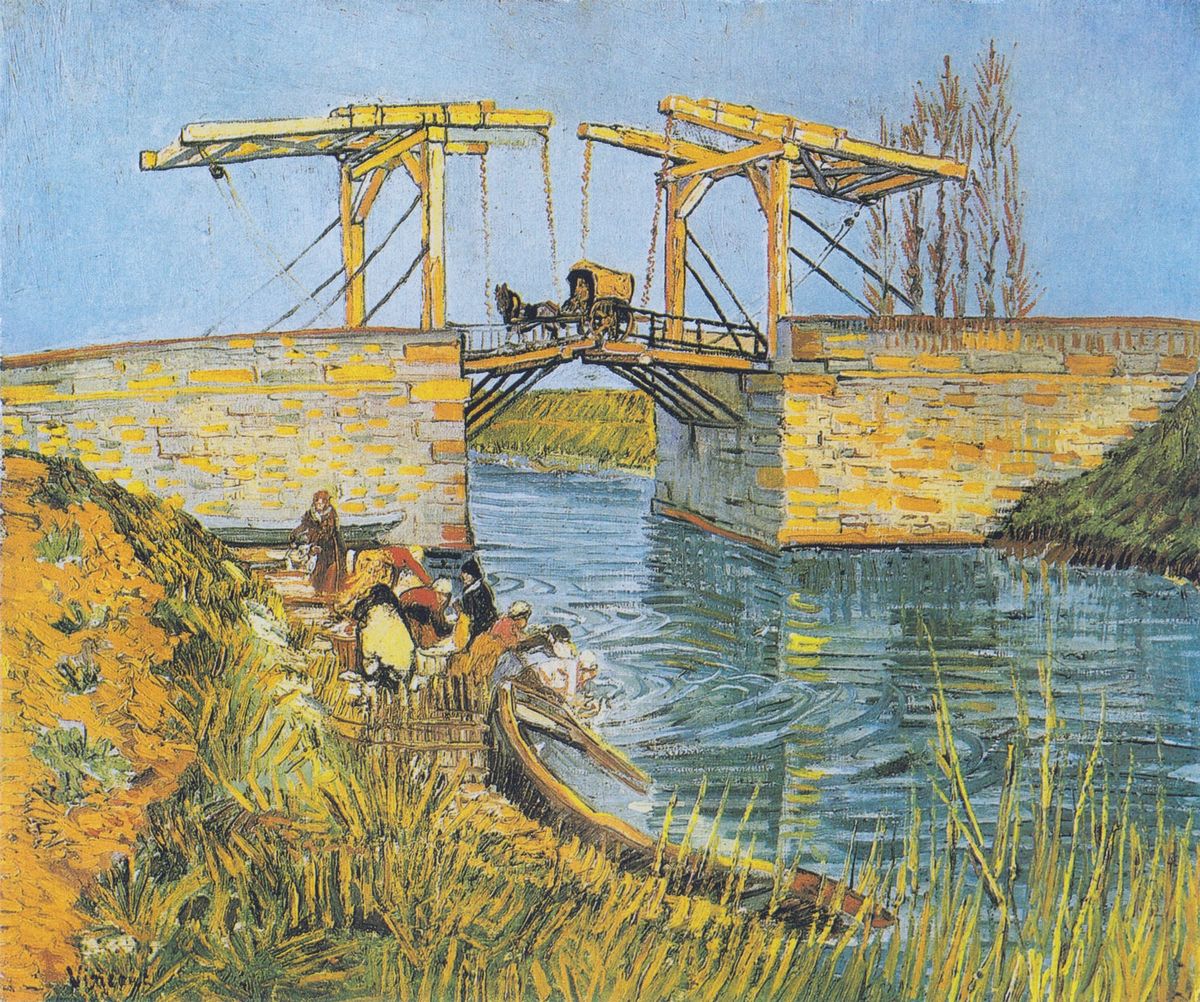
네덜란드의 후기 인상주의 거장 빈센트 반 고흐(Vincent van Gogh, 1853–1890)가 1888년 5월 프랑스 아를(Arles)에서 완성한 유화 《아를의 랑글루아 다리(The Langlois Bridge at Arles)》는 49.5 cm × 64.0 cm 크기의 캔버스에 유채로 그린 대표작으로, 현재 프랑스 파리의 오르세 미술관(Musée d'Orsay)에 영구 소장되어 있습니다.
아를의 첫 봄을 사로잡은 도개교와 고향을 향한 예술적 오마주
1888년 2월, 파리의 삭막한 겨울을 벗어나 남프랑스 아를에 안착한 고흐는 따스하게 쏟아지는 지중해의 봄 햇살과 생동감 넘치는 대자연에 깊이 매료되었습니다. 그는 시내 남쪽의 운하를 산책하던 중 네덜란드 출신의 공학 기술자들이 세운 목조 도개교인 랑글루아 다리를 발견하고 강렬한 창작열을 불태웠습니다.
이 목조 다리는 고흐에게 유년 시절 고국 네덜란드의 물길 풍경을 생생하게 상기시켰으며, 동시에 그가 열렬히 찬미했던 일본 우키요에 판화의 구조적 미학을 완벽히 구현할 수 있는 최적의 무대가 되어주었습니다. 동생 테오에게 보낸 편지에서 그는 "맑고 푸른 물, 노란 다리, 그리고 물가에서 빨래하는 여인들의 조화가 한 폭의 일본 그림처럼 아름답다"고 적으며 벅찬 감흥을 고백했습니다.
고흐는 이 매혹적인 풍경을 여러 점의 연작으로 남겼으며, 그중에서도 5월에 완성된 이 작품은 한층 더 정교해진 필치와 명징한 색채의 대비를 통해 남프랑스의 전원적 서정을 가장 우아하게 담아낸 걸작으로 손꼽힙니다.
무의식 속 시선의 공간 유영과 서정적 정화
감상자의 시선은 화폭 좌측 중앙 물가에 옹기종기 모여 앉아 빨래를 하는 여인들의 다채로운 실루엣과 잔잔하게 퍼져나가는 물결의 동심원으로 가장 먼저 이끌립니다. 여인들이 입은 옷의 흰색과 붉은빛 악센트는 시선을 자연스럽게 머물게 하며, 분주한 일상 속의 따뜻한 생명력을 전해줍니다.
이어 시선은 물가에 정박한 갈색 목선을 스쳐, 푸른 하늘을 배경으로 당당하게 솟아오른 랑글루아 다리의 노란 목조 골조와 그 위를 건너는 마차의 실루엣으로 경쾌하게 상승합니다.
그 후 시선은 다리의 견고한 석조 교각을 타고 내려와 전면 우측에 섬세하게 솟아오른 노란 갈대숲의 율동적인 필치를 거쳐, 맑은 에메랄드빛 운하 수면으로 완만하게 순환합니다. 따뜻한 황토빛 흙길과 차가운 청록색 물빛이 이루는 완벽한 보색의 균형 속에서, 관람자는 의식하지 못하는 사이 일상의 피로를 잊고 맑은 남프랑스의 대기가 선사하는 고요한 평온과 서정적 안도감에 깊이 젖어들게 됩니다.
구조적 균형과 색채의 자율성이 이룩한 미술사적 도약
미술계는 이 작품을 반 고흐가 인상주의의 순간적 빛 탐구를 완전히 내면화하고 자신만의 독창적인 조형 세계로 도약했음을 알리는 중요한 분기점으로 평가합니다.
선명한 외곽선과 수평, 수직, 대각선이 정교하게 맞물리는 구조적 안정감은 일본 판화의 평면적 공간 미학과 서양의 깊이감 있는 원근법을 훌륭하게 결합해 냈습니다. 형태와 색채를 자연의 단순한 모사에서 해방시켜 화가의 감정과 조형적 의도를 직접적으로 전달하는 매개체로 끌어올린 이 걸작은, 훗날 20세기 모더니즘과 야수파의 태동에 깊은 영감을 준 불멸의 유산으로 빛나고 있습니다.
Serenade on the Canal Waters of Arles, The Langlois Bridge at Arles
Painted in May 1888 during his celebrated Arles period by Vincent van Gogh (1853–1890), The Langlois Bridge at Arles is an oil on canvas measuring 49.5 cm × 64.0 cm (19.5 in × 25.2 in), preserved in the permanent collection of the Musée d'Orsay in Paris, France.
Provençal Awakening and the Synthesis of Dutch Heritage and Japonisme
In February 1888, leaving the gray urban fatigue of Paris behind, Van Gogh arrived in Arles and was immediately rejuvenated by the dazzling clarity of the Southern French sun. Wandering along the canal south of the historic city, he encountered the Langlois Bridge—a wooden drawbridge designed by Dutch engineers—and felt an instantaneous surge of artistic inspiration.
The rustic timber structure resonated deeply within Vincent’s psyche, evoking nostalgic memories of Dutch waterways while perfectly embodying the flat, dynamic spatial structures of the Japanese woodblock prints he collected. Writing to his brother Theo, Vincent described how the clear emerald waters, the golden-yellow bridge, and the washerwomen gathered along the bank formed a scene as exquisitely poised as a Japanese print.
Among his multiple variations of this motif, this May canvas represents the height of his stylistic refinement, capturing the lyrical vitality of the Provençal countryside through disciplined linear rhythms and brilliant chromatic purity.
Psychological Trajectory of the Gaze and Unconscious Harmony
The observer’s subconscious gaze is immediately welcomed by the cluster of washerwomen in the lower-left foreground. The vibrant highlights of their bonnets and garments, along with the gentle ripples emanating from their hands, establish an immediate sense of human warmth and rhythmic communal life.
From this lively foreground, visual perception glides across the moored wooden skiff and ascends diagonally along the robust timber beams of the drawbridge, catching the delicate silhouette of the horse and carriage traversing the span against a pale, open sky.
The gaze then travels down the solid masonry abutments, brushing through the delicate, upward-reaching reeds on the right before resting upon the tranquil, reflective surface of the turquoise canal. Balancing the warm golden earth on the left with the cool expanses of sky and water, the viewer subconsciously internalizes an enduring feeling of atmospheric lightness, pastoral peace, and restorative calm.
Structural Mastery and the Emancipation of Color: Critical Legacy
Art historians celebrate this masterpiece as a triumphant turning point in Van Gogh’s oeuvre, showcasing the full maturity of his Post-Impressionist visual vocabulary.
By fusing rigorous geometric architecture with lyrical color harmonies, Van Gogh bridged the structural purity of Japanese ukiyo-e with the rich emotional textures of Western oil painting. Emancipating line and color from mere photographic imitation to serve as vessels of pure feeling, The Langlois Bridge at Arles stands as a monumental precursor to 20th-century Modernism, radiating an eternal joy of living and creative freedom.
Copyright © Palette Jeju. All rights reserved. Unauthorized reproduction or redistribution is strictly prohibited.
본 컨텐트의 저작권은 팔렛트제주에 있습니다. 허가없는 무단전제를 금지합니다.