해바라기와 다른 꽃들이 있는 정물 - Still Life with Sunflowers and Other Flowers (Sunflowers, Roses and Other Flowers in a Bowl)
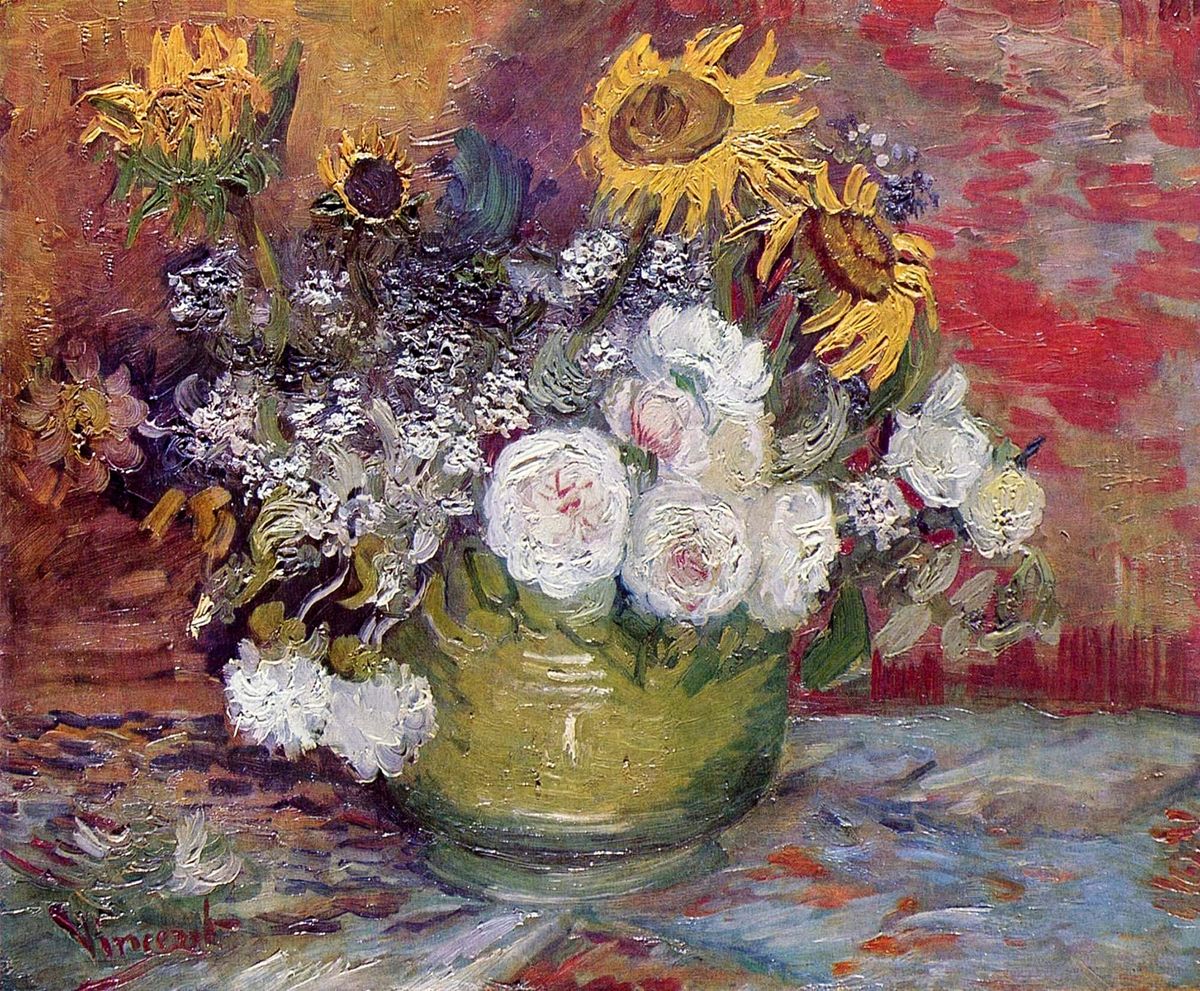
빈센트 반 고흐(Vincent van Gogh, 1853–1890)가 1886년 늦여름 프랑스 파리 체류 시절 완성한 '해바라기와 다른 꽃들이 있는 정물(Still Life with Sunflowers and Other Flowers)'은 캔버스에 유채(Oil on canvas)로 제작된 정물화입니다. 작품의 실제 규격은 세로 50.0cm, 가로 61.0cm이며, 현재 독일 만하임 시립미술관(Kunsthalle Mannheim)에 영구 소장되어 있습니다.
고흐는 이 작품에서 화면 상단을 불타오르듯 가로지르는 짙은 루비 레드와 적갈색 배경 위에, 올리브 그린빛 도자기 화병과 그 안에서 화려하게 만개한 다양한 꽃들의 유기적인 생명력을 응축했습니다. 순백의 풍성한 장미와 안개꽃처럼 흩뿌려진 소국들, 그리고 그 위로 고개를 치켜든 황금빛 해바라기의 잎사귀들은 두텁게 물감을 빚어 올린 임파스토(Impasto) 기법으로 조각되어 입체적인 양감을 과시합니다. 화면 좌측 하단에는 붉은색 안료로 화가의 서명 'Vincent'가 굵고 힘찬 필치로 새겨져 있습니다.
이 그림에는 반 고흐가 파리에 도착한 직후 인상주의의 찬란한 빛에 눈을 뜨며 '꽃의 화가'로 거듭나기 위해 치열하게 붓을 휘둘렀던 눈물겨운 인간적 에피소드와 흥미진진한 비하인드 스토리가 깃들어 있습니다. 1886년 봄, 네덜란드의 어두운 흙빛을 뒤로하고 파리 몽마르트르에 있던 동생 테오의 아파트에 도착한 고흐는 클로드 모네와 르누아르의 화려한 색채를 목격하고 엄청난 충격에 휩싸였습니다. 고흐는 자신이 평생 써왔던 칙칙하고 어두운 갈색 톤을 하루빨리 벗겨내고 찬란한 원색을 자유자재로 다루기를 간절히 갈망했습니다.
하지만 당시 고흐는 지독하게 가난하여 인물 모델을 살 돈이 없었습니다. 그러자 고흐의 딱한 사정을 알게 된 몽마르트르의 친절한 이웃 화가들과 화방 주인, 그리고 동생 테오가 시장에서 각양각색의 싱싱한 꽃다발을 사다 주었습니다. 고흐는 좁은 방 안에서 꽃들이 시들어 버리기 전에 색채를 낚아채겠다는 일념으로, 1886년 여름 단 몇 달 동안 무려 30여 점이 넘는 꽃 정물화를 폭발적으로 쏟아냈습니다.
당시 고흐는 동생 테오에게 보낸 편지에서 "나는 지금 맹렬하게 꽃을 그리고 있다. 붉은 양귀비, 푸른 수레국화, 흰 장미, 그리고 노란 해바라기를 연속해서 그리며 보색의 충돌과 조화를 온몸으로 훈련하고 있다. 꽃은 지독한 가난 속에서도 내게 색채의 순수한 기쁨을 가르쳐주는 가장 거룩한 스승이다"라고 털어놓았습니다. 방 안 가득 풍기는 꽃향기와 유화 물감 냄새 속에서 땀을 비 오듯 흘리며 붓을 휘두르던 붉은 수염의 고흐에게 이 정물화 작업은, 훗날 전 세계를 뒤흔든 '아를의 해바라기 연작'을 탄생시킨 가장 눈부신 예술적 요람이었습니다.
후대의 미술사학자들과 평단은 이 만하임 소장본을 반 고흐가 어두운 네덜란드 화풍의 껍질을 깨고 나와 파리의 모더니즘 색채 감각을 완벽히 흡수했음을 알린 기념비적인 출발점으로 평가합니다. 우아하게 정돈된 전통 정물화의 틀을 깨고 맹렬한 붓 터치와 원색의 강렬한 충돌을 통해 꽃에 생명과 영혼의 진동을 불어넣은 이 조형적 성취는 20세기 표현주의 회화의 문을 연 위대한 걸작으로 찬사를 받고 있습니다.
관람자의 시선은 가장 먼저 화병 전면을 가득 채우며 소용돌이치는 순백의 장미 꽃송이들의 두터운 임파스토 질감과 화사한 볼륨감에 사로잡힙니다. 이어 꽃다발 상단과 우측에서 사방으로 뻗어 나가는 거친 황금빛 해바라기들의 날카로운 꽃잎 율동감을 타고 올라간 뒤, 좌측 하단의 강렬한 붉은 서명 'Vincent'와 푸른빛이 감도는 테이블보의 사선 붓 터치로 내려옵니다. 마지막으로 배경 전체를 붉게 물들이며 진동하는 루비 레드의 정열적인 붓질을 따라 화면 전체로 유려하게 순환하게 됩니다.
심리적으로 관람자는 붉은 배경과 순백의 장미, 황금빛 해바라기가 뿜어내는 생생한 생명력의 하모니 속에서 깊은 정서적 정화와 따스한 위안을 경험하게 됩니다. 곤궁한 현실 속에서도 꽃을 통해 순수한 색채의 환희를 길어 올렸던 화가의 진솔한 열정은 현대인의 마음에 쌓인 피로와 공허함을 따뜻하게 녹여주며, 지친 영혼에 어떤 시련 속에서도 다시 피어나는 희망과 내면의 깊은 평온을 풍성하게 채워줍니다.
Still Life with Sunflowers and Other Flowers (Sunflowers, Roses and Other Flowers in a Bowl)
Painted by Vincent van Gogh (1853–1890) in Paris during the late summer of 1886, Still Life with Sunflowers and Other Flowers is an iconic oil on canvas masterpiece measuring 50.0 cm in height and 61.0 cm in width. This celebrated work is permanently preserved in the renowned collection of the Kunsthalle Mannheim in Mannheim, Germany.
Van Gogh constructed the composition around an audacious chromatic symphony, contrasting a fiery, textured ruby-red and terracotta background with the cool olive glaze of a ceramic bowl brimming with blossoms. The lush white cabbage roses and delicate filler blooms are sculpted with dense, creamy impasto that gives tangible relief to the petals, while the radiant golden sunflowers crowning the bouquet introduce dynamic linear movement. In the lower left corner, the artist boldly applied his signature: Vincent.
The canvas holds an intimate history of relentless artistic reinvention and creative joy amidst intense Parisian poverty. In the spring of 1886, having moved into his brother Theo’s Montmartre apartment, Van Gogh was utterly transformed by the luminous, optical brilliance of the Impressionists. Desperate to purge the somber umbers of his Dutch roots and master complementary color theory, but unable to afford live models, he turned entirely to botanical arrangements.
Supportive friends, local shopkeepers, and Theo regularly brought fresh bouquets to their cramped quarters. Racing against the rapid wilting of the fresh petals, Van Gogh painted over thirty floral still lifes in rapid succession during the summer of 1886. Writing to his English friend Horace M. Livens, Van Gogh reflected: "I have made a series of color studies in painting... simply flowers, red poppies, cornflowers, white roses, and yellow chrysanthemums, seeking oppositions of blue with orange, red and green, yellow and violet." This intensive workshop in Paris directly provided the technical and emotional foundation for his iconic sunflower masterworks in the south of France.
Modern art historians celebrate this Mannheim masterpiece as the vital bridge where Van Gogh liberated his brushwork and chromatic palette. By replacing photographic description with visceral, textured emotion, Van Gogh elevated the traditional salon still life into an unvarnished spiritual celebration of living light and natural abundance.
A viewer’s gaze is instantaneously magnetized by the thick, sculptural white roses swirling at the center of the bouquet. The eyes then ascend through the spiky, golden ribbons of the sunflowers reaching toward the upper right, before descending along the earthen curves of the glazed green bowl to the prominent red signature on the left. Finally, the gaze circulates effortlessly through the fiery, diagonal currents of the crimson backdrop, encompassing the entire harmonious composition.
Psychologically, immersion in this rich dialogue of pure white, luminous yellow, and warm vermilion induces an immediate sensation of emotional uplift, clarity, and inner vitality. The artist's triumphant discovery of joyful light amidst difficult circumstances dissolves modern stress and mental exhaustion, enveloping the observer in an enduring atmosphere of creative warmth, steadfast hope, and restorative peace.
본 리뷰에서 작품을 제외한 컨텐츠의 저작권은 팔렛트제주에 있습니다.
"퍼블릭도메인 고전명화"를 제외한 모든 창작 콘텐츠는 저작권법 제4조 및 제10조에 의거하여 보호됩니다. 무단 도용시 저작권법 제136조(벌칙)에 의거, 당사의 사전 서면 승인 없는 저작권 침해 행위를 금지합니다.