해바라기 (열다섯 송이 해바라기) - Sunflowers (Fifteen Sunflowers in a Vase)
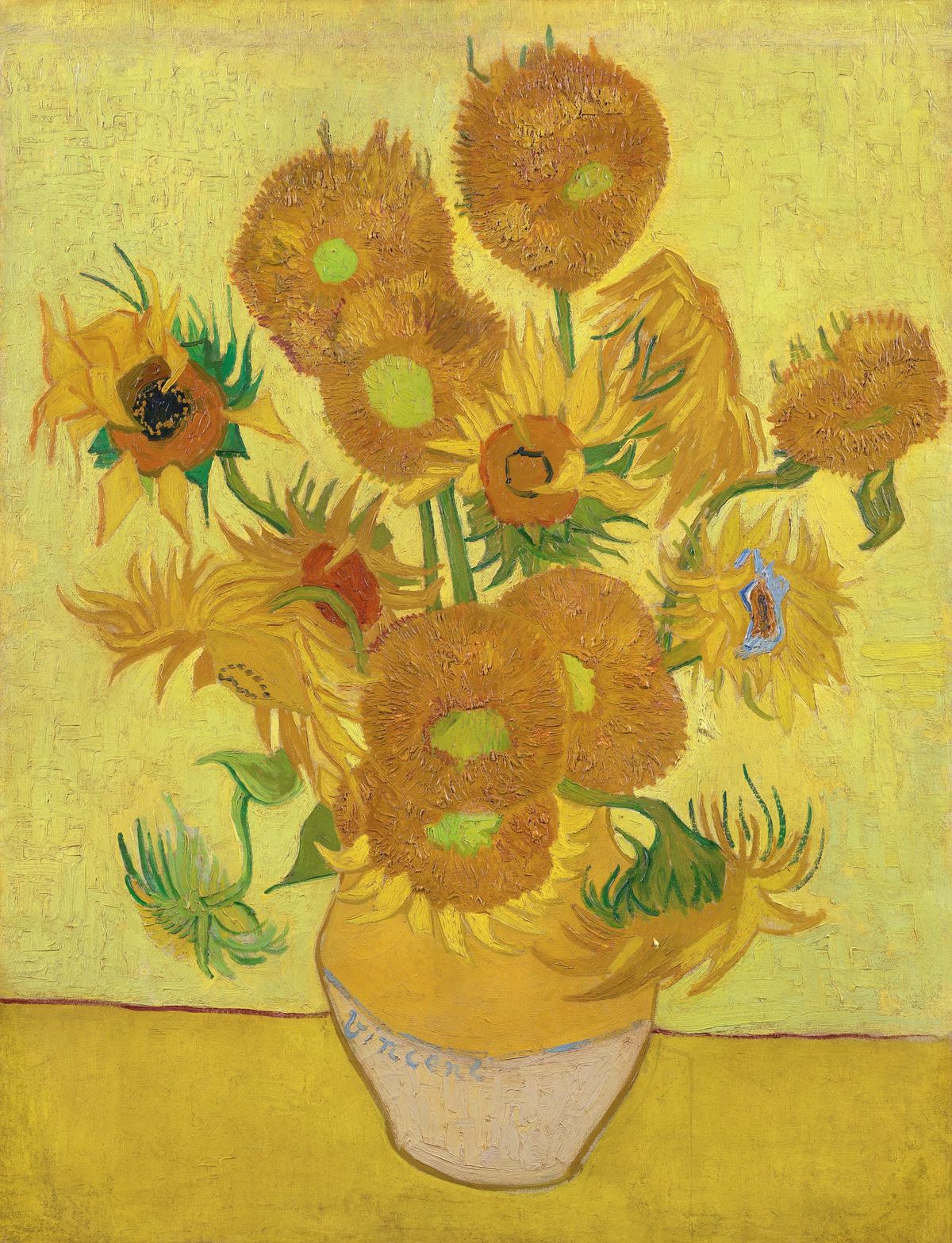
빈센트 반 고흐(Vincent van Gogh, 1853–1890)가 1888년 8월 프랑스 남부 아를(Arles)의 노란 집에서 완성한 '해바라기(Sunflowers)'는 캔버스에 유채(Oil on canvas)로 제작된 정물화입니다. 작품의 실제 규격은 세로 92.1cm, 가로 73.0cm이며, 현재 영국 런던의 내셔널 갤러리(The National Gallery, London)에 영구 소장되어 있습니다.
고흐는 이 작품에서 배경, 테이블, 화병, 꽃잎에 이르기까지 화면의 90% 이상을 오직 '노란색'이라는 단일 계열의 무한한 변주로 채워 넣는 파격적인 색채 실험을 감행했습니다. 레몬 옐로, 크롬 옐로, 오커, 황갈색이 빚어내는 황금빛 교향곡 속에서 꽃술의 청록색 점들과 화병을 가로지르는 푸른 윤곽선은 절묘한 보색 대비를 이룹니다. 꽃잎과 씨앗 머리를 빚어내듯 두텁게 얹어 올린 특유의 임파스토(Impasto) 기법은 조각 같은 부조적 질감을 형성하며, 꽃들의 다양한 생애 주기(피어남, 만개, 시듦)를 통해 자연의 순환과 폭발적인 생명력을 응축해 냅니다. 화병 중앙에는 푸른색 안료로 화가의 서명 'Vincent'가 선명하게 새겨져 있습니다.
이 그림에는 고흐가 평생 꿈꾸었던 '남프랑스 예술가 공동체'의 결성을 앞두고, 동료 폴 고갱(Paul Gauguin)을 맞이하기 위해 온 영혼의 불꽃을 태웠던 눈물겹고도 가슴 벅찬 인간적 에피소드가 깃들어 있습니다. 1888년 늦여름, 아를의 '노란 집'으로 고갱이 내려온다는 확답을 받은 고흐는 뛸 듯이 기뻐하며 친구의 침실을 온통 찬란한 태양빛으로 장식할 거대한 해바라기 연작을 기획했습니다. 프로방스의 뜨거운 뙤약볕 아래서 해바라기가 빠르게 시들어 버리기 전에 포착해야 했던 고흐는 매일 새벽 해가 뜨기도 전에 들판으로 달려가 꽃을 꺾어왔습니다.
당시 고흐는 식사도 잊고 화실에 틀어박혀 하루에 12시간씩 미친 듯이 붓을 휘둘렀습니다. 그는 동생 테오에게 보낸 편지에서 "매일 아침 해가 뜨자마자 작업을 시작한다. 꽃들은 금방 시들어버리기 때문에 단숨에 한 호흡으로 그려내야 한다. 고갱의 방을 온통 찬란한 해바라기들로 가득 채워 그에게 감동을 선물하고 싶다. 촛대처럼 타오르는 이 노란 꽃들이야말로 남부의 찬란한 빛이자 진정한 감사의 상징이다"라며 아이처럼 순수한 환희를 털어놓았습니다.
아를의 마을 사람들은 덧창을 굳게 닫은 차가운 화실에서 땀을 비 오듯 흘리며 노란색 물감을 빵에 버터 바르듯 캔버스에 짓이기던 붉은 머리의 고흐를 기이하게 바라보았습니다. 하지만 고흐에게 해바라기는 단순한 식물이 아니라, 지독한 고독의 터널을 지나 마침내 찾아올 진정한 벗을 향한 가장 숭고한 환대의 징표이자 자신의 예술혼 그 자체였습니다. 고갱이 마침내 노란 집에 도착했을 때, 방 안 가득 걸린 이 눈부신 해바라기들을 보고 넋을 잃은 채 "이것이야말로 완벽한 노란색의 기적이다. 세상에서 꽃을 이렇게 살아 숨 쉬게 그릴 수 있는 화가는 빈센트 너뿐이다"라며 깊은 경탄을 표했습니다.
후대의 미술사학자들과 평단은 이 런던 내셔널 갤러리 소장본을 반 고흐의 전 생애를 통틀어 가장 높은 색채적 순도와 조형적 완결성을 지닌 불멸의 정물화이자 서양 미술사의 최고 걸작으로 평가합니다. 빛과 색채의 광학적 법칙을 영적 감동의 차원으로 승화시키며 '노란색'이라는 색채에 영원한 생명을 부여한 이 조형적 성취는 20세기 현대 미술과 표현주의의 탄생을 알린 위대한 이정표로 찬사를 받고 있습니다.
관람자의 시선은 가장 먼저 화병 중심부와 상단에서 빽빽한 씨앗을 품고 거대한 솜뭉치처럼 소용돌이치는 황금빛 해바라기 머리들의 두터운 질감에 사로잡힙니다. 이어 사방으로 불꽃처럼 뻗어나간 날카로운 꽃잎들과 좌우로 늘어진 녹색 잎사귀들의 리드미컬한 곡선을 타고 내려와, 투톤으로 나뉜 단아한 도자기 화병과 그 위에 푸르게 새겨진 'Vincent' 서명에 머물게 됩니다. 마지막으로 태양빛으로 물든 화사한 노란 배경의 직조된 붓 터치를 따라 화면 전체로 유려하게 순환하게 됩니다.
심리적으로 관람자는 온 화면을 가득 채운 황금빛 태양의 온기와 꽃송이들이 뿜어내는 찬란한 생명력 속에서 깊은 정서적 충만감과 따스한 위안을 경험하게 됩니다. 소중한 벗을 향한 순수한 헌신과 열정으로 빚어낸 화가의 따뜻한 온도는 현대인의 마음에 자리한 공허함과 피로를 부드럽게 녹여주며, 어떤 시련 앞에서도 꺼지지 않는 삶의 불굴의 희망과 내면의 깊은 평온을 풍성하게 채워줍니다.
Sunflowers (Fifteen Sunflowers in a Vase)
Painted by Vincent van Gogh (1853–1890) in the Yellow House in Arles in August 1888, Fifteen Sunflowers in a Vase is an iconic oil on canvas masterpiece measuring 92.1 cm in height and 73.0 cm in width. This celebrated masterwork is permanently preserved in the prestigious collection of The National Gallery in London, United Kingdom.
Van Gogh constructed this legendary still life through an unprecedented symphony of yellow, harmonizing chrome yellows, glowing ochres, and ambers across the blooms, vase, and background. By introducing subtle turquoise centers within the seed heads and a crisp blue contour along the ceramic vase, he created a refined chromatic vibration that prevents the monochromatic field from flattening. The dense, sculptural impasto mimics the tangible physical texture of the drying seeds and twisting petals, celebrating the entire life cycle of the flower from budding vitality to mature decay, with 'Vincent' inscribed proudly in blue across the waist of the vase.
The canvas holds an intimate history of profound creative ecstasy and fraternal generosity. In late August 1888, upon learning that Paul Gauguin had agreed to join him in Arles to establish the "Studio of the South," Van Gogh was overwhelmed with joy and immediately launched a decorative suite to furnish his friend’s bedroom. Because the southern summer heat caused the cut blooms to wilt rapidly, he woke before sunrise each day to capture them with continuous, rapid execution.
Writing to his brother Theo, Van Gogh described his frantic labor: "I am painting with the gusto of a Marseillais eating bouillabaisse... The whole thing will be a symphony in blue and yellow. I am working on it every morning from sunrise on, for the flowers fade so quickly." Working inside his shuttered studio, drenched in sweat and consuming little food, Van Gogh poured his vital essence into the canvas. For him, the sunflower was not merely an agricultural plant, but a sacred emblem of solar energy, gratitude, and warm hospitality.
When Gauguin finally arrived at the Yellow House, he stood mesmerized before these radiant canvases, later remarking that Van Gogh had achieved something completely unique in modern art and painting a dedicated portrait of Van Gogh at work on them. Even after their friendship ended in tragedy, Gauguin treasured the memory of these golden blossoms for the rest of his life.
Modern art historians celebrate this London masterpiece as a defining pinnacle of Post-Impressionism. By transmuting botanical realism into a transcendent hymn of pure color and emotional devotion, Van Gogh redefined the boundaries of still-life painting, leaving an eternal monument to human resilience and creative light.
A viewer’s gaze instinctively settles upon the dense, tactile seed heads clustering at the center of the bouquet. The eyes then ascend through the dynamic, flame-like petals crowning the top, before tracing the drooping green stems and curling leaves down to the clean horizontal line of the earthenware pot and the blue signature. Finally, the gaze circulates effortlessly through the radiant, woven yellow atmosphere of the surrounding background.
Psychologically, immersion in this glowing golden-yellow harmony induces an immediate sensation of emotional warmth, clarity, and inner vitality. The pure generosity and luminous optimism embedded in each brushstroke gently dissolve internal fatigue and anxiety, enveloping the observer in an enduring atmosphere of creative warmth, steadfast joy, and restorative peace.
본 리뷰에서 작품을 제외한 컨텐츠의 저작권은 팔렛트제주에 있습니다.
"퍼블릭도메인 고전명화"를 제외한 모든 창작 콘텐츠는 저작권법 제4조 및 제10조에 의거하여 보호됩니다. 무단 도용시 저작권법 제136조(벌칙)에 의거, 당사의 사전 서면 승인 없는 저작권 침해 행위를 금지합니다.