해바라기 (네 송이의 잘린 해바라기) - Sunflowers (Four Cut Sunflowers)
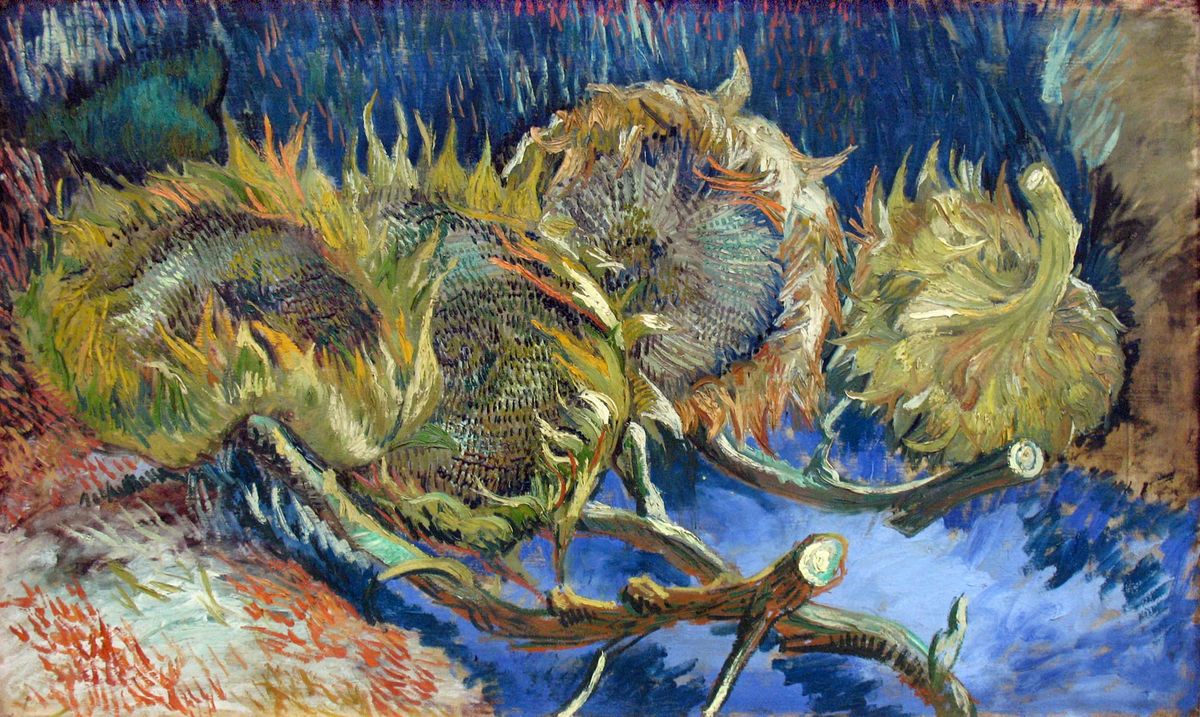
빈센트 반 고흐(Vincent van Gogh, 1853–1890)가 1887년 8월에서 9월 사이 프랑스 파리 몽마르트르 체류 시절 완성한 '해바라기(Four Cut Sunflowers)'는 캔버스에 유채(Oil on canvas)로 제작된 정물화입니다. 작품의 실제 규격은 세로 60.0cm, 가로 100.0cm의 웅장한 파노라마 비율을 지니고 있으며, 현재 네덜란드 오테를로의 크뢸러 뮐러 미술관(Kröller-Müller Museum)에 영구 소장되어 있습니다.
고흐는 이 작품에서 테이블이나 바닥에 꺾여 나란히 누운 네 송이 해바라기의 원초적 형태를 파격적인 수평 구도로 포착했습니다. 짙은 울트라마린 블루와 코발트 블루로 소용돌이치는 배경 위에 황금빛 오커, 크롬 옐로, 타오르는 주황빛으로 말려 들어간 꽃잎들을 얹어 극적인 보색 대비를 완성했습니다. 신인상주의 점묘법을 자신만의 선묘적 필치로 변용한 빗살무늬 붓 터치와 두터운 임파스토(Impasto) 기법은, 거대한 씨앗 머리의 빽빽한 질감과 꺾인 줄기의 단면을 조각하듯 생생하게 살려냈습니다. 화면 좌측 하단에는 붉은 갈색 안료로 'Vincent'라는 서명을 새겨 넣었습니다.
이 그림에는 반 고흐와 폴 고갱(Paul Gauguin)의 운명적인 예술적 교감, 그리고 고갱의 평생에 걸친 '해바라기 집착'을 촉발한 흥미진진한 비하인드 스토리가 깊게 배어 있습니다. 1887년 가을, 파리 몽마르트르에서 고흐는 화병에 담긴 정형화된 꽃 대신, 들판에서 꺾여 씨앗을 품고 말라가는 해바라기들을 바닥에 늘어놓고 대형 연작을 그렸습니다. 당시 무명 화가였던 고흐의 작업실을 방문한 고갱은 캔버스 위에서 맹렬한 불꽃처럼 타오르는 이 네 송이 해바라기를 보고 엄청난 충격을 받았습니다.
고갱은 고흐에게 간곡히 청하여 자신의 마르티니크 풍경화 두 점과 이 파리 해바라기 그림들을 맞바꾸었습니다. 당대 인정받던 고갱이 자신의 작품을 최고의 걸작으로 인정해 주자, 깊은 감동을 받은 고흐는 훗날 아를로 내려가 '해바라기'를 자신의 상징이자 고갱을 맞이하기 위한 환대의 징표로 삼게 되었습니다.
고갱의 이 그림에 대한 애착은 두 사람이 아를에서 비극적으로 결별한 후에도 멈추지 않았습니다. 고갱은 파리로 돌아간 뒤에도 고흐에게 편지를 보내 해바라기 그림을 더 달라고 집요하게 요구했고, 훗날 남태평양 타히티로 떠난 말년에도 파리에서 고흐와 함께했던 시절을 그리워하며 프랑스에서 해바라기 씨앗을 주문해 정원에 심고 '해바라기를 그리는 반 고흐'의 모습을 추억하며 그림을 남겼습니다. 이 네 송이의 꺾인 해바라기는 두 거장의 불꽃 같았던 예술적 우정과 라이벌 의식을 영원히 묶어준 전설적인 출발점이었습니다.
후대의 미술사학자들과 평단은 이 크뢸러 뮐러 소장본을 반 고흐가 어두운 네덜란드 화풍을 완벽히 청산하고 파리의 색채 혁명을 집대성한 정물화의 최고봉으로 평가합니다. 만개한 화려함 뒤에 찾아오는 시듦과 결실의 순간을 숭고한 침묵과 생명력으로 승화시킨 이 걸작은, 세상의 냉대와 가난 속에서도 예술혼을 불태웠던 반 고흐 자신의 처절한 자화상이자 20세기 표현주의의 길을 연 불멸의 유산으로 찬사를 받고 있습니다.
관람자의 시선은 가장 먼저 화면 좌측과 중앙에서 거대한 소용돌이처럼 빽빽한 질감을 드러내는 두 송이 해바라기의 씨앗 머리에 강렬하게 사로잡힙니다. 이어 비틀린 줄기와 꽃받침의 사선 리듬을 타고 우측의 뒤집힌 채 얽혀 있는 세 번째, 네 번째 해바라기의 거친 꽃잎들로 이동한 뒤, 캔버스 좌측 하단의 붉은 서명 'Vincent'로 내려옵니다. 마지막으로 화면 상단과 하단을 짙게 감싸며 진동하는 푸른빛 배경과 붉은 바닥의 빗살무늬 붓 터치를 따라 화면 전체로 유려하게 순환하게 됩니다.
심리적으로 관람자는 짙푸른 어둠 속에서도 식지 않고 타오르는 황금빛 태양의 잔열과 식물의 굳건한 생명력에서 깊은 정서적 정화와 경외감을 느끼게 됩니다. 꺾여 있는 운명 앞에서도 찬란한 결실을 품어내는 해바라기의 단단한 에너지는 현대인의 마음에 자리한 피로와 상실감을 따뜻하게 어루만져 주며, 삶의 어떠한 시련 속에서도 결코 꺾이지 않는 불굴의 회복 탄력성과 내면의 깊은 평온을 풍성하게 채워줍니다.
Sunflowers (Four Cut Sunflowers)
Painted by Vincent van Gogh (1853–1890) in Paris between August and September 1887, Four Cut Sunflowers is an iconic oil on canvas still life measuring 60.0 cm in height and 100.0 cm in width. This celebrated masterwork is permanently preserved in the prestigious collection of the Kröller-Müller Museum in Otterlo, Netherlands.
Van Gogh established a bold, panoramic compositional structure by capturing four severed sunflower heads resting horizontally upon a ground. Against an undulating background of deep ultramarine and cobalt blue, he orchestrated a fiery harmony of golden ochres, chrome yellows, and blazing amber tones. Adapting Neo-Impressionist mark-making into directional, linear impasto strokes, he sculpted the dense, granular texture of the seed cores and the twisted contours of the stems with extraordinary physical presence, signing 'Vincent' in the lower left corner.
The canvas holds an intimate history as the catalyst that forged the legendary artistic relationship between Van Gogh and Paul Gauguin. In late 1887, Gauguin visited Van Gogh’s studio in Montmartre and was utterly spellbound by the raw vitality of these large cut sunflower studies.
Recognizing a revolutionary mastery of form and color, Gauguin traded two of his own prized Martinique landscapes for Van Gogh's cut sunflower canvases. For Van Gogh, receiving such high validation from a respected avant-garde peer provided immense creative confidence, permanently establishing the sunflower as his personal emblem and directly inspiring the legendary decorative suite for the Yellow House in Arles.
Gauguin’s fascination with Van Gogh’s sunflowers endured for the rest of his life. Even after their turbulent split in the south of France, Gauguin repeatedly wrote requesting sunflower paintings. Decades later, while living in Tahiti, plagued by declining health and profound nostalgia, Gauguin had sunflower seeds sent from France to grow in his tropical garden, painting homage pieces to the departed friend whose vision had fundamentally marked his own.
Modern art historians celebrate this Kröller-Müller masterpiece as the ultimate culmination of Van Gogh’s Parisian color revolution. By depicting the flowers not in fresh bloom, but in the dignified, seed-bearing stage of maturity, the painting serves as an enduring metaphor for the artist's own resilient existence—persevering through material hardship to yield lasting spiritual and creative sustenance.
A viewer’s gaze is instantaneously seized by the dark, textured vortex of the primary seed heads dominating the left-center of the canvas. The eye then follows the energetic, flame-like twists of the drying petals and tangled stems across to the upturned blooms on the right, before descending toward the artist's signature in the lower left. Finally, the gaze expands into the rhythmic blue strokes of the background, circulating continuously through the wide, harmonious composition.
Psychologically, witnessing the indestructible warmth and organic dignity preserved within these severed blossoms evokes an immediate sensation of catharsis, grounded fortitude, and emotional reassurance. The incandescent golden-yellows set against tranquil blues dissolve subconscious fatigue and anxiety, enveloping the observer in an enduring atmosphere of creative resilience, inner strength, and restorative peace.
본 리뷰에서 작품을 제외한 컨텐츠의 저작권은 팔렛트제주에 있습니다.
"퍼블릭도메인 고전명화"를 제외한 모든 창작 콘텐츠는 저작권법 제4조 및 제10조에 의거하여 보호됩니다. 무단 도용시 저작권법 제136조(벌칙)에 의거, 당사의 사전 서면 승인 없는 저작권 침해 행위를 금지합니다.