광대 칼라바사스 (Portrait of the Jester Calabazas)
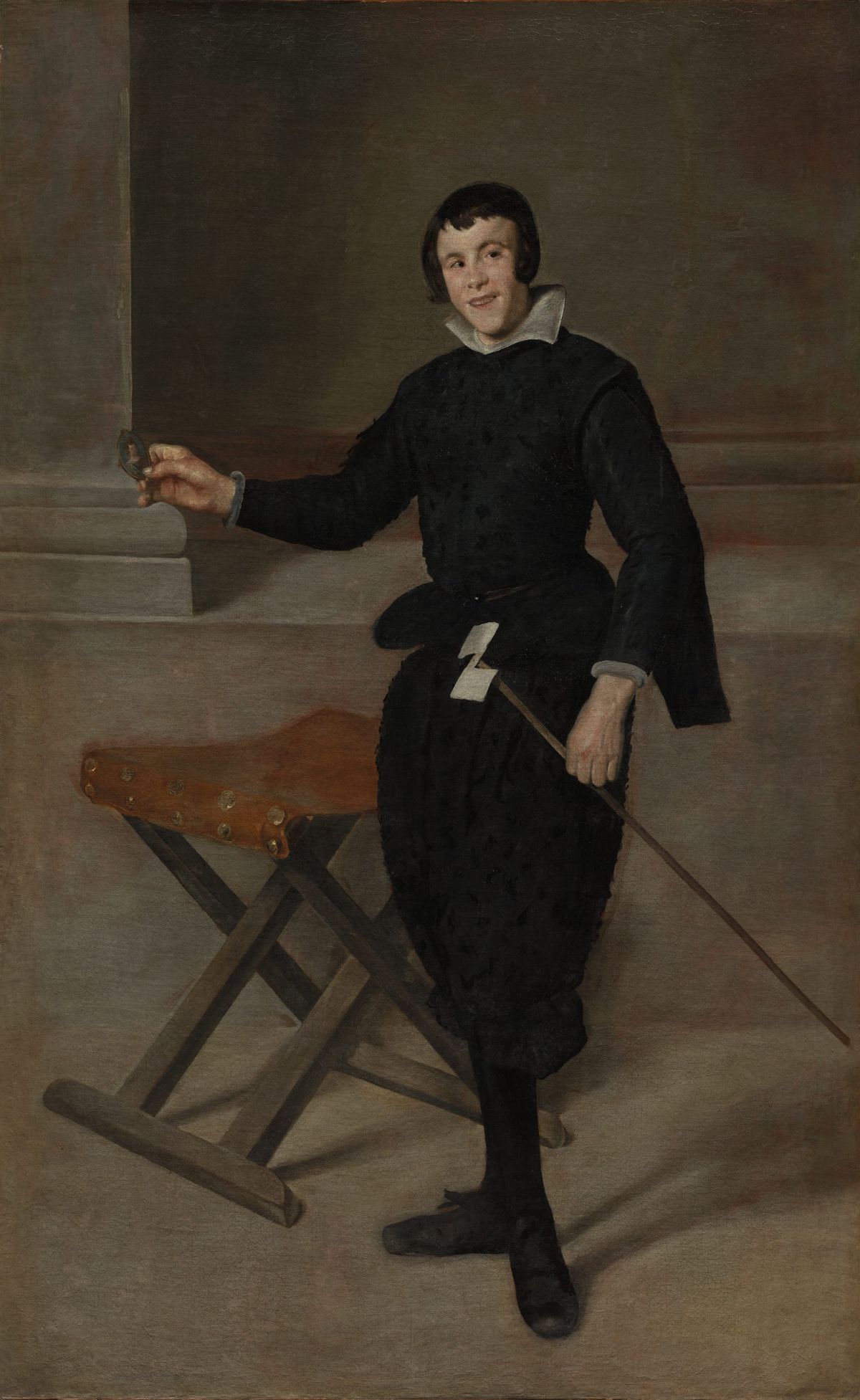
광대 칼라바사스 (Portrait of the Jester Calabazas)
이 작품은 스페인 바로크 회화의 거장 디에고 벨라스케스가 1631~1632년경 펠리페 4세의 궁정 광대였던 칼라바사스를 화폭에 담아낸 명작으로, 사회적 소외계층을 격조 높은 품격과 인간적 존엄성으로 재해석한 벨라스케스 특유의 숭고한 통찰력이 돋보이는 대표작입니다. 화가는 단순한 코미디언으로서의 외형적 과시나 희화화를 배제한 채, 검은 연주복 형태의 단정한 의상과 흰 크라바트를 착용한 칼라바사스의 기품 있는 자태를 정교하게 묘사했습니다. 오른손에 작은 미니어처 초상화를 들고 왼손에는 긴 지팡이를 쥔 그의 포즈는, 궁정이라는 엄격한 공간 속에서 해학으로 인간의 내면을 비추었던 인물의 지적 정체성과 스페인 황금기 회화가 지닌 고유한 미학적 아우라를 생생하게 전해줍니다.
감상자가 이 그림을 볼 때 직관적으로 깨닫지 못하지만 무의식적으로 매료되는 시각적 흐름의 핵심은 바로 '오른손의 미니어처 초상화에서 출발하여 흰 목깃을 거쳐 하단의 접이식 의자로 낙하하는 수직·사선 균형 구도'입니다. 화면 좌측 중앙, 손끝에 들린 작은 미니어처 프레임은 관람객의 무의식적 시선을 끌어당기는 섬세한 조형적 출발점 역할을 합니다. 관람객의 시선은 인물의 손목을 타고 올라가 정갈하게 빛나는 흰 목깃과 미묘한 미소를 머금은 칼라바사스의 얼굴에 고정되며, 이어 오른손의 지팡이 라인을 따라 좌측 하단의 기하학적인 원목 접이식 의자와 차분한 바닥 음영 속으로 수평·사선 방향으로 빠져나가게 됩니다.
이 무의식적인 시선의 이동은 관람객으로 하여금 신분과 역할에 상관없이 한 인간이 품은 내면의 고결함과 정서적 정직함을 시각적으로 체감하게 만듭니다. 어두운 단색조 배경과 인물의 검은 제복이 만들어내는 깊이감, 그리고 흰 목깃과 손 끝에 떨어진 빛의 극적인 명암 대조는 궁정 광대라는 인물의 존재감을 화면 중심에서 명징하게 부각시키는 벨라스케스 특유의 명암적 프레임으로 작용합니다. 정면을 응시하는 맑은 눈빛과 단정한 자세는 어떠한 희화화에도 굴하지 않는 인물의 내면적 자부심을 은유합니다.
디에고 벨라스케스는 고전주의적 정교한 필치와 세비야 화파 고유의 사실주의적 절제를 결합하여 궁정 광대의 삶을 숭고한 예술적 서사로 승화시켰습니다. 인물의 단순한 외형을 넘어 인간 본연의 품격과 고요한 정신성을 화폭 위에 정직하고 아름답게 증명해 낸 이 작품은, 스페인 궁정 미술사에서 인물화가 도달한 기술적·인간학적 정점을 가감 없이 보여주는 불후의 걸작입니다.
Portrait of the Jester Calabazas (Diego Velázquez)
Executed around 1631–1632 by Diego Velázquez—the monumental master of Spanish Baroque painting—this celebrated masterpiece depicts Juan Calabazas, a court jester in the royal household of King Philip IV. The canvas exemplifies Velázquez’s sublime insight in reinterpreting socially marginalized figures with dignified poise and profound human dignity. Eschewing caricature or overt theatricality, the painter exquisitely renders Calabazas attired in a refined black doublet with a crisp white collar. Holding a miniature portrait delicately in his right hand and a long cane in his left, his posture vividly imparts the intellectual identity of a figure who reflected human nature through humor within the rigid court, as well as the unique aesthetic aura of Golden Age Spanish painting.
While viewers may not consciously realize it, the key visual mechanism that unconsciously draws the eye is a balanced vertical and diagonal framework that originates from the miniature portrait held in his right hand, ascends toward the white collar, and descends toward the folding stool in the lower register. On the left side of the canvas, the small miniature frame held at his fingertips acts as a subtle compositional anchor that captures the spectator's subconscious gaze. The line of sight glides up his arm, lodges firmly upon his immaculate white collar and his face framed by a subtle smile, and then travels along the diagonal line of the cane toward the geometric wooden folding stool and muted floor shadows on the lower left.
This subconscious visual progression allows the viewer to physically experience the intrinsic nobility and emotional honesty of a human being, regardless of status or role. The depth created by the dark monochromatic backdrop and his black attire, coupled with the dramatic chiaroscuro illuminating the white collar and hands, functions as a signature Velázquez frame that elevates the jester’s presence to the focal point of the canvas. His clear gaze looking forward and his composed stance symbolize an inner pride untouched by mockery.
Velázquez seamlessly fuses the rigorous precision of Neoclassical draftsmanship with the restrained realism of the Sevillian school, elevating a court jester's life into a sublime artistic narrative. Moving far beyond a simple likeness to quietly capture the subject's spiritual dignity and human nobility, this canvas stands as an enduring masterpiece that demonstrates the technical and humanistic pinnacle of Spanish portraiture.
본 리뷰에서 작품을 제외한 컨텐츠의 저작권은 팔렛트제주에 있습니다.
"퍼블릭도메인 고전명화"를 제외한 모든 창작 콘텐츠는 저작권법 제4조 및 제10조에 의거하여 보호됩니다. 무단 도용시 저작권법 제136조(벌칙)에 의거, 당사의 사전 서면 승인 없는 저작권 침해 행위를 금지합니다.