관에 누운 여인 A Woman Laid Out for Burial
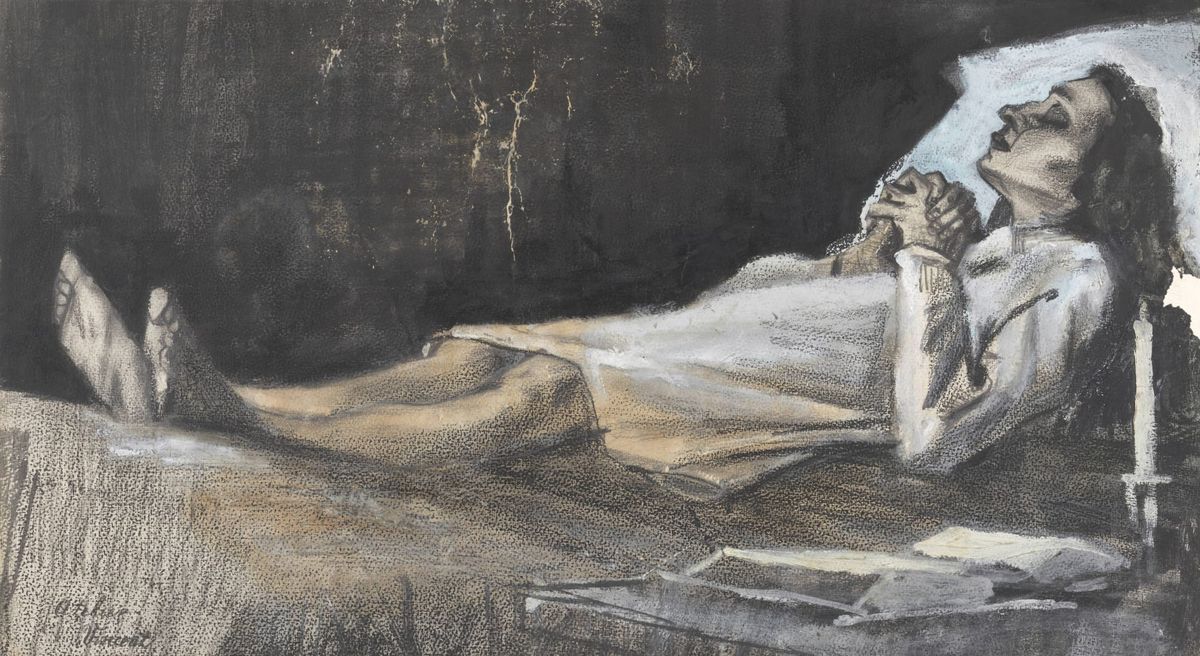
빈센트 반 고흐(Vincent van Gogh, 1853–1890)는 1883년 네덜란드 헤이그에 체류하던 시기에 삶과 죽음의 경계에 놓인 인간의 비극적인 현실과 묵직한 슬픔을 담아내는 드로잉 작업을 진행했습니다.
이 작품은 1883년 4월에 제작된 블랙 초크, 과슈, 펜, 붓 등을 활용한 혼합 매체 드로잉으로, 야콥 바르트 드 라 파이유의 전작 도록 기준 공식 등록번호는 F1029이며 실제 작품의 실측 규격은 29.5 × 54.5 cm입니다.
현재 네덜란드 암스테르담에 위치한 반 고흐 미술관에서 소장하고 있습니다.
작가의 고뇌와 비하인드
헤이그 시절 고흐는 동거하며 삶의 위안을 삼았던 전직 매춘부이자 알코올 중독자인 시엔 호른과 그녀의 무너져가는 가족을 부양하며 극심한 가난과 사회적 냉대에 시달렸고, 결국 시엔의 어머니 혹은 가족이 사망했을 때 마주한 참혹한 현실에 큰 충격을 받았습니다.
당시 그는 가난과 죽음이 소용돌이치는 비참한 일상 속에서 사회적으로 버림받은 이들이 맞이하는 쓸쓸한 마지막을 지켜보며, 인간의 허무함과 절박한 심경을 고스란히 화폭에 담아내고자 했습니다.
화면 전면에는 짙은 어둠 속에서 관에 누워 있는 여인의 발끝과 침상 아래 놓인 성경책, 그리고 희미하게 타오르는 촛불의 실루엣이 거칠고 무거운 필치로 표현되어 있습니다.
중경에는 하얀 수의를 입은 채 두 손을 가슴에 모으고 누워 있는 여인의 앙상한 상체와 숙연한 표정이 극적인 명암 대비 속에 자리 잡고 있습니다.
원경의 배경에는 모든 빛이 차단된 듯한 칠흑 같은 어둠이 에워싸고 있어, 비참한 생의 굴레를 벗어나 영원한 안식에 든 이의 절대적인 적막을 묵직하게 완성합니다.
무의식 속 시선 및 심리 흐름
관람객의 시선은 가장 먼저 화면 왼쪽 하단에 묵직하게 드러난 여인의 차가운 발끝과 촛불이 밝히는 침상의 거친 질감에 닿으며 가슴 먹먹한 비극성을 느끼게 됩니다.
이어지는 시선은 수의를 입고 두 손을 모은 채 눈을 감은 여인의 고요한 상체와 얼굴로 숙연하게 이동합니다.
마지막으로 화면 전체를 짓누르는 어두운 배경의 적막 속으로 시선이 넓게 퍼져나가며, 삶의 가장 밑바닥에서 고통을 견디다 마주한 죽음이라는 엄숙한 국면 앞에서 인간이 느끼는 깊은 슬픔을 차분하게 체감하게 됩니다.
미술계의 평가와 조형미
미술사학계에서는 이 작품을 두고 고흐가 초기 네덜란드 시기에 어두운 목탄과 분필의 질감을 활용하여 인간의 죽음과 슬픔을 가장 극적이고 진중하게 시각화한 수작으로 평가합니다.
흑백의 강렬한 대조와 거친 선의 묘사는 화면 전체에 비극적 긴장감과 깊은 정서적 울림을 부여합니다.
눈에 보이는 장례의 풍경을 넘어, 가장 소외된 이들의 고단한 삶과 죽음을 외면하지 않고 캔버스 위에 영혼의 무게로 아로새긴 위대한 미술사적 성취입니다.
A Woman Laid Out for Burial
Vincent van Gogh explored the solemn and tragic realities of human mortality through expressive works on paper during his stay in The Hague, Netherlands, in April 1883.
Created in April 1883, this mixed-media drawing utilizing black chalk, gouache, pen, and brush is cataloged as F1029 in J.B. de la Faille's catalogue raisonné and measures 29.5 × 54.5 cm.
The artwork is currently housed in the Van Gogh Museum in Amsterdam.
During his difficult period in The Hague, while living with Sien Hoornik—a former prostitute and recovering alcoholic who provided him with domestic refuge—Van Gogh faced crushing poverty and social ostracism, which culminated in profound emotional shock and grief when Sien's mother or a family member passed away. Deeply affected by the brutal realities of destitution surrounding him, he channeled his raw anguish and existential despair into this artwork, capturing the unvarnished sorrow of the marginalized who faced death forgotten by society. The foreground is anchored by the stark silhouette of the deceased woman's bare feet, a flickering candle, and a Bible resting near the foot of the bed, rendered in heavy, moody strokes. In the middle ground, the woman lies motionless in a white shroud with her hands clasped over her chest, her pale form standing out sharply against the surrounding darkness. In the distant background, a deep, impenetrable blackness envelops the interior space, establishing a suffocating atmosphere of absolute silence and sorrow.
The viewer's gaze is initially drawn toward the textured feet and the low-lit objects resting near the bottom of the composition.
The perspective then follows the horizontal alignment of the bed inward, resting upon the solemn face and clasped hands of the woman in the middle ground.
Finally, the eye diffuses into the overwhelming darkness of the background, allowing the observer to experience a profound psychological transition from physical observation to a heavy, contemplative grief.
Art historians regard this drawing as a powerful early milestone of Van Gogh's Dutch period, where stark tonal contrasts and raw draftsmanship capture the solemn dignity of death.
The dramatic interplay between deep blacks and stark white highlights generates an intense emotional resonance that transcends mere illustration.
It stands as an enduring artistic achievement that etches the poignant reality of human loss and existential vulnerability onto paper.
본 컨텐트의 저작권은 팔렛트제주에 있습니다. 허가없는 무단전제를 금지합니다.
Copyright © Palette Jeju. All rights reserved. Unauthorized reproduction or redistribution is strictly prohibited.