구릿빛 화병에 만개한 황금빛 왕관의 생명력, 구리 화병의 왕관패모 Fritillaries in a Copper Vase
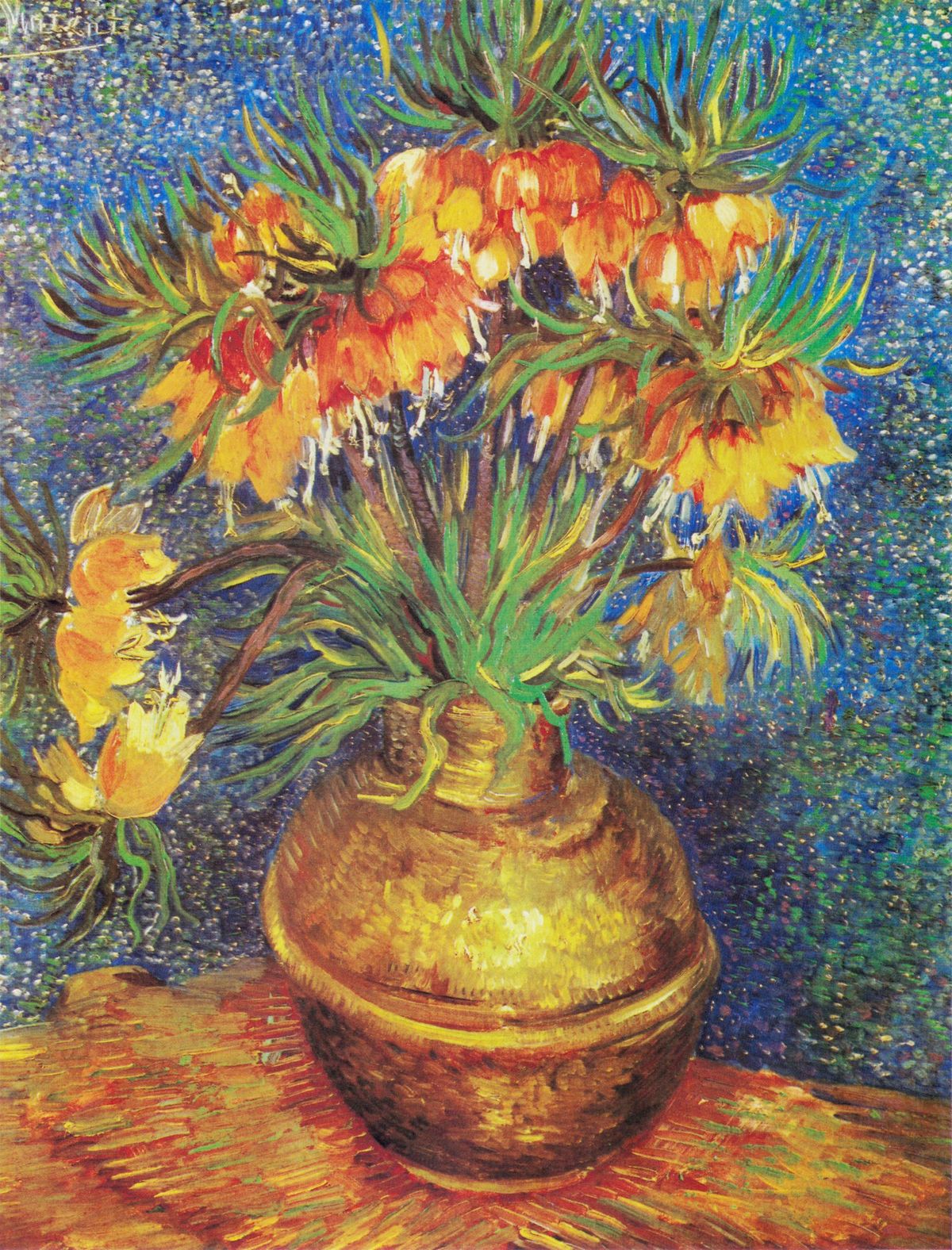
후기 인상주의의 거장 빈센트 반 고흐(Vincent van Gogh, 1853–1890)가 파리 체류 시절인 1887년 봄에 완성한 유화 《구리 화병의 왕관패모(Fritillaries in a Copper Vase, 또는 구리 화병에 담긴 패모꽃)》는 73.5 cm × 60.5 cm 크기의 캔버스에 유채로 그린 대표 정물화로, 현재 프랑스 파리의 오르세 미술관(Musée d'Orsay)에 영구 소장되어 있습니다.
파리의 봄날에 만난 이국적인 꽃과 점묘주의적 색채 실험
1886년 봄 파리에 도착한 고흐는 인상주의와 신인상주의 화가들과 교류하며 자신의 어두웠던 화풍을 쇄신하기 위해 수많은 꽃 정물화를 그리기 시작했습니다. 꽃은 당시 가난했던 그에게 저렴하면서도 다채로운 원색의 상호작용을 연구할 수 있는 가장 완벽한 실험 대상이었습니다.
이 작품의 중심 소재인 '왕관패모(Imperial Crown Fritillary)'는 4월과 5월에 걸쳐 주황빛 꽃송이들이 마치 왕관처럼 아래를 향해 둥글게 피어나는 봄꽃입니다. 고흐는 둥글고 묵직한 구리 화병에 이 화려한 꽃다발을 꽂고, 캔버스 배경 전체에 신인상주의의 점묘주의 기법을 과감하게 적용했습니다.
그는 미세한 푸른빛과 은빛, 녹색의 점들을 촘촘하게 병치시켜 배경을 채움으로써, 전면의 주황빛 꽃과 구릿빛 화병이 마치 빛을 발하듯 화면 밖으로 튀어나오게 만드는 눈부신 보색 대비의 극치를 완성했습니다.
무의식 속 시선의 회전과 찬란한 시각적 온기
감상자의 시선은 화폭의 상단에서 화려한 왕관 모양을 이루며 아래로 고개를 숙인 주황색과 황금빛 꽃송이들로 가장 먼저 빨려 들어갑니다. 불꽃처럼 타오르는 꽃잎과 사방으로 뻗친 날렵한 녹색 잎사귀들은 보는 이의 무의식 속에 강렬한 시각적 활력과 생동감을 선사합니다.
이어 시선은 줄기를 타고 매끄럽게 내려와, 따뜻한 금빛 광택을 은은하게 머금은 둥근 구리 화병의 묵직한 부피감에 안착합니다. 그 후 시선은 붉은빛과 노란색의 터치로 직조된 테이블보를 스쳐, 배경 전체에 별빛처럼 아스라이 흩뿌려진 미세한 청록색 점묘의 바다로 확장됩니다.
배경의 차가운 푸른빛과 꽃다발의 뜨거운 주황빛이 빚어내는 절묘한 균형 속에서, 관람자는 의식하지 못하는 사이 봄날의 싱그러운 온기와 화가가 창작의 희열 속에서 쏟아부었던 순수한 생명력에 깊이 몰입하게 됩니다.
색채 과학의 수용과 독창적 정물화의 도약, 미술사적 평가
미술계는 《구리 화병의 왕관패모》를 반 고흐가 쇠라와 시냐크의 광학적 색채 분할 이론을 완벽히 흡수하여 자신만의 역동적인 회화 언어로 탈바꿈시킨 파리 시기 최고의 정물화 걸작으로 평가합니다.
단순히 빛을 분석적으로 쪼개는 데 그치지 않고, 두터운 물감의 마티에르와 꽃잎 하나하나에 담긴 유기적인 붓질을 통해 대상에 살아 숨 쉬는 생명력을 불어넣었습니다. 훗날 아를에서 활짝 피어나게 될 '해바라기' 연작의 눈부신 색채 조형을 예고하는 이 작품은, 고흐가 전통적 정물화의 틀을 깨고 현대 미술의 새로운 지평을 열어젖힌 찬란한 기념비로 빛나고 있습니다.
Golden Crowns of Vitality in a Gilded Vessel, Fritillaries in a Copper Vase
Painted in the spring of 1887 during his transformative Paris period by Vincent van Gogh (1853–1890), Fritillaries in a Copper Vase (also known as Crown Imperials in a Copper Vase) is an oil on canvas measuring 73.5 cm × 60.5 cm (28.9 in × 23.8 in), preserved in the permanent collection of the Musée d'Orsay in Paris, France.
Parisian Spring and the Mastery of Chromatic Divisionism
Upon arriving in Paris in 1886, Van Gogh immersed himself in the avant-garde circle of Impressionists and Neo-Impressionists, producing dozens of floral still lifes to systematically brighten his Dutch palette. Flowers offered an accessible and ideal laboratory for testing the optical laws of simultaneous contrast and pure pigmentation.
For this composition, Vincent chose the crown imperial fritillary, a striking bulbous flower that blooms in April and May with vibrant orange pendants clustered beneath a tuft of spiky leaves. Arranging the bouquet within a rounded, polished copper vessel, he set the subject against a shimmering ground executed in pointillist touches of cerulean blue, viridian, and silver-gray.
The optical juxtaposition between the cool, vibrating dots of the background and the fiery orange bells of the blossoms elevates the arrangement into an incandescent burst of light and saturated warmth.
Psychological Trajectory of the Gaze and the Rhythm of Light
The observer’s subconscious gaze is immediately seized by the fiery crown of pendulous orange blossoms radiating across the upper half of the composition. The dynamic explosion of slender green leaves and golden petals instills an instant sensation of organic vitality and botanical abundance.
From this floral apex, visual perception flows along the green stems to rest upon the solid mass of the copper vase, rendered with rich impasto that captures the lustrous sheen of reflected light.
The eye then sweeps across the warm, patterned tablecloth before dispersing into the cool expanse of the pointillist background. Navigating this exquisite harmony between fiery warmth and atmospheric coolness, the viewer subconsciously internalizes an enduring feeling of springtime renewal, serenity, and joyful artistic awakening.
Textural Freedom and the Evolution of Modern Still Life: Critical Legacy
Art historians revere Fritillaries in a Copper Vase as a pivotal milestone of Van Gogh’s Parisian oeuvre, marking his transition from the analytical restraint of Neo-Impressionism to an emotional, expressive aesthetic.
Rather than treating pointillism as a rigid scientific exercise, Vincent infused each staccato mark with textural energy and emotional spontaneity. Directly foreshadowing the explosive chromatic harmonies of his legendary Sunflowers in Arles, this masterpiece stands as a triumphant testament to his creative liberation and an enduring icon of Post-Impressionist still-life painting.
Copyright © Palette Jeju. All rights reserved. Unauthorized reproduction or redistribution is strictly prohibited.
본 컨텐트의 저작권은 팔렛트제주에 있습니다. 허가없는 무단전제를 금지합니다.