구리 화병에 꽂힌 패모꽃 - Fritillaries in a Copper Vase
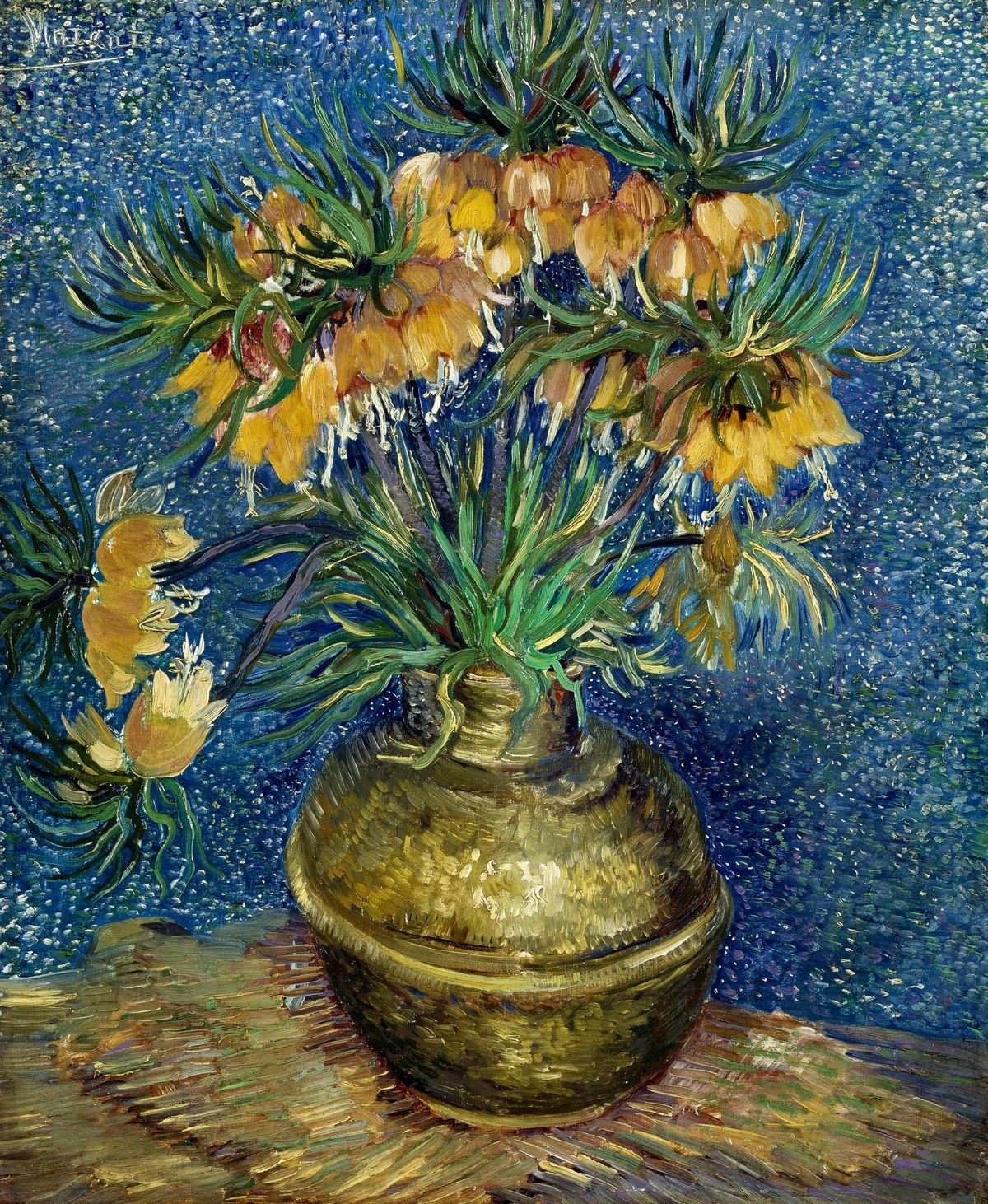
빈센트 반 고흐(Vincent van Gogh, 1853–1890)가 1887년 봄 프랑스 파리 체류 시절 완성한 '구리 화병에 꽂힌 패모꽃(Fritillaries in a Copper Vase)'은 캔버스에 유채(Oil on canvas)로 제작된 정물화입니다. 작품의 실제 규격은 세로 73.5cm, 가로 60.5cm이며, 현재 프랑스 파리의 오르세 미술관(Musée d'Orsay)에 영구 소장되어 있습니다.
고흐는 이 작품에서 점묘파의 광학적 색채 이론과 인상주의의 생동하는 빛을 자신만의 독창적인 조형 언어로 승화시켰습니다. 배경 전체를 푸른색과 은백색의 미세한 점과 짧은 붓 터치로 채워 마치 밤하늘의 별무리나 은하수가 일렁이는 듯한 신비로운 아우라를 부여했으며, 구리 화병과 패모꽃의 꽃잎, 잎사귀에는 물감을 도톰하게 얹는 두터운 임파스토 기법과 역동적인 선묘를 적용해 사물의 실재감과 조형적 입체감을 극대화했습니다.
이 정물화는 반 고흐가 파리에서 인상주의와 신인상주의의 혁신적인 화풍을 흡수하며 색채의 마술사로 거듭나던 결정적인 순간에 제작되었습니다. 패모꽃(황제관 패모, Fritillaria imperialis)은 초봄에 피어나는 구근 식물로, 당시 파리 근교 아니에르(Asnières)의 정원들에서 흔히 볼 수 있던 꽃이었습니다. 고흐는 황금빛과 오렌지빛으로 종처럼 아래를 향해 피어나는 꽃송이와 왕관처럼 솟아오른 뾰족한 녹색 잎의 형태미에 깊이 매료되었으며, 이를 묵직한 구리 화병에 담아 찬란한 생명의 개화를 선언하듯 화폭에 담아냈습니다.
후대의 미술사학자들과 비평가들은 이 작품을 네덜란드 시절의 어둡고 무거운 흙빛 팔레트에서 완전히 벗어나, 보색 대비와 빛의 진동을 완벽히 장악한 반 고흐 파리 시대 정물화의 최고 걸작 중 하나로 평가합니다. 황금빛 주황색 꽃과 배경의 청명한 블루 톤이 일으키는 극적인 보색 대비는 시각적 쾌감을 극대화하며, 이후 아를 시절의 전설적인 '해바라기' 연작으로 이어지는 꽃 정물화의 위대한 서막으로 인정받고 있습니다.
관람자의 시선은 가장 먼저 화면 상단에서 왕관처럼 화려하게 만개한 황금빛 패모꽃의 꽃송이들과 솟아오른 녹색 잎사귀의 역동적인 리듬으로 집중됩니다. 이어 굵고 굳건하게 뻗은 줄기를 따라 시선이 아래로 내려와 은은한 금속성 광택을 뿜어내는 묵직한 구리 화병에 안착한 뒤, 바탕 전체에서 무수히 진동하는 청색 배경의 점묘 터치를 따라 화면 전체로 유려하게 확산됩니다.
심리적으로 관람자는 황금빛 꽃잎의 따스한 온기와 깊고 청명한 푸른빛 배경이 이루는 조화 속에서 복잡한 마음이 차분하게 정돈되는 시각적 환희와 정서적 평온을 동시에 경험하게 됩니다. 혹독한 겨울을 뚫고 솟아오른 봄꽃의 싱싱한 생명력과 단단한 구리 화병의 묵직한 안정감은 무의식중에 내재된 피로와 스트레스를 씻어내며, 지친 영혼에 새로운 활력과 따스한 회복의 에너지를 깊이 채워줍니다.
Fritillaries in a Copper Vase
Painted by Vincent van Gogh (1853–1890) in Paris during the spring of 1887, Fritillaries in a Copper Vase is an oil on canvas still life measuring 73.5 cm in height and 60.5 cm in width. This masterwork is permanently preserved in the renowned collection of the Musée d'Orsay in Paris, France.
Van Gogh brilliantly harmonized the optical theories of Neo-Impressionist Pointillism with his own expressive brushwork in this composition. The shimmering background is constructed with fine, pulsating dashes of celestial blue and silvery white, creating a vibrating cosmic atmosphere that envelops the subject. In contrast, the crowned imperial fritillaries and the burnished metallic vase are sculpted with thick, deliberate impasto strokes, granting the organic and manufactured textures a tactile, sculptural presence.
The painting was created at a crucial juncture when Van Gogh was eagerly absorbing the avant-garde methods of the Parisian art scene, radically redefining his chromatic vocabulary. The crown imperial fritillary (Fritillaria imperialis), a stately bulbous plant flowering in early spring, adorned many public and private gardens around Paris and Asnières. Fascinated by the pendulous, bell-shaped orange blossoms crowned with tufts of spiky green leaves, Van Gogh positioned them within a rounded copper vessel, immortalizing the triumphant return of spring and the resilience of natural life.
Art historians and modern scholars celebrate this still life as a defining masterpiece of Van Gogh's Parisian breakthrough, marking the definitive transition from his somber Dutch palette to an ecstatic mastery of pure, complementary colors. The vibrant resonance generated between the glowing golden-orange petals and the cool, cobalt-infused background creates an extraordinary visual energy, serving as a magnificent stylistic precursor to his celebrated Arles Sunflowers.
A viewer’s gaze is instinctively drawn to the radiant crown of golden-amber blossoms and upward-reaching green leaves bursting from the upper center of the canvas. The eyes then journey downward along the sturdy vertical stems to rest upon the solid, reflective mass of the copper vase, before gracefully dispersing into the shimmering, pointillist sea of blue that frames the entire arrangement.
Psychologically, the dynamic harmony between the warm luminescence of the flowers and the serene coolness of the background offers an immediate sense of perceptual refreshment and emotional equilibrium. The robust vitality of the blossoming flora, anchored by the grounded stability of the metallic vase, gently relieves underlying tension, imparting the observer with an enduring feeling of inner vitality, aesthetic joy, and restorative tranquility.
본 리뷰에서 작품을 제외한 컨텐츠의 저작권은 팔렛트제주에 있습니다.
"퍼블릭도메인 고전명화"를 제외한 모든 창작 콘텐츠는 저작권법 제4조 및 제10조에 의거하여 보호됩니다. 무단 도용시 저작권법 제136조(벌칙)에 의거, 당사의 사전 서면 승인 없는 저작권 침해 행위를 금지합니다.