궁술 대회를 하는 농부들 Peasants at Archery
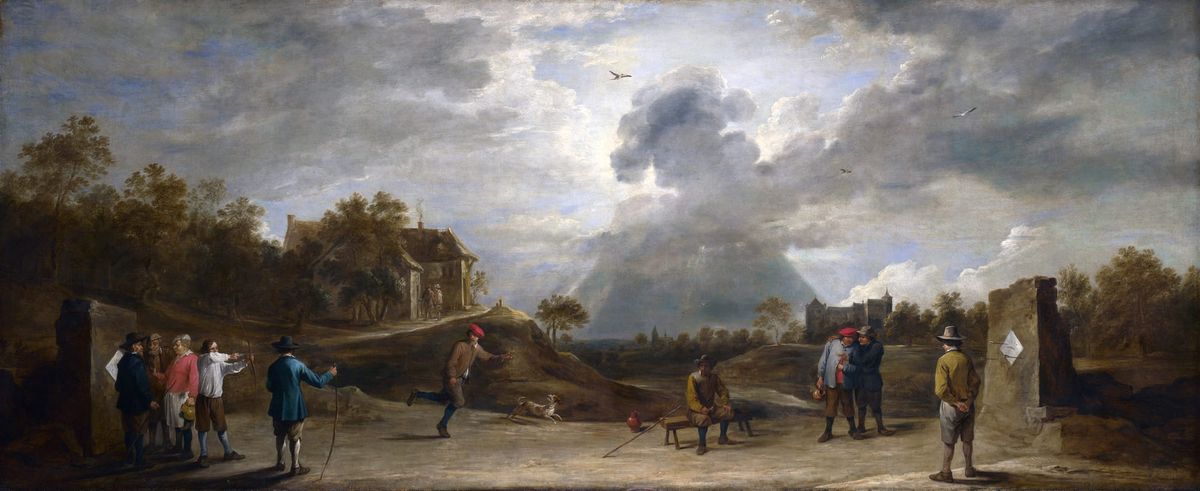
17세기 플랑드르 바로크 풍속화 및 대형 전원 풍경화의 거장 소 다비드 테니어르스(David Teniers le Jeune, 1610–1690)가 1645년경 안트베르펜 전성기 시절에 완성한 기념비적 야외 풍속 유화 궁술 대회를 하는 농부들(Peasants at Archery, 공식 소장품 등록번호: NG817)은 119.4 cm × 289.6 cm 크기의 웅장한 가로형 대형 캔버스에 유채로 그린 대표적인 북유럽 풍속화 최고 걸작입니다.
1948년 아서 제임스(Arthur James) 컬렉션에서 메리 베네시아 제임스 부인(Mrs Mary Venetia James)의 유증을 통해 영국 런던의 내셔널 갤러리(National Gallery, London)에 영구 소장되어 보존되어 오고 있습니다.
코메디아 델라르테의 연극적 풍자와 거대한 풍경 속 농민들의 은밀한 소동을 향한 화가의 고뇌
1645년경 안트베르펜에서 활동하던 삼십 대의 테니어르스는, 선배 화가 아드리안 브라우어의 거친 풍속화 전통을 이어받으면서도 당대 상류층 컬렉터들이 즐기던 이탈리아 전통 연극인 코메디아 델라르테의 희극적 인물들을 플랑드르 농촌 풍경 속에 어떻게 우아하게 녹여낼지 깊이 고민했습니다.
화가는 단순히 활을 쏘는 진지한 스포츠 경기를 보여주는 대신, 화면 중앙 하늘을 뒤덮은 거대한 먹구름 아래에서 과녁을 향해 겨누는 궁수 뒤로 이웃들끼리 벌이는 은밀한 사기극과 쑥덕공론을 화폭에 담아내며 인간 본성의 해학을 유쾌하게 탐구했습니다.
런던 내셔널 갤러리의 공식 소장 도록에 따르면, 이 작품은 붉은 모자를 쓰고 달리는 인물이 이탈리아 연극의 익살스러운 광대 아를레키노(Arlecchino)를 상징하며, 붉은 모자와 푸른 옷을 입은 뚱뚱한 인물은 수다스러운 주정뱅이 의사 캐릭터를 차용한 것으로 분석됩니다.
화가는 넓은 들판과 낡은 초가집이 어우러진 마을 공터에서, 과녁을 향해 활시위를 당기는 사내와 그 주변에서 온갖 딴청을 피우며 소동을 벌이는 마을 사람들의 생생한 순간을 화폭에 담았습니다.
화면 오른쪽 끝에서는 노란 조끼를 입은 사내가 돌 과녁에 박힌 화살을 등 뒤로 한 채 진지하게 과녁을 바라보고 있으며, 화면 왼쪽에서는 흰 셔츠를 입은 궁수가 한쪽 눈을 감고 활을 겨누고 있고 주변 사람들은 그를 구경하고 있습니다.
화면 한가운데에서는 붉은 모자를 쓴 사내가 재빨리 뛰어가는 동세를 취하며 작은 사냥개와 함께 시선을 끌고, 그 뒤편 벤치에 앉은 노인과 오른쪽에서 귓속말을 나누는 두 사내가 해학적인 긴장감을 더합니다.
화면 전체를 거대하게 압도하는 짙푸른 폭풍우 구름과 그 사이로 쏟아지는 빛줄기, 그리고 왼쪽 멀리 자리 잡은 초가 헛간과 오른쪽 원경의 아늑한 풍경은 거친 자연의 위협 속에서도 웃음을 잃지 않는 서민들의 생명력을 손에 잡힐 듯 생생하게 웅변합니다.
궁수와 과녁의 긴장감에서 붉은 모자 사내와 거대한 폭풍우 구름으로, 시선의 심리적 여정
그림을 마주하는 순간 관람객의 무의식적 시선은 화면 오른쪽 끝에서 돌 과녁에 꽂힌 화살을 향해 등을 돌리고 선 노란 옷의 궁수와 왼쪽 끝에서 활시위를 당기는 사내의 집중된 자세로 가장 먼저 빨려 들어갑니다.
과녁을 맞히기 위해 숨을 죽인 궁수들의 진지한 몸짓은 보는 이에게 깊한 시각적 몰입감과 함께 스포츠의 긴장감을 선사합니다.
이어 시선은 화면 한가운데를 가로지르며 활기차게 뛰어가는 붉은 모자의 사내와 그를 따르는 날렵한 사냥개의 역동적인 움직임으로 이동합니다.
경기의 진지함에서 벗어나 마을 사람들 사이에 벌어지는 은밀한 소동과 익살스러운 꿍꿍이를 눈치채는 순간, 관람객은 웅성거리는 사람들의 소리와 흙먼지가 날리는 17세기 플랑드르 마을 공터 한복판 속으로 온몸이 빨려 들어가게 됩니다.
마지막으로 시선은 화면 중앙 하늘을 무겁게 짓누르며 솟아오른 거대한 잿빛 폭풍우 구름과 그 틈새로 쏟아지는 극적인 햇살, 그리고 저 멀리 평화롭게 자리 잡은 초가집과 나무들에 멈춥니다.
전면 인간 군상의 해학적 소동과 후면 장엄한 자연 풍광이 빚어내는 완벽한 극적 대비를 마주하며, 관람객은 삶의 희로애락을 유쾌한 예술로 승화시킨 거장 테니어르스의 깊은 통찰을 가슴 깊이 마주하게 됩니다.
17세기 플랑드르 대형 풍속화의 정점과 조형미, 미술계의 평가
미술계와 런던 내셔널 갤러리 공식 도록은 궁술 대회를 하는 농부들을 테니어르스가 넓은 가로형 파노라마 화면 위에 연극적 서사와 정교한 풍경 묘사를 가장 완벽한 조화로 융합해 낸 대표적인 최고봉 마스터피스로 평가합니다.
단순한 야외 풍경화나 스포츠 기록을 넘어 이탈리아 코메디아 델라르테의 희극적 캐릭터를 북유럽 농촌 풍속 속에 완벽하게 이식했을 뿐만 아니라, 웅장한 하늘을 채운 구름의 입체적 질감, 돌 과녁과 초가벽의 거친 표면, 인물들의 다채로운 의상 색채와 대기 원근법을 극도로 섬세한 북유럽 사실주의 유화 기법으로 완벽하게 구현했기 때문입니다.
인간의 본성과 자연의 거대한 섭리를 가장 격조 높은 시각 희랍극으로 승화시킨 테니어르스의 이 걸작 화폭은, 오늘날까지도 전 세계 수많은 감상자들에게 깊은 감탄과 잊을 수 없는 시각적 즐거움을 전해주는 불멸의 명작으로 손꼽히고 있습니다.
Peasants at Archery
Painted around 1645 by the master of Flemish Baroque genre and panoramic landscape painting David Teniers the Younger (1610–1690), Peasants at Archery (Accession No. NG817) is a monumental horizontal genre masterpiece in oil on canvas measuring 119.4 cm × 289.6 cm (47.0 in × 114.0 in).
Bequeathed in 1948 by Mrs Mary Venetia James from the Arthur James collection, it is preserved today in the distinguished permanent collection of the National Gallery in London, United Kingdom.
Commedia dell'arte Satire, Farcical Subplots, and the Impending Storm
During the mid-1640s in Antwerp, David Teniers the Younger synthesized the raucous peasant traditions of Adriaen Brouwer with the sophisticated theatricality of Italian commedia dell'arte, creating multi-layered narrative paintings prized by wealthy urban collectors.
Moving beyond straightforward sport documentation, the master meditated deeply on how to subordinate the formal archery contest to a rich web of human mischief, gossip, and comical subplots enacted beneath a towering, menacing rain cloud that threatens to wash out the village gathering.
According to academic records in the National Gallery collection catalogue, the figures in the composition function much like theatrical stock characters, with the lithe runner in the red hat evoking Harlequin, and the pompous figures embodying traditional comic archetypes who invite viewer amusement and playful speculation.
Teniers staged the expansive narrative across an open rustic common framed by farm buildings and distant trees.
In the right foreground, an archer in a yellow vest stands with his back turned, contemplating the target pinned to a crumbling stone pier where a single arrow has struck, while on the left, an archer in a white shirt draws his bow with intense focus before an interested group of onlookers.
In the center, a lively figure in a red hat dashes briskly across the clearing accompanied by a bounding terrier, injecting frantic physical comedy into the composition.
To the right and left, seated elders, gossiping peasants, and plotting companions engage in covert schemes, all unified beneath a magnificent, towering thundercloud suffused with dramatic shafts of silver daylight breaking across the sprawling Flemish landscape.
Subconscious Trajectory of the Gaze: From the Focused Archer to the Towering Thundercloud
The observer's subconscious gaze is immediately magnetized by the right foreground, drawn to the poised archer in yellow facing the stone target and the opposing bowman taking aim on the left, establishing an instant focal point of athletic concentration.
Their deliberate postures, taut bows, and expectant stances create a compelling axis of physical tension across the canvas.
The visual path then sweeps toward the center, following the energetic sprint of the red-hatted figure and the playful movements of the hunting dog darting across the sunlit clearing.
Taking in the secondary gossip and conspiratorial whispering among the surrounding villagers, the viewer directly experiences the humorous social dynamics and theatrical mischief of a 17th-century village festival.
Finally, the visual trajectory lifts upward toward the massive, billowy storm cloud dominating the upper sky, tracing the atmospheric light as it cascades down across the distant cottages, trees, and rolling terrain.
Observing the harmonious equilibrium between foreground theatrical farce, sweeping horizontal breadth, and precise Netherlandish draftsmanship, the spectator perceives the timeless vitality of human folly and the profound aesthetic brilliance Teniers embedded within the canvas.
The Monument of Flemish Narrative Genre: Critical Legacy
Art historians revere the National Gallery Peasants at Archery as a supreme milestone in Teniers’s oeuvre, illustrating his consummate ability to unite large-scale multi-figure narrative choreography with breathtaking atmospheric landscape painting.
By orchestrating delicate textural contrasts between weathered masonry, coarse woolen fabrics, shimmering atmospheric light, and heavy moisture-laden storm clouds within a unified panoramic space, Teniers transformed a village pastime into an exquisite aesthetic treatise on human nature and theatrical artifice.
This magnificent historical canvas endures as an inspiring testament to the master's creative fortitude, celebrating the quiet poetry of everyday existence and the transformative grace of living art.
본 컨텐트의 저작권은 팔렛트제주에 있습니다. 허가없는 무단전제를 금지합니다.
Copyright © Palette Jeju. All rights reserved. Unauthorized reproduction or redistribution is strictly prohibited.