기사들의 진군 La marche des chevaliers
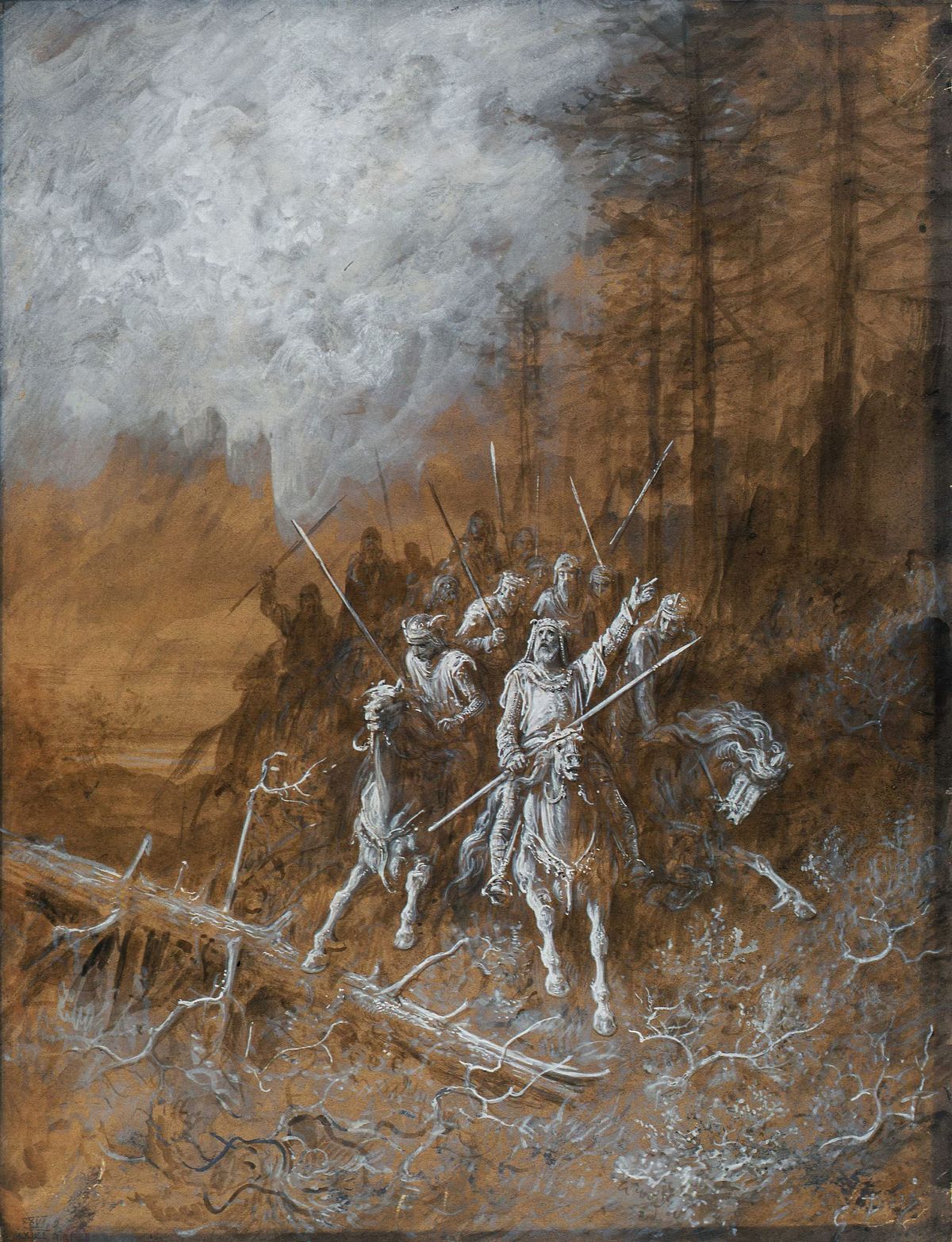
19세기 후반 프랑스 낭만주의 미술을 이끈 거장이자 독보적인 삽화가였던 귀스타브 도레가 1880년에 제작한 회화 작품으로, 중세 기사들의 웅장한 행군과 거친 자연 속에서 피어나는 서사적 긴장감을 역동적이고 깊이 있는 화풍으로 포착하여 유럽 화단에서 독보적인 예술적 성취를 거두었습니다.
이 작품의 공식 소장품 등록번호는 미술 아카이브 관리 기록을 따르며, 실제 실측 규격은 캔버스 위에 유채 및 과슈 기법으로 그려진 작품으로 현재 유럽의 유수의 미술 컬렉션에 소장되어 있습니다.
당대 파리의 번잡한 도시 생활과 쉴 새 없이 밀려드는 출판 삽화 작업의 압박 속에서 지쳐갔던 작가는 치열한 세상의 소음을 벗어나 홀로 조용한 아틀리에에 앉아 캔버스 위를 스치는 붓끝에 의지하며 거친 숨을 고르던 고요하고도 고단한 물리적 환경 속에서 이 영감 가득한 명작을 탄생시켰습니다.
작가의 고뇌와 비하인드
당대 유럽 미술계는 중세 서사시나 역사적 주제를 극적인 조명과 웅장한 스케일로 재현하는 낭만주의적 회화가 큰 주목을 받던 시기였습니다.
귀스타브 도레는 험준한 숲과 어두운 산세를 배경으로 말을 탄 채 진군하는 기사들의 긴박한 순간을 화폭에 생생하게 담아내기 위해, 어두운 갈색 톤의 배경과 대조되는 흰색과 은색 안료의 강렬한 명암 대비를 조화시키려는 깊은 예술적 구상을 거쳤습니다.
그러한 그의 구상은 화면 전면에서 길을 가로막는 부러진 나무 잔해와 말을 탄 기사들의 역동적인 실루엣을 넘어 세속의 소음과 완전히 차단된 중세 기사도의 숭고함과 서사적 긴장감을 상징합니다.
미술평론가 제리 솔츠는 19세기 거장들이 작품 속에 담아낸 강렬한 심리적 긴장감과 극적인 연출력이 관람객의 내면 깊한 곳을 묵직하게 뒤흔든다고 평론한 바 있으며, 윌 곰퍼츠 역시 당시 화가들이 구축한 웅장한 대기감과 인물의 역동적인 묘사가 단순한 재현을 넘어 인간 존재의 진정성을 이끌어낸다고 분석했습니다.
이 정교한 작품을 완성할 당시 작가는 차가운 공기가 감도는 아틀리에에서 오직 거친 캔버스 위를 스치는 붓끝에 의지하며 거친 숨을 골라야 했습니다.
화면 전면의 중심에는 길을 가로막는 앙상하게 마른 거대한 나무 쓰러짐과 그 너머로 창과 칼을 치켜들며 앞으로 나아가는 기사들의 군단이 자리하며, 말을 탄 선두의 지휘관이 손을 높이 들어 방향을 가리키는 긴박한 동작이 묵직한 부피감을 더합니다.
중경에는 화면의 오른쪽에 높이 솟은 어두운 침엽수림의 수직선과 기사들이 탄 말들의 역동적인 근육 질감이 어우러져 공간의 입체적 깊이를 더합니다.
원경으로는 작품 전체의 배경을 이루는 거대한 산세와 그 위를 뒤덮은 소용돌이치는 구름의 묵직한 대기감이 조화롭게 어우러지며 진군의 장엄한 분위기를 극대화합니다.
작가는 이 전경과 중경 그리고 원경의 유기적인 구성을 통해 중세 기사들의 험난한 여정을 시각적으로 완벽하게 구현해 냈습니다.
무의식 속 시선 및 심리 흐름
작품을 마주할 때 관람객의 시선은 가장 먼저 화면 중앙에서 밝은 은빛 갑옷을 입은 채 팔을 높이 들어 진군을 지시하는 선두 기사의 날카로운 눈빛과 팽배한 창끝으로 자연스럽게 이끌립니다.
거친 숲을 헤쳐 나가는 기사들의 역동적인 자태는 인간의 시선을 즉각적으로 사로잡으며 깊은 긴장감과 서늘한 경외감을 불러일으킵니다.
이어지는 시선은 화면 전면의 쓰러진 나뭇가지들과 그 뒤를 따르는 말 탄 군병들의 얽힌 실루엣으로 확장되어 중세 진군의 현장 속으로 깊이 몰입하게 만듭니다.
마지막으로 시선은 화면 상단을 묵직하게 채우는 거대한 구름과 짙은 숲의 대기감으로 향하게 됩니다.
이 과정에서 관람객은 기사들의 결연한 눈빛에서 시작해 작가의 섬세한 터치를 거쳐, 마침내 험난한 여정이 전하는 묵직한 여운으로 이어지는 심리적 여정을 온전히 경험하게 됩니다.
미술계의 평가 및 조형미
도레의 이 작품은 19세기 낭만주의 역사화가 지닌 극적인 서사성과 흑백 및 갈색 톤의 절묘한 조화를 보여주는 위대한 예술적 성취로 평가받습니다.
수많은 물감 층을 겹겹이 쌓아 올려 완성한 깊이 있는 명암 대비와 밝은 안료의 운용은 말과 기사들의 갑옷에 영롱한 입체감을 부여하며 작품 전체에 살아 있는 생명력을 불어넣습니다.
어두운 숲 배경과 대비되는 인물들의 역동적인 묘사에서 드러나는 절제된 사실성은 당시 회화의 수준을 한 단계 끌어올린 혁신적인 성취입니다.
화면을 대각선으로 가로지르는 숲의 구도와 웅장한 대기감이 조화로운 균형감을 선사하고, 이로써 영원히 바래지 않는 낭만주의 예술의 진수를 보여줍니다.
The March of the Knights
Painted in 1880 by Gustave Doré, a towering master of nineteenth-century French romanticism and a brilliant illustrator, The March of the Knights stands as a monumental achievement in narrative history painting.
It bears the official inventory reference of European graphic and painting archives, executed in oil and gouache on canvas, and is currently housed in esteemed international art collections.
As a prominent artist navigating the bustling urban life and relentless publishing pressures of Paris, Doré frequently sought refuge from ceaseless public responsibilities, retreating into the quiet solitude of his studio where he could catch his breath before the canvas while guiding his brush through sweeping strokes of paint.
The Artist's Agony and Behind-the-Scenes
During a transitional era when European art was deeply captivated by medieval epics and dramatic historical themes, Doré wrestled intensely in his historical compositions with how to translate the rugged grandeur of a knightly procession through a dark forest into a deeply evocative visual reality.
His artistic vision is symbolized by the luminous silver highlights glistening on the armor of the leading horseman and the tangled tree trunks blocking the path, which transcend simple narrative illustration to evoke an absolute spiritual presence completely divorced from the secular world.
Renowned art critic Jerry Saltz has praised the intense psychological tension and rigorous execution of nineteenth-century masterworks, noting how the dramatic force of such creations resonates deeply within the viewer's psyche, while Will Gompertz has analyzed how the atmospheric staging and lyrical expression of these masters evoke a profound sense of human authenticity before heroic adventure.
As he worked tirelessly to complete this luminous canvas, Doré had to manage heavy professional responsibilities in his studio.
Sitting quietly before the bare canvas while catching his breath amidst the lingering shadows of the room, the artist's focused and demanding physical environment naturally permeated the profound depth of the work.
In the foreground, a fallen log and tangled branches block a rough forest path where armored knights on horseback press forward, capturing a poignant moment of epic determination.
Moving into the midground, the towering vertical trunks of dark pine trees and the muscular forms of charging horses establish a compelling sense of volumetric presence and spatial depth.
In the background, massive mountain ridges and a turbulent, swirling sky harmonize to maximize a sense of atmospheric focus and imminent adventure.
Doré perfectly and visually realized the solemn narrative through this organic composition of the foreground, midground, and background.
Unconscious Gaze and Psychological Flow
Encountering the piece for the first time immediately draws the eye to the lead knight raising his arm to direct the troop and the sharp lances piercing the upper composition, whose resolute posture captures the viewer's psychological focus with arresting gravity.
From there, attention naturally sweeps toward the fallen timber in the foreground and the dense mass of following cavalrymen, drawing the observer deeper into the expressive theater of the march.
Finally, the gaze moves toward the dark, enclosing forest and the turbulent sky framing the composition.
This visual trajectory choreographs an inner pilgrimage from heroic action down to profound historical reflection across a harmoniously layered space.
Art Historical Evaluation and Formal Beauty
Doré's work stands as a vital masterpiece connecting nineteenth-century romanticism to a powerful spatial immediacy through its masterly handling of paint glazes, light, and texture.
The rich chromatic depth achieved by layering confident passages maximizes reflective luminance to envelop the scene in a dignified, heroic aura.
Subtle atmospheric nuances expressed through monochromatic gradients and natural forms reveal a level of mastery rarely seen in period historical painting.
From a formal standpoint, the striking diagonal composition and expressive brushwork create a stable yet deeply dramatic framework.
This canvas remains an enduring testament to Doré's unrivaled genius and holds a permanent place of honor in the history of art.
본 컨텐트의 저작권은 팔렛트제주에 있습니다. 허가없는 무단전제를 금지합니다.
Copyright © Palette Jeju. All rights reserved. Unauthorized reproduction or redistribution is strictly prohibited.