깊은 숲속 바위에 기대어 뜯는 황금 하프와 고독한 시심, 사포 Sappho
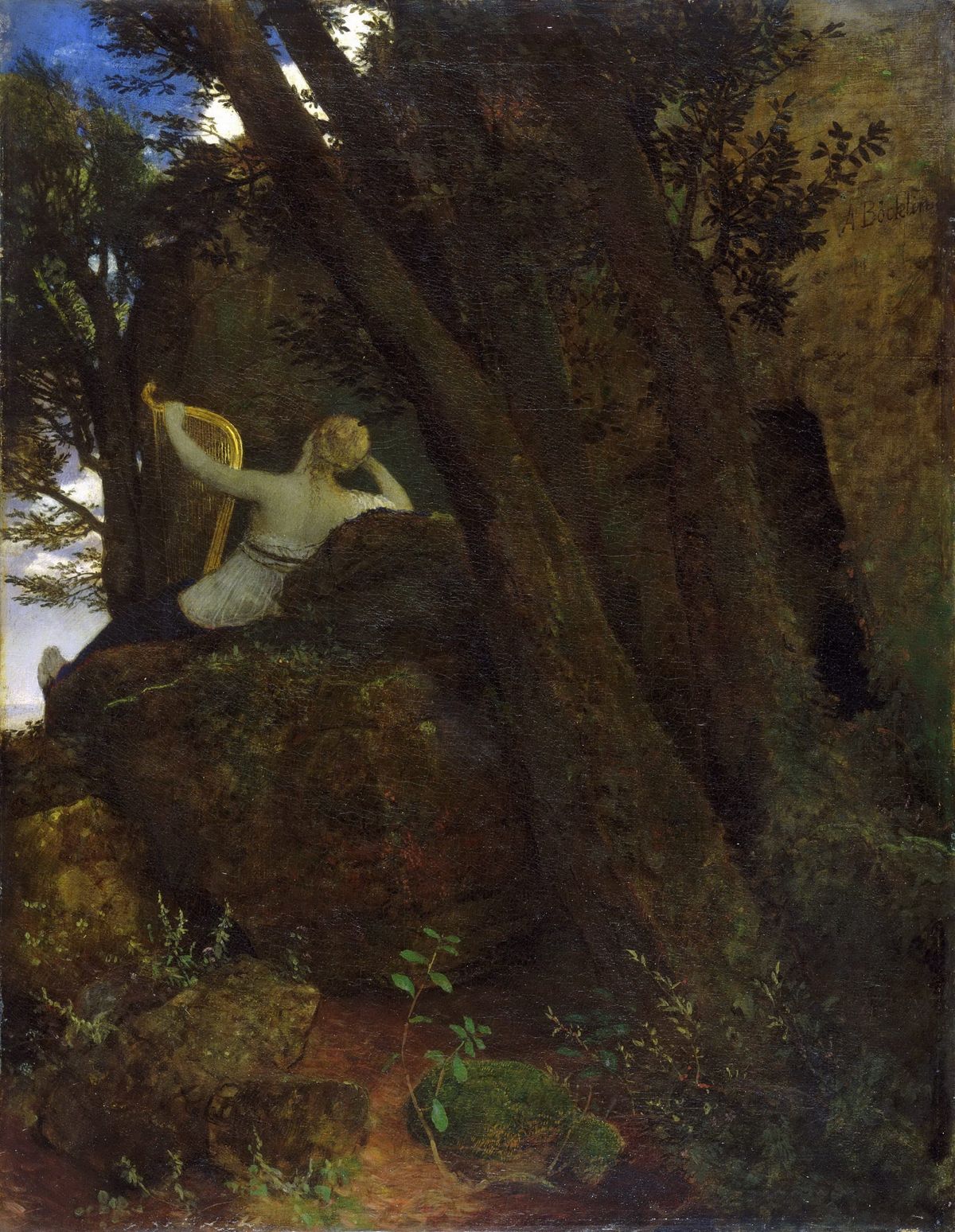
스위스 출신의 상징주의 거장 아놀드 뵈클린(Arnold Böcklin, 1827–1901)이 1862년에 독일 바이마르에서 완성한 유화 사포(Sappho, 독일어: Sappho)는 94.8 cm × 73.8 cm 크기의 캔버스에 유채로 그린 대표적인 초기 서정주의 명작입니다. 현재 독일 프랑크푸르트의 슈테델 미술관(Städel Museum, Frankfurt am Main)에 소장되어 있습니다.
바이마르 교수직의 갑갑함을 벗어나 갈망한 고대 서정시의 세계
1860년대 초반 뵈클린은 독일 작센 대공의 초빙을 받아 바이마르 미술학교의 교수로 재직하고 있었습니다. 대공의 전폭적인 지원과 안정적인 교수 직위가 보장되었지만, 아카데미 특유의 엄격한 형식주의와 동료 교수들의 보수적인 시선은 자유로운 예술혼을 갈망하던 화가의 숨을 턱턱 막히게 했습니다. 화려한 궁정 생활과 제도권 교육의 답답한 틀 속에서 깊은 고독과 회의감을 느끼던 뵈클린은, 기원전 고대 그리스의 전설적인 여성 서정시인 사포의 고독한 예술혼에 자신의 영혼을 투영하기 시작했습니다.
화면은 거대한 고목과 바위로 둘러싸인 깊은 숲속 절벽 끝에 홀로 기댄 시인 사포를 비추고 있습니다. 흰옷을 입은 사포는 한 손으로 턱을 괸 채 깊은 사색에 잠겨 있고, 다른 손으로는 황금빛 하프의 줄을 살며시 쥐고 있습니다. 그녀의 등 뒤로는 굵은 나무 기둥들이 하늘을 향해 비스듬히 솟아 있고, 나뭇가지 사이로는 아스라한 지중해의 푸른 하늘과 바다가 언뜻 모습을 드러냅니다. 뵈클린은 세상의 소음과 단절된 채 오직 자신의 내면과 시적 영감에 귀를 기울이는 예술가의 고귀한 고독을 포착했습니다. 안정된 현실의 안주 대신 진정한 예술적 자유를 갈망하며 끊임없이 방황했던 화가 자신의 내밀한 고뇌와 고전 시정에 대한 깊은 동경이 이 울창한 숲의 그늘 속에 오롯이 배어 있습니다.
밝게 빛나는 사포의 어깨선에서 황금 하프의 현으로, 시선의 심리적 여정
그림을 마주하는 순간 관람객의 무의식적 시선은 화면 왼쪽 위 어두운 숲 그늘 속에서 은은한 빛을 받아 눈부시게 떠오르는 사포의 하얀 어깨와 등을 타고 가장 먼저 이끌립니다. 바위에 비스듬히 기대어 머리를 괴고 있는 시인의 우아하고 고독한 뒷모습은 보는 이에게 깊은 사색과 시적인 침묵을 선사합니다.
이어 시선은 그녀의 왼손이 부드럽게 감싸 쥔 황금빛 하프의 매끄러운 곡선과 팽팽하게 당겨진 현으로 이동합니다. 숲의 바람결을 타고 당장이라도 애절한 시의 멜로디가 울려 퍼질 것만 같은 악기의 존재감을 확인하는 순간, 관람객은 시각적 정적을 깨뜨리는 고요한 청각적 울림을 경험합니다.
마지막으로 시선은 화면 오른쪽을 웅장하게 가로막고 선 거대한 나무 기둥들의 거친 이끼 낀 껍질을 지나, 사포의 발아래 붉은 흙길과 푸른 잎사귀들, 그리고 저 멀리 나뭇가지 틈새로 보이는 푸른 바다의 수평선에 멈춥니다. 빽빽한 원시림의 깊은 어둠과 그 너머로 언뜻 비치는 맑은 지중해의 대조를 마주하며, 관람객은 고독 속에서 영원한 이상을 노래했던 시인의 숭고한 예술혼과 자연의 깊은 평온을 가슴 깊이 마주하게 됩니다.
고전 문학과 서정 풍경의 완벽한 융합, 미술계의 평가
미술계는 사포를 뵈클린이 바이마르 시절의 학구적 구속을 딛고 고대 문학의 인물을 자연의 서정적 분위기와 완벽하게 결합해 낸 초기 걸작으로 평가합니다.
인물의 얼굴을 직접 드러내지 않고도 우아한 뒷모습과 악기, 그리고 울창한 숲의 명암 대비만으로 인물의 깊은 내면세계를 탁월하게 시각화했기 때문입니다. 고독한 예술가의 영혼을 자연의 신비로움 속에 녹여낸 뵈클린의 이 감동적인 화폭은 훗날 그가 독일과 유럽 전역을 사로잡게 되는 상징주의 회화의 거대한 서막을 알리는 소중한 이정표로 손꼽힙니다.
The Solitary Melodies of the Ancient Grove, Sappho
Painted in 1862 in Weimar by the preeminent Swiss Symbolist master Arnold Böcklin (1827–1901), Sappho (German: Sappho) is an early oil on canvas measuring 94.8 cm × 73.8 cm (37.3 in × 29.1 in), preserved in the permanent collection of the Städel Museum in Frankfurt am Main, Germany.
The Weimar Professorship, Institutional Confinement, and the Poetic Solitude of Sappho
In the early 1860s, Arnold Böcklin held a prestigious professorship at the Grand-Ducal Saxon Art School in Weimar under the patronage of Grand Duke Carl Alexander. Although financially secure, the painter felt suffocated by academic bureaucracy and the conservative artistic tastes of his peers. Longing for unconstrained creative expression, Böcklin identified deeply with the legendary lyric poet Sappho of archaic Greece, using her archetype of poetic exile to explore the profound solitude and spiritual independence of the true creator.
The composition places the poet in an ancient, untouched forest perched atop a rocky promontory. Draped in a simple classical tunic, Sappho leans pensively against a mossy boulder, resting her head in one hand while gently holding the frame of a golden harp with the other. Massive tree trunks frame the enclosure diagonally, while glimpses of a luminous cerulean sea and sky emerge through the upper foliage. Böcklin deliberately avoided overt theatricality, concentrating instead on the acoustic quietude of the grove and the inward meditation of the artist. This intimate canvas reflects the master's yearning for Mediterranean light and spiritual liberty away from institutional constraints.
Subconscious Trajectory of the Gaze: From Sunlit Shoulders to the Gilded Strings
The observer's subconscious gaze is immediately captured by the soft, sunlit contours of Sappho’s exposed shoulders and white drapery positioned in the upper left clearing. Her graceful, introspective posture leaning against the dark rock face creates an immediate aura of quiet dignity and classical melancholia.
The visual path then shifts to the elegant arc of the golden harp cradled against her arm. Observing the tactile delicacy of her hand resting near the taut strings, the viewer experiences a transition from reflective stillness to the imagined resonance of ancient lyric poetry echoing through the woodland.
Finally, the trajectory descends along the massive, moss-covered tree trunks commanding the right foreground, exploring the wild ferns and earthen path below before rising toward the patch of Mediterranean sky visible through the canopy. Contemplating the threshold between the secluded shadows of the grove and the expansive sea beyond, the spectator perceives the timeless nobility of the artistic spirit seeking communion with nature.
The Harmony of Classical Lyricism and Romantic Atmosphere: Critical Legacy
Art historians revere Sappho as a vital masterpiece of Böcklin’s early mature period, demonstrating his ability to unite literary motifs with evocative landscape painting.
By concealing the figure's countenance and relying upon anatomical posture, rich chiaroscuro, and organic textures to convey psychological depth, Böcklin anticipated the evocative interiority of the Symbolist movement. This poetic canvas endures as an essential early milestone, testifying to the master's extraordinary gift for translating classical myth into profound meditations on the creative soul.
본 컨텐트의 저작권은 팔렛트제주에 있습니다. 허가없는 무단전제를 금지합니다.
Copyright © Palette Jeju. All rights reserved. Unauthorized reproduction or redistribution is strictly prohibited.