깊은 산골짝을 가르는 사냥의 환호성과 맑은 계곡물, 디아나의 사냥 The Hunt of Diana
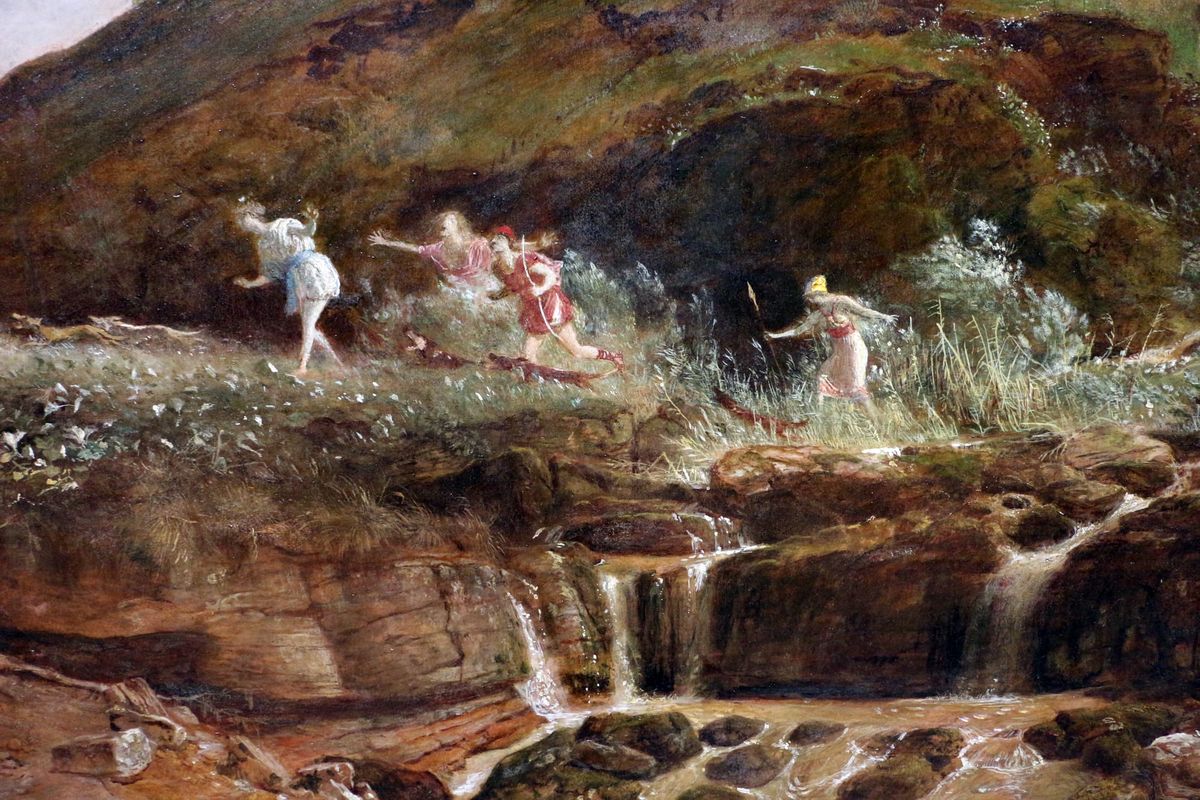
스위스 출신의 상징주의 거장 아놀드 뵈클린(Arnold Böcklin, 1827–1901)이 1896년에 이탈리아 피렌체 인근 산 도메니코에서 완성한 유화 디아나의 사냥(The Hunt of Diana, 이탈리아어: La Caccia di Diana, 독일어: Jagd der Diana)은 99.5 cm × 200.5 cm 크기의 대형 캔버스에 유채로 그린 대표작입니다. 현재 프랑스 파리의 오르세 미술관(Musée d'Orsay, Paris)에 소장되어 있습니다.
노년의 평온 속에서 되살려낸 신화 속 야생의 생명력
1890년대 중반 뵈클린은 스위스를 떠나 이탈리아 피렌체 교외의 아름다운 마을 산 도메니코에 자리를 잡았습니다. 뇌졸중을 겪고 육체적으로 쇠약해진 69세의 노화가였지만, 지중해의 따뜻한 햇살과 울창한 숲은 그의 가슴속에 잠들어 있던 원초적인 자연에 대한 갈망을 다시금 불타오르게 했습니다. 화가는 로마 신화 속 사냥과 달의 여신인 디아나(그리스 신화의 아르테미스)와 그녀를 따르는 숲의 님프들이 깊은 산속에서 사냥개들과 함께 사냥감을 쫓아 질주하는 역동적인 순간을 화폭에 담았습니다.
평생 동안 가난과 8명의 자녀를 먼저 떠나보내는 지독한 참척의 고통을 겪었던 뵈클린에게, 인간의 손길이 닿지 않은 태고의 숲과 계곡은 상처 입은 영혼을 씻어주는 신성한 도피처였습니다. 깎아지른 바위 언덕 아래로 맑은 시냇물이 폭포처럼 쏟아져 내리고, 흰옷과 붉은 옷을 입은 요정들이 활과 창을 쥐고 사냥개들과 함께 덤불을 헤치며 뛰어가는 장면은 자연의 거침없는 생명력을 고스란히 보여줍니다. 죽음의 그림자가 드리우던 노년의 문턱에서도 화가는 신화 속 사냥의 활기찬 에너지를 통해 삶을 향한 끝없는 찬가와 예술적 열정을 눈부시게 뿜어냈습니다.
질주하는 님프들의 흰 옷자락에서 쏟아지는 계곡 폭포수로, 시선의 심리적 여정
그림을 마주하는 순간 관람객의 무의식적 시선은 화면 왼쪽 위 풀숲 사이를 날렵하게 뛰어가는 여신 디아나와 님프들의 하얀 옷자락, 그리고 앞장서서 달려나가는 사냥개들의 날렵한 몸짓으로 가장 먼저 빨려 들어갑니다. 바람에 흩날리는 옷자락과 활시위를 메고 질주하는 요정들의 역동적인 몸짓은 보는 이에게 짜릿한 속도감과 숲속의 신선한 공기를 전해줍니다.
이어 시선은 창을 꼬나쥐고 어두운 동굴과 바위틈 사이를 샅샅이 수색하는 오른쪽 님프의 결연한 뒷모습과, 붉은 옷을 입고 활을 든 사냥꾼의 긴장된 표정으로 이동합니다. 덤불 속에서 언제 튀어나올지 모르는 사냥감을 쫓는 사냥꾼들의 예리한 집중력을 확인하는 순간 관람객은 신화 속 사냥터 한가운데에 서 있는 듯한 생생한 몰입감을 경험합니다.
마지막으로 시선은 요정들의 발밑으로 흘러내려 화면 아래쪽을 시원하게 채우고 있는 층층의 붉은 암반과 그 위를 포말을 일으키며 쏟아지는 맑은 계곡물에 멈춥니다. 바위에 부딪혀 하얗게 부서지는 시원한 물줄기와 촉촉하게 젖은 돌들의 생생한 질감을 마주하며, 관람객은 거친 대지 속에서도 끊임없이 순환하는 대자연의 원초적인 활력과 티 없이 맑은 평화로움을 가슴 깊이 마주하게 됩니다.
신화와 풍경의 완벽한 융합, 미술계의 평가
미술계는 디아나의 사냥을 단순한 고전 신화의 일러스트레이션을 넘어서, 웅장한 자연 풍경과 인물의 서사적 움직임이 하나의 거대한 교향악처럼 어우러진 후기 상징주의 회화의 걸작으로 평가합니다.
박제된 고대 신화의 틀을 깨고 숲의 소리와 물의 차가움, 그리고 사냥의 뜨거운 열기를 오직 색채와 대기의 조화로 완벽하게 포착했기 때문입니다. 삶의 황혼기에서도 자연의 신비와 영원한 젊음을 노래했던 뵈클린의 이 눈부신 캔버스는 오늘날까지도 수많은 이들에게 대자연이 품은 무한한 생명력을 전해주는 찬란한 유산으로 손꼽힙니다.
The Primeval Surge of the Forest Chase, The Hunt of Diana
Painted in 1896 in San Domenico near Florence by the preeminent Swiss Symbolist master Arnold Böcklin (1827–1901), The Hunt of Diana (Italian: La Caccia di Diana, German: Jagd der Diana) is an oil on canvas measuring 99.5 cm × 200.5 cm (39.2 in × 78.9 in), preserved in the permanent collection of the Musée d'Orsay in Paris, France.
Tuscan Sanctuary, Mythic Awakening, and the Triumph over Frailty
In the mid-1890s, Arnold Böcklin established his final residence in San Domenico overlooking Florence. Though physically slowed by an earlier stroke and approaching his seventieth year, the radiant Tuscan climate and rugged Apennine hills reignited his lifelong passion for elemental nature. Turning away from the somber motifs of mortality, the veteran painter immersed himself in classical myth, depicting Diana, the virgin goddess of the hunt, pursuing quarry through a rugged mountain ravine alongside her attendant nymphs and hound pack.
Having endured crushing poverty and the tragic loss of eight of his fourteen children throughout his lifetime, Böcklin regarded untamed wilderness as a sacred sanctuary of psychic renewal. Framed by steep rocky embankments where crystalline streams cascade over tiered stone steps, nymphs draped in fluttering white and vermilion tunics leap forward with bows and hunting spears. Rather than treating mythology as a detached academic exercise, Böcklin transformed the hunt into a vibrant celebration of bodily energy and uninhibited freedom, channeling his own indomitable will to live into a kinetic hymn to primal nature.
Subconscious Trajectory of the Gaze: From Flowing Drapery to the Cascading Torrent
The observer's subconscious gaze is immediately seized by the lithe silhouette of Diana surging along the elevated ledge on the left, drawn to the luminous white folds of her short chiton and the low-slung forward sprint of the hunting hounds. The aerodynamic velocity of the figures bounding across the flowering bank generates an instant sensation of physical exhilaration.
The visual path then tracks rightward across the companions in pursuit, moving past the archer in scarlet to the resolute nymph brandishing a spear near the dark cavernous crevice. Encountering the sharp alertness of the hunters probing the shadowy undergrowth, the viewer is drawn into the breathless suspense of the ancient chase.
Finally, the trajectory descends beneath the hunters' path into the lower register, resting upon the stratified, earth-toned rock shelf and the foaming mountain brook spilling over the falls. Observing the glistening highlights on the wet stone and the transparent pools of rushing water, the spectator confronts the harmonious integration of human vitality with the enduring, uncorrupted forces of the natural world.
The Symphony of Myth and Landscape: Critical Legacy
Art historians revere The Hunt of Diana as a quintessential late triumph of Böcklin’s visionary Symbolism, seamlessly harmonizing narrative action with atmospheric landscape painting.
By prioritizing sensory immediacy, the tactile weight of earth and water, and the natural dynamics of movement over rigid neoclassical decorum, Böcklin revitalized antiquity through a vibrant modern sensibility. This radiant landscape stands as an inspiring monument to the master's late creative resurgence, celebrating the timeless youth and unconquerable majesty of the primordial earth.
본 컨텐트의 저작권은 팔렛트제주에 있습니다. 허가없는 무단전제를 금지합니다.
Copyright © Palette Jeju. All rights reserved. Unauthorized reproduction or redistribution is strictly prohibited.