그리스도의 유혹 The Temptation of Christ
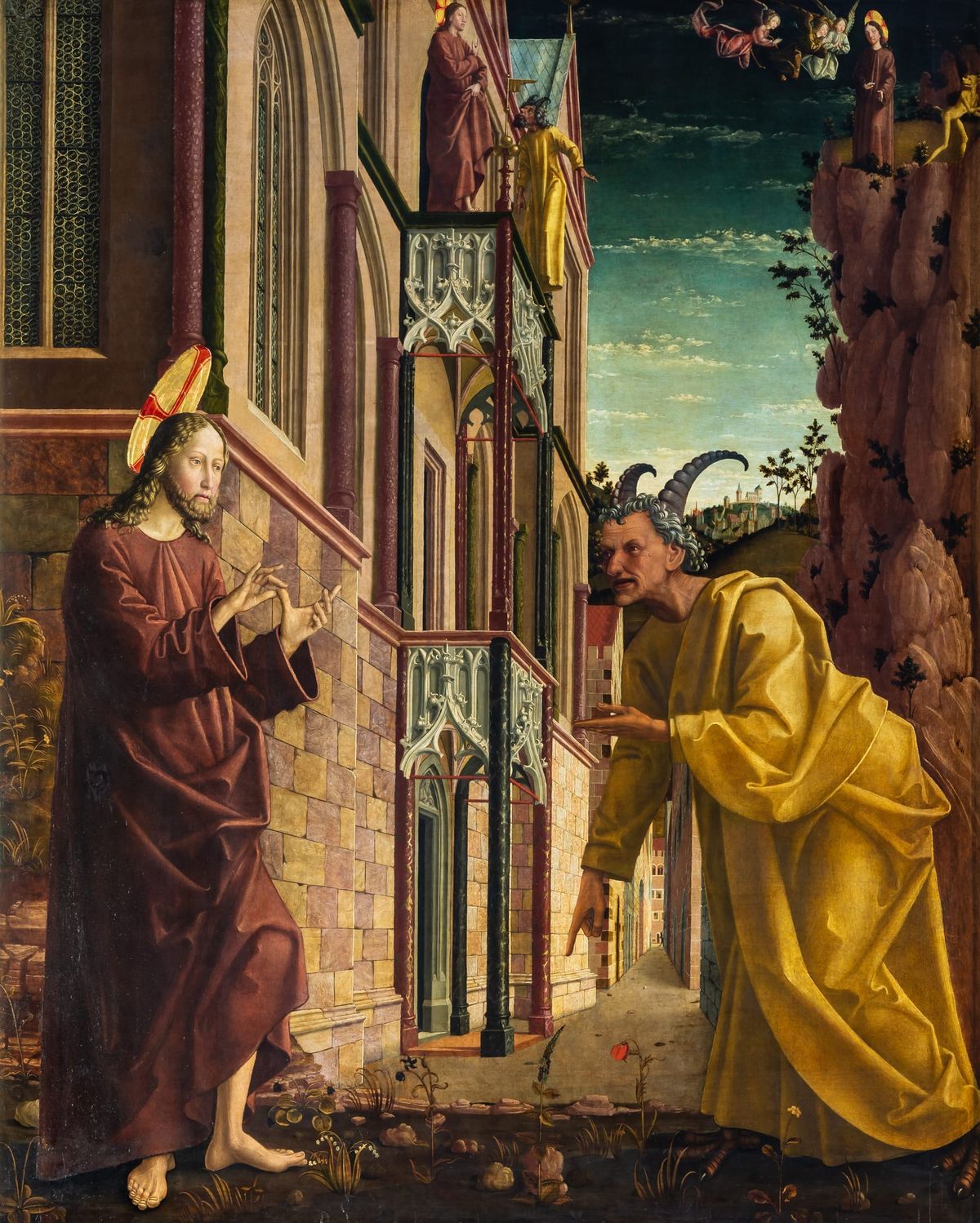
알프스의 찬 바람이 창틈을 매섭게 파고들던 15세기 후반, 티롤 지방의 외딴 공방에서 미하엘 파허는 꽁꽁 얼어붙은 손을 입김으로 녹여가며 이 거대한 제단화의 패널을 마주했습니다. 북유럽 고딕의 묵직한 전통 위에 이탈리아 르네상스의 새로운 공간감을 불어넣으려 치열하게 고민하던 그는, 나무 패널 위에 템페라와 유채를 겹겹이 얹으며 성스러운 구원의 서사를 완성해 나갔습니다.
이 작품은 오스트리아 잘츠캄머구트의 성 볼프강 성당에 위치한 성 볼프강 제단화의 날개 패널 중 하나인 그리스도의 유혹으로, 제작 시기는 1471년부터 1481년 사이입니다. 정확한 공식 소장처는 성 볼프강 가톨릭 성당이며, 패널의 대략적인 실측 규격은 높이가 약 200센티미터를 넘는 거대한 규모로 성당 제단의 장엄함을 더합니다.
작가의 고뇌/비하인드
작품의 전면 왼쪽에는 붉은 옷을 입은 그리스도가 맨발로 단단한 대지 위에 서서 차분하지만 단호한 손짓으로 유혹을 거절하고 있으며, 오른쪽에는 뿔이 돋아난 기괴한 얼굴과 새의 발을 한 악마가 노란 옷을 걸친 채 굽은 자세로 교묘한 제안을 건네고 있습니다.
중경에는 정교하게 조각된 고딕 양식의 건물 테라스와 회랑이 입체적인 원근법을 바탕으로 펼쳐져 있으며, 그 위층과 발코니에는 작은 규모로 반복되는 유혹의 서사적 순간들이 다채롭게 배치되어 시각적 깊이감을 더합니다.
원경의 오른쪽 위 하늘 높이솟은 험준한 바위 산 위에는 또 다른 유혹의 장면에 등장하는 인물들과 함께 천사들이 머물고 있고, 멀리 지평선 너머로 아스라이 펼쳐진 풍경이 대기감을 형성하며 공간을 극적으로 확장합니다.
무의식 속 시선 및 심리 흐름
관람객의 시선은 가장 먼저 화면 왼쪽 전면에 배치된 그리스도의 밝은 얼굴과 붉은 의복, 그리고 그를 향해 허리를 굽힌 오른쪽 악마의 노란 실루엣 사이의 팽팽한 긴장감으로 곧바로 빨려 들어갑니다.
이어 시선은 두 인물 사이의 대립을 넘어 중앙의 정교한 고딕 건축물 회랑과 테라스의 수직적 구조물로 자연스럽게 이동하며 공간 속으로 깊숙이 걸어 들어가는 듯한 몰입감을 느끼게 됩니다.
마지막으로 시선은 아득한 원경의 바위 절벽 위에서 빛나는 천사들과 아득한 하늘의 대기감으로 부드럽게 확산되며, 내면의 번뇌를 넘어선 궁극의 평온과 영적인 카타르시스를 경험하게 됩니다.
미술계의 평가 및 조형미
미술사학계는 이 작품을 북유럽 고딕 미술의 정교한 장인 정신과 이탈리아 르네상스의 선구적인 원근법이 가장 완벽하게 융합된 세기의 걸작으로 평가합니다.
템페라와 유채의 특성을 섬세하게 결합하여 구현한 건축물의 질감, 의복의 깊은 주름, 그리고 인물의 표정에서 드러나는 심리적 극대화는 물질적인 안료를 넘어선 깊은 감동을 선사합니다.
시대와 공간의 한계를 뛰어넘어 인간의 본원적 갈등과 구원의 메시지를 시각적 예술의 극치로 승화시킨 이 작품은, 영원토록 미술사에서 빛나는 숭고한 가치를 지니고 있습니다.
영문 번역본 구성
The Temptation of Christ
In the late fifteenth century, as the biting alpine winds pierced through the cracks of a remote workshop in Tyrol, Michael Pacher faced the panels of this grand altarpiece while warming his frozen hands with his breath. Grappling intensely to infuse the heavy traditions of Northern Gothic art with the revolutionary spatial perspective of the Italian Renaissance, he meticulously layered tempera and oil upon the wooden panel to complete a sacred narrative of salvation.
This work is The Temptation of Christ, a wing panel from the famous St. Wolfgang Altarpiece located in the Pilgrimage Church of St. Wolfgang in the Salzkammergut region of Austria, created between 1471 and 1481. Officially housed in its original location at the Catholic parish church of St. Wolfgang, the monumental panel stands over two meters in height, exuding the solemn grandeur of the sanctuary.
The Artist's Struggle and Behind-the-Scenes
In the foreground on the left, Christ stands barefoot upon the solid earth, clad in a red robe, refusing the temptation with a calm yet resolute gesture, while on the right, a horned, grotesque demon with bird-like feet and a hunched yellow garment slyly offers a cunning proposition.
In the middle ground, elaborately rendered Gothic architectural terraces and corridors unfold based on precise linear perspective, where smaller narrative episodes of the temptation are artfully arranged on upper levels to enhance spatial depth.
In the distant background high atop the rugged rocky cliffs to the upper right, figures from another temptation scene appear alongside gathering angels, while a faint landscape rolling beyond the horizon creates an atmospheric expanse that dramatically widens the pictorial space.
Subconscious Gaze and Psychological Flow
The viewer's gaze is immediately drawn into the intense psychological tension between the bright countenance and red drapery of Christ on the lower left and the stooped yellow silhouette of the demon confronting Him on the right.
The eye then naturally flows upward and inward, traversing the intricate vertical structures of the Gothic architectural arcades and terraces in the center, creating an immersive sensation of stepping deep into the pictorial space.
Finally, the gaze expands softly toward the radiant angels perched upon the distant rocky cliffs and the atmospheric sky, guiding the observer past inner turmoil to experience ultimate tranquility and spiritual catharsis.
Art World Evaluation and Formal Beauty
Art historians evaluate this work as a supreme masterpiece that seamlessly merges the intricate craftsmanship of Northern Gothic art with the pioneering perspective of the Italian Renaissance.
The textures of the architecture, the deep folds of the garments, and the psychological intensity conveyed through the figures' expressions—achieved through the delicate integration of tempera and oil—deliver a profound resonance that transcends mere physical pigments.
Elevating the fundamental human conflict and the message of salvation to the pinnacle of visual art across time and space, this creation retains an enduring, sublime value in art history.
Copyright © Palette Jeju. All rights reserved. Unauthorized reproduction or redistribution is strictly prohibited.