거위를 돌보는 소녀 - The Goose Girl (La Gardeuse d'oies)
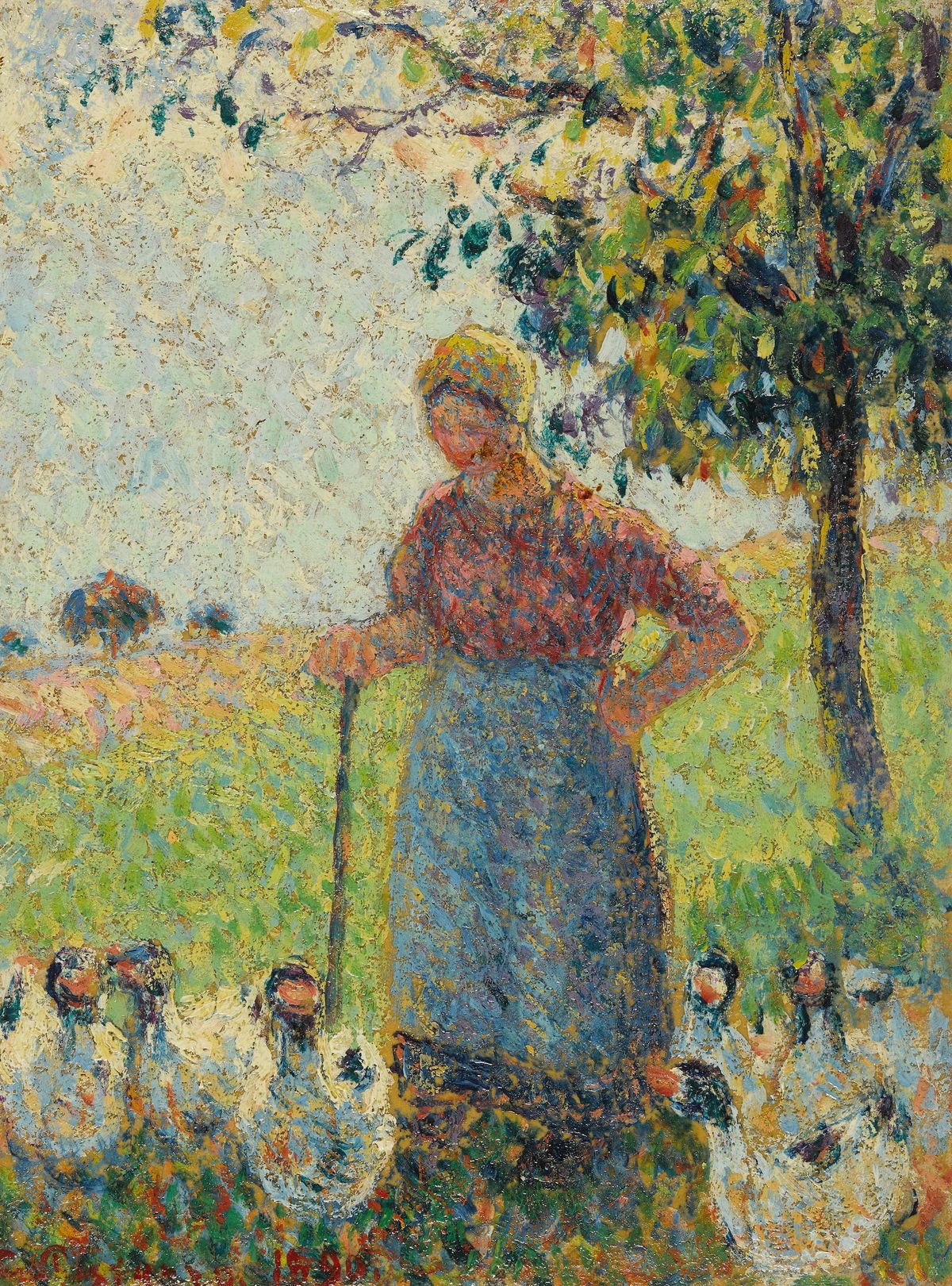
카미유 피사로(Camille Pissarro)가 1890년에 완성한 캔버스 유화 작품입니다. 실제 크기는 약 46.5 x 38 cm이며, 현재 개인 소장(Private Collection)으로 보관되어 있습니다.
인상주의를 넘어 신인상주의 점묘 기법의 정수를 탐구하던 시기에 제작된 이 작품은, 캔버스 위에 작은 색점과 짧은 붓질을 무수히 중첩하여 눈부신 햇살의 진동과 싱그러운 자연의 생명력을 극대화했습니다. 흙과 풀, 인물의 옷자락과 거위의 깃털 위에 흩뿌려진 다채로운 색채 입자들은 서로 어우러지며 보석처럼 반짝이는 독특한 질감과 따스한 대기감을 자아냅니다.
이 작품에는 나이와 명성을 내려놓고 오직 순수한 예술적 열정에 모든 것을 걸었던 피사로의 놀라운 비하인드 스토리가 깃들어 있습니다. 당시 50대 후반의 원로 화가였던 피사로는 자신보다 스물아홉 살이나 어린 조르주 쇠라와 폴 시냐크의 점묘주의에 매료되어, 기존의 성공적인 화풍을 과감히 버리고 새로운 기법을 치열하게 연마했습니다.
그림을 완성하는 데 너무 많은 시간과 정성이 들어가자 전속 화상이었던 뒤랑뤼엘은 그림이 팔리지 않는다며 거세게 불평했고, 피사로는 또다시 극심한 가난과 생활고에 시달려야 했습니다. 그러나 그는 예술적 신념을 꺾지 않고 에라니의 시골집 마당에서 매일같이 붓을 들었습니다.
마을의 소박한 처녀와 마당을 뒤뚱거리며 먹이를 조르는 거위 떼를 다정한 눈길로 관찰하며 완성한 이 그림은, 가난과 주변의 냉소 속에서도 삶의 순수한 기쁨과 유머를 잃지 않았던 대가의 따뜻한 품성을 그대로 보여줍니다.
미술사적으로 이 작품은 과학적인 색채 분할 이론과 피사로 특유의 따스한 인간애가 가장 완벽하게 융합된 후기 명작으로 평가받습니다. 차갑고 계산적으로 흐르기 쉬운 점묘 기법에 대자연의 호흡과 정겨운 시골의 정취를 불어넣어 생명력을 부여했기 때문입니다.
평단과 후대의 비평가들은 평범한 시골 소녀와 거위들의 만남을 성스러운 목가적 평화로 승화시킨 피사로의 끈기와 순수한 예술혼에 깊은 찬사를 보내고 있습니다.
관람자의 무의식적인 시선은 지팡이를 짚고 허리에 손을 얹은 채 우뚝 서 있는 소녀의 안정감 있는 자세에서 편안하게 출발합니다.
이어 시선은 소녀의 발치에서 목을 길게 빼고 옹기종기 모여 재잘거리듯 올려다보는 거위들의 익살스럽고 귀여운 움직임으로 자연스럽게 하강합니다.
이 유쾌한 시각적 상호작용은 복잡한 일상에 지쳐 굳어 있던 뇌의 긴장을 즉각적으로 무장해제시키며 마음에 따스한 미소와 심리적 안도감을 선사합니다.
뒤이어 햇살을 듬뿍 머금은 나무줄기와 반짝이는 나뭇잎의 녹음을 지나 아스라한 들판과 하늘로 뻗어나가는 시선의 순환은, 상쾌한 전원의 풀 내음을 맡는 듯한 깊은 이완감과 충만한 정서적 치유를 이끌어냅니다.
The Goose Girl - The Goose Girl (La Gardeuse d'oies)
Painted in 1890 by Camille Pissarro, this oil on canvas measures approximately 46.5 by 38 centimeters and is held within a private collection.
Created during a pivotal era when Pissarro engaged with the scientific nuances of Neo-Impressionism, the canvas is woven with dense, rhythmic touches of pure color that bring the vibrant midday light to life. The shimmering interplay of broken pigments across the earthen ground, the peasant's apron, and the lively plumage of the geese creates a richly tactile surface radiating with pastoral warmth.
Behind this idyllic vision lies an extraordinary testament to Pissarro's courageous artistic integrity. In his late fifties, already celebrated as a father figure of Impressionism, Pissarro humbly embraced the revolutionary divisionist methods pioneered by Georges Seurat and Paul Signac, men nearly three decades his junior.
Because this meticulous pointillist technique demanded immense patience, his art dealer, Paul Durand-Ruel, protested that the works took too long to produce and were difficult to sell, plunging Pissarro once again into severe financial hardship.
Yet, undeterred by poverty and criticism, he continued to paint steadfastly in the gardens of Éragny. Observing a humble village girl minding her curious flock of geese, Pissarro captured this unpretentious daily routine with heartfelt affection, infusing the scene with subtle rural humor and genuine tenderness.
Art historians revere this work as a masterful synthesis where rigorous color theory harmoniously unites with profound humanist empathy. Rather than allowing divisionism to become rigid or mechanical, Pissarro breathed organic life and rustic poetry into every pigment.
Critics celebrate the canvas for elevating a simple peasant scene into an enduring pastoral sanctuary, honoring Pissarro's lifelong dedication to finding boundless grace in the humblest moments of rural existence.
The viewer's subconscious gaze first rests upon the centered, grounded posture of the young woman leaning gently against her staff.
The eye then descends naturally toward the flock of geese bustling at her feet, craning their necks upward in charming curiosity.
This endearing visual dialogue instantly dissolves mental fatigue, replacing daily tension with a lighthearted sense of delight and emotional grounding.
As the gaze wanders upward along the sunlit tree trunk, through the rustling canopy, and into the luminous horizon, the observer experiences a soothing sensory immersion akin to inhaling the fresh, sunny air of a quiet country field.
본 리뷰에서 작품을 제외한 컨텐츠의 저작권은 팔렛트제주에 있습니다.
"퍼블릭도메인 고전명화"를 제외한 모든 창작 콘텐츠는 저작권법 제4조 및 제10조에 의거하여 보호됩니다. 무단 도용시 저작권법 제136조(벌칙)에 의거, 당사의 사전 서면 승인 없는 저작권 침해 행위를 금지합니다.