건초더미가 있는 풍경, 오니 - Landscape with Haystacks, Osny (Paysage avec meules, Osny)
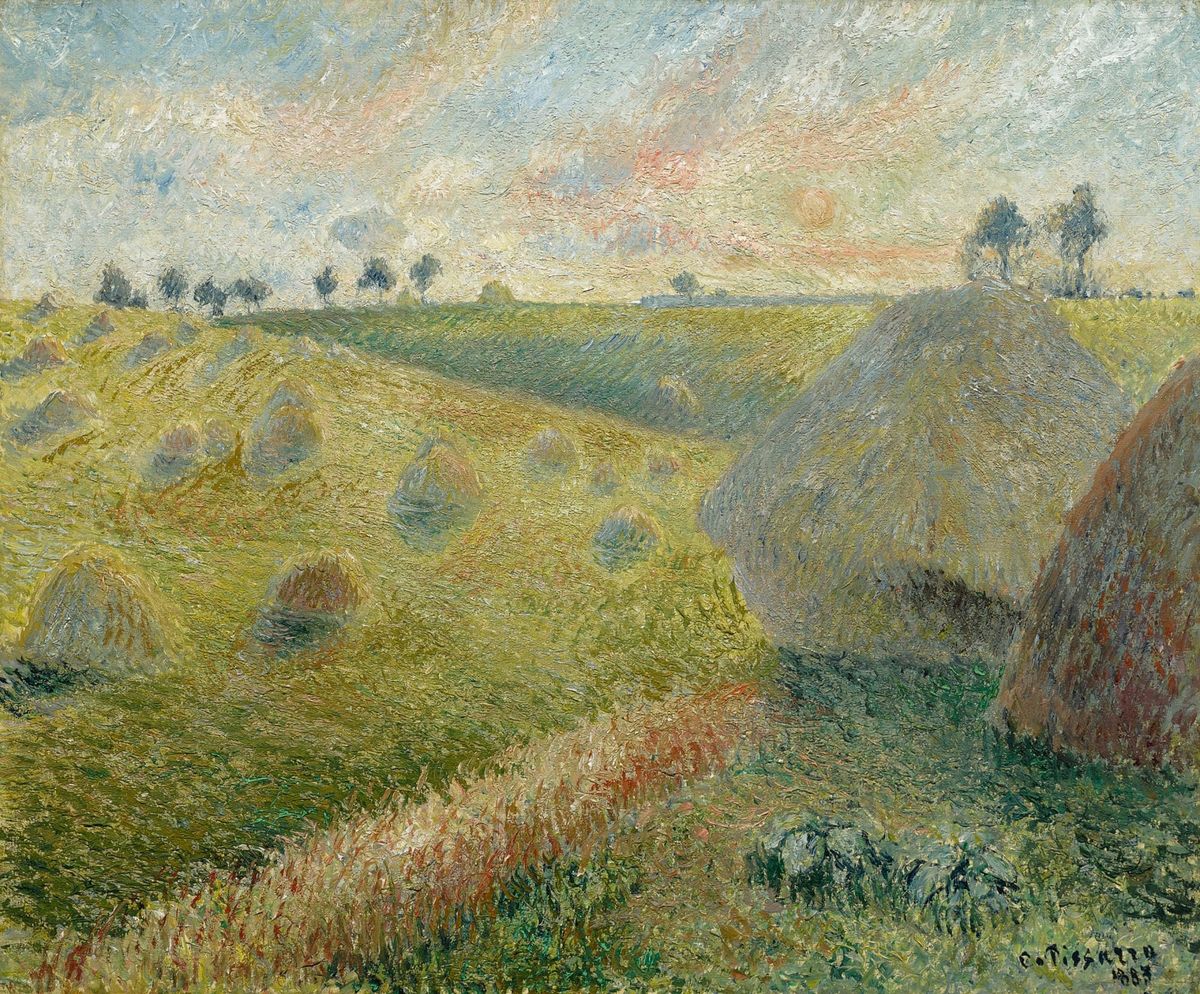
카미유 피사로(Camille Pissarro)가 1883년에 완성한 캔버스 유화 작품입니다. 실제 크기는 약 46 x 55 cm이며, 현재 개인 소장(Private Collection)으로 보관되어 있습니다. 화면 우측 하단에는 화가의 서명과 제작 연도인 'C. Pissarro 1883'이 정갈하게 새겨져 있습니다.
피사로는 늦여름에서 초가을로 넘어가는 계절의 햇살과 대기의 미묘한 떨림을 특유의 조밀하고 직조된 듯한 분할 붓터치로 생생하게 담아냈습니다. 전면의 마른 풀밭과 층층이 쌓아 올린 건초더미의 거친 촉감, 그리고 완만한 구릉지대를 가로지르는 빛의 산란은 두터운 유화 물감의 마티에르와 어우러져 깊은 공간감과 함께 전원의 풍성한 계절감을 자아냅니다.
이 작품이 완성된 1883년은 피사로가 파리 근교의 소박한 시골 마을 오니(Osny)에 머물며 생계와 예술의 갈림길에서 치열하게 분투하던 시기였습니다. 당시 인상주의 그림은 대중과 비평가들에게 외면받았고, 피사로는 대가족의 빵값을 걱정해야 할 정도로 극심한 생활고에 시달렸습니다.
그러나 피사로는 좌절하는 대신 매일 아침 화구를 짊어지고 오니의 들판으로 나갔습니다. 당시 농촌의 건초더미는 고된 수확의 결실이자 다가올 겨울을 버텨낼 수 있는 생명과 희망의 상징이었습니다. 흥미롭게도 클로드 모네가 훗날 1890년대에 연작으로 그려 전 세계적인 명성을 얻게 된 '건초더미' 연작보다 무려 7년이나 앞서, 피사로는 이미 오니의 들판에서 건초더미의 구조적 아름다움과 햇살의 변화를 진지하게 탐구하고 있었습니다. 가난 속에서도 묵묵히 붓을 들고 자연의 순수한 질서를 예찬했던 대가의 뚝심과 인내심이 캔버스 구석구석에 깃들어 있습니다.
미술사적으로 이 작품은 자연의 빛을 포착하는 인상주의의 시각적 혁신과 대지의 영속적인 조형미가 가장 조화롭게 결합된 수작으로 평가받습니다. 찰나의 빛 효과에만 몰두하기보다 들판의 부피감과 건초의 단단한 존재감을 화면에 안정적으로 정초 시켰기 때문입니다.
평단과 후대의 비평가들은 화려한 수사 없이도 수확을 마친 시골 들판에서 숭고한 평화와 삶의 안도감을 길어 올린 피사로의 깊은 휴머니즘에 아낌없는 찬사를 보내고 있습니다.
관람자의 무의식적인 시선은 화면 우측 전면에 묵직하고 든든하게 자리 잡은 거대한 건초더미의 둥근 실루엣에서 편안하게 출발합니다.
이어 시선은 완만한 언덕의 능선을 따라 좌측으로 유려하게 흘러가며, 들판 곳곳에 정겹게 흩어져 있는 작은 건초더미들의 리드미컬한 배열을 차례로 짚어 나갑니다.
이 안정적인 수평적 시선의 확장은 바쁜 일상과 끝없는 업무에 쫓기던 현대인의 뇌파를 순식간에 차분한 알파파 상태로 이끌며, 수확의 풍요로움이 주는 깊은 심리적 안도감과 충만함을 선사합니다.
마지막으로 지평선 위에 아스라하게 서 있는 미루나무들과 부드러운 노을빛 구름이 흐르는 하늘을 돌아 다시 따뜻한 황금빛 들판으로 순환하는 시선의 흐름은, 늦은 오후의 은은한 햇살 아래 서서 가을바람을 깊게 들이마시는 듯한 깊은 이완과 정서적 정화를 이끌어냅니다.
Landscape with Haystacks, Osny - Landscape with Haystacks, Osny (Paysage avec meules, Osny)
Painted in 1883 by Camille Pissarro, this oil on canvas measures approximately 46 by 55 centimeters and is preserved within a private collection. The artist's signature and date, 'C. Pissarro 1883', are inscribed distinctly in the lower right corner.
Employing a dense, woven network of divided brushstrokes, Pissarro masterfully captures the delicate vibration of early autumn sunlight across the rural countryside. The coarse, tactile presence of dry meadow grasses, the layered impasto of rounded haystacks, and the luminous play of light traversing the rolling hills unite into an extraordinary harmony of color, texture, and spatial depth.
The year 1883 marked an intense chapter of artistic perseverance during Pissarro's residence in the quiet commune of Osny. Enduring severe financial strain while providing for his large family, Pissarro faced constant rejection from conservative art circles yet ventured outdoors daily with his easel.
To the rural community, freshly built haystacks represented the successful culmination of seasonal labor and an essential reserve of sustenance for the approaching winter. Remarkably, seven years before Claude Monet achieved international acclaim with his own famous series of haystacks in the 1890s, Pissarro was already investigating the structural dignity and atmospheric nuances of these pastoral forms on the slopes of Osny. Despite enduring poverty, Pissarro translated the quiet rhythms of the earth with unyielding devotion and moral grace.
Art historians celebrate this painting as a magnificent triumph where Impressionist optical sensitivity harmoniously merges with enduring architectural stability. Rather than allowing forms to dissolve purely into optical reflections, Pissarro grounded the canvas with the tangible weight and presence of the harvest.
Modern critics honor the work for its authentic emotional resonance, praising Pissarro's steadfast ability to discover timeless peace, quiet solace, and universal nobility across the unadorned fields of the French countryside.
The viewer's subconscious gaze is first grounded by the monumental, comforting presence of the large haystack rising in the right foreground.
The eye then glides smoothly along the diagonal contour of the rolling field toward the left, tracing the rhythmic progression of smaller haystacks scattered peacefully across the sunlit hillside.
This expansive and unhurried visual pathway relieves accumulated mental fatigue, instilling an immediate sense of emotional stability, safety, and grounded contentment.
As the visual path wanders toward the delicate row of trees along the ridge and into the soft, pastel-tinted sky before returning to the sun-warmed earth, the observer experiences a soothing sensory escape, enveloped in the lasting calm and restorative tranquility of an autumn evening across the open fields.
본 리뷰에서 작품을 제외한 컨텐츠의 저작권은 팔렛트제주에 있습니다.
"퍼블릭도메인 고전명화"를 제외한 모든 창작 콘텐츠는 저작권법 제4조 및 제10조에 의거하여 보호됩니다. 무단 도용시 저작권법 제136조(벌칙)에 의거, 당사의 사전 서면 승인 없는 저작권 침해 행위를 금지합니다.