거친 파도 속에서 피어난 바다 괴물 가족의 유쾌한 일상, 바다의 목가 Meeresidylle
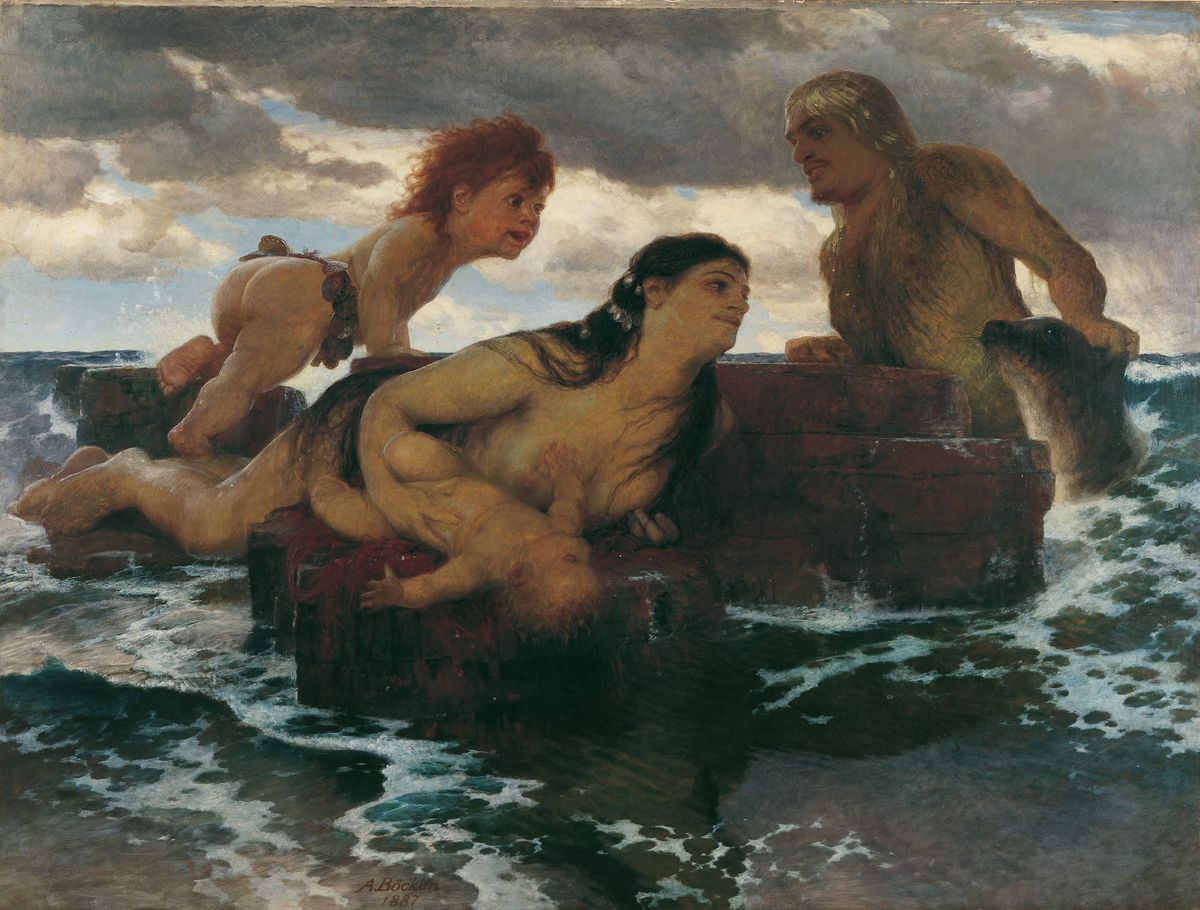
스위스 출신의 상징주의 거장 아놀드 뵈클린(Arnold Böcklin, 1827–1901)이 1887년에 스위스 취리히에서 완성한 유화 바다의 목가(Sea Idyll, 독일어: Meeresidylle)는 167.0 cm × 224.0 cm 크기의 거대한 캔버스에 유채로 그린 대표작입니다. 현재 오스트리아 빈의 벨베데레 미술관(Österreichische Galerie Belvedere, Vienna)에 소장되어 있습니다.
박제된 고전주의를 향해 날린 유쾌한 도발과 바다 생명체의 유머
1880년대 후반 뵈클린은 스위스 취리히에서 왕성한 창작열을 불태우며 유럽 전역에서 거장의 명성을 확고히 다지고 있었습니다. 당시 주류 아카데미 미술계는 고대 그리스와 로마의 신화를 고귀하고 엄숙하며 비례가 완벽한 신들의 이야기로만 다루어야 한다는 엄격한 규율에 얽매여 있었습니다. 신화 속 인물들은 항상 우아하고 조각상처럼 완벽해야 한다는 보수적 비평가들의 고루한 태도에 뵈클린은 깊은 지루함을 느꼈습니다. 그는 신화를 신성한 박제 상태에서 끄집어내어 인간미 넘치고 흙냄새 나는 생생한 현실로 뒤집어버리고자 했습니다.
이 거대한 캔버스에서 신화 속 바다 괴물인 트리톤 가족은 근엄함 대신 왁자지껄한 보통 사람들의 따뜻한 가족 일상을 보여줍니다. 젖은 바위 위에 엎드려 젖먹이 아기에게 젖을 물리는 어머니 트리톤과, 호기심 가득한 눈으로 엉덩이를 치켜들고 바위 위를 기어가는 붉은 머리 어린아이, 그리고 물개 한 마리를 옆에 끼고 흐뭇한 눈빛으로 아내와 아이들을 바라보는 털북숭이 아버지는 지극히 현실적이고 유쾌합니다. 뵈클린은 신화의 주인공들을 완벽한 신이 아니라 바닷바람을 맞으며 거칠고 생명력 넘치게 살아가는 하나의 생명체 가족으로 표현했습니다. 엄격한 미술계의 고정관념을 보란 듯이 깨뜨리며 생생한 해학과 원초적인 생명력을 유쾌하게 분출한 화가의 기발한 예술혼이 화폭 가득 살아 숨 쉽니다.
젖을 먹이는 어머니의 시선에서 장난기 어린 바다 아이로, 시선의 심리적 여정
그림을 마주하는 순간 관람객의 무의식적 시선은 화면 중앙 젖은 붉은 암반 위에 누워 갓난아기에게 젖을 물리고 있는 풍만한 어머니 트리톤의 밝은 피부와 부드러운 옆모습으로 가장 먼저 빨려 들어갑니다. 아기를 품에 안고 남편을 바라보는 어머니의 온화한 눈빛은 보는 이에게 깊은 모성애와 따뜻한 안정감을 선사합니다.
이어 시선은 화면 오른쪽 바다에서 솟아올라 물개를 붙잡고 사람 좋은 미소를 짓고 있는 털북숭이 아버지 트리톤의 얼굴로 이동합니다. 억센 체구와 헝클어진 머리칼 뒤에 숨겨진 다정다감한 아버지의 시선을 확인하는 순간, 관람객은 거친 바다 괴물의 외형 속에 깃든 지극히 인간적인 정겨움을 느끼게 됩니다.
마지막으로 시선은 화면 왼쪽 위 바위턱을 짚고 통통한 엉덩이를 드러낸 채 바다를 쳐다보는 붉은 머리 사내아이를 지나, 화면 아래쪽 짙푸른 바닷물이 하얀 거품을 일으키며 밀려드는 생생한 파도에 멈춥니다. 쉴 새 없이 출렁이는 차가운 바다 한가운데서도 흔들림 없이 피어나는 가족의 소박한 행복을 마주하며, 관람객은 겉치레를 벗어던진 순수한 생명체가 뿜어내는 따스한 유머와 원초적인 생명력을 가슴 깊이 마주하게 됩니다.
신화의 파격적 해학과 상징주의의 새로운 지평, 미술계의 평가
미술계는 바다의 목가를 19세기 유럽 상징주의 회화가 고전 신화의 엄숙주의를 해체하고 가장 독창적인 해학과 활력으로 재창조해 낸 기념비적인 명작으로 평가합니다.
바다의 습기와 차가운 소금기, 그리고 인물들의 살아 숨 쉬는 피부 질감을 과감한 붓 터치와 독보적인 조형미로 완벽하게 포착했기 때문입니다. 고루한 아카데미의 틀을 벗어나 신화 속 괴물들조차 따뜻한 생명의 가족으로 탈바꿈시킨 뵈클린의 이 대담한 화폭은 훗날 상징주의는 물론 현대적 환상 미술의 새로운 장을 연 불멸의 걸작으로 손꼽힙니다.
The Primeval Humor of the Siren Family, Sea Idyll
Painted in 1887 in Zurich by the preeminent Swiss Symbolist master Arnold Böcklin (1827–1901), Sea Idyll (German: Meeresidylle) is a monumental oil on canvas measuring 167.0 cm × 224.0 cm (65.7 in × 88.2 in), preserved in the permanent collection of the Belvedere Museum (Österreichische Galerie Belvedere) in Vienna, Austria.
Defiance of Neoclassical Dogma and the Earthy Humor of Mythic Life
In the late 1880s, Arnold Böcklin enjoyed immense acclaim across German-speaking Europe while working in his Zurich studio. At that time, academic institutions strictly dictated that classical deities and sea mythology must be rendered with solemn nobility, idealized proportions, and pristine marble perfection. Böcklin felt deeply constrained by this lifeless academic decorum, finding traditional historical treatments detached from genuine physical vitality. Determined to strip ancient myth of its polite aristocratic veneer, he sought to humanize supernatural beings with uninhibited humor and elemental warmth.
This vast canvas subverts mythological conventions by depicting a family of Triton sea creatures enjoying an unpolished, domestic afternoon upon a coastal reef. Lounging on a wet stone shelf, a maternal siren nurses her infant while exchanging an affectionate glance with her bearded partner, who wades in the breaking waves clutching a seal. Meanwhile, an older red-headed imp crawls inquisitively across the rocks, displaying a bare, sunlit rump toward the stormy sea. Böcklin transformed fantastic monsters into tangible, living organisms governed by the basic instincts of kinship, affection, and survival, creating a triumphant celebration of primal biological vitality that mocked conservative academic propriety.
Subconscious Trajectory of the Gaze: From Maternal Embrace to the Inquisitive Imp
The observer's subconscious gaze is immediately arrested by the luminous, full-figured silhouette of the sea nymph reclining upon the dark red reef at the center. The soft modeling of her pale skin against the wet stone and the tender posture of cradling her nursing child establish an immediate atmosphere of primal maternal warmth.
The visual path then shifts rightward to the muscular, seaweed-draped figure of the Triton emerging from the foam. Taking in his jovial countenance, shaggy hair, and the dark head of the sea lion held under his arm, the viewer experiences a delightful transition from classical fantasy to good-natured domestic familiarity.
Finally, the trajectory ascends toward the upper left to discover the buoyant, red-haired toddler scrambling along the wave-swept outcrop, before descending into the churning white surf washing across the lower foreground. Observing the tactile contrast between the cold oceanic current and the warm intimacy of the amphibious family, the spectator confronts Böcklin’s extraordinary capacity to unite mythic grandeur with playful, unvarnished human realism.
The Monument of Mythological Vitalism: Critical Legacy
Art historians revere Sea Idyll as one of Böcklin’s most audacious masterpieces, dismantling academic classicism through expressive humor and visceral naturalism.
By prioritizing physiological authenticity, tactile textures of brine and stone, and psychological warmth over neoclassical decorum, Böcklin established a groundbreaking visual language for modern Symbolist art. This monumental canvas endures as an inspiring testament to the master's boundless imaginative freedom, celebrating the untamed vitality and timeless humor of the natural world.
본 컨텐트의 저작권은 팔렛트제주에 있습니다. 허가없는 무단전제를 금지합니다.
Copyright © Palette Jeju. All rights reserved. Unauthorized reproduction or redistribution is strictly prohibited.