가스파르 어멈, 퐁투아즈 (La Mère Gaspard, Pontoise, 1876)
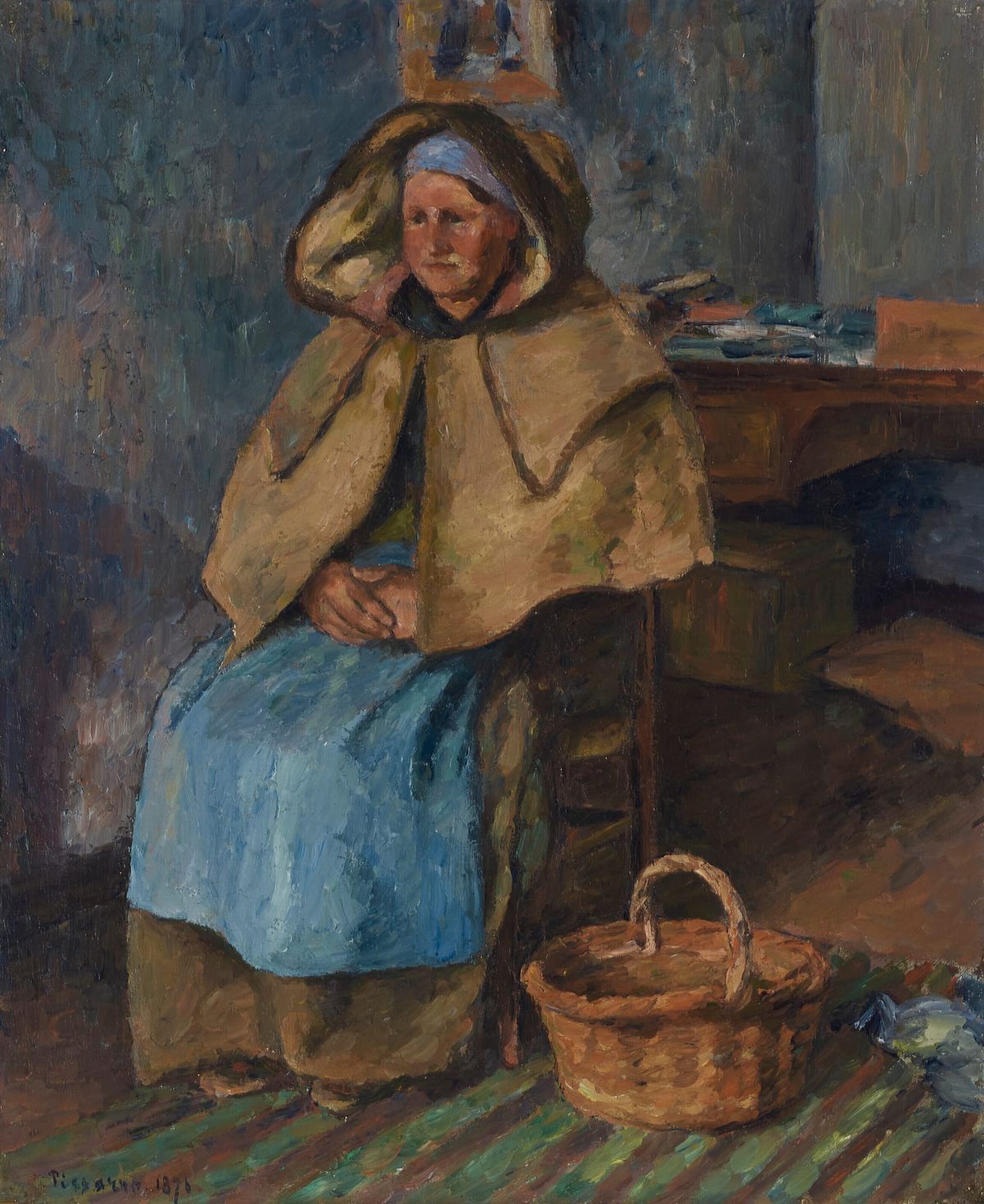
1870년대 중반 퐁투아즈에 정착하여 대지의 정직한 숨결을 화폭에 담던 카미유 피사로는 풍경뿐만 아니라 그 터전에서 거친 세월을 살아낸 평범한 이웃들의 얼굴에 주목했습니다. 당시 파리의 화려한 사교계나 부르주아의 우아한 초상화가 주류를 이루던 시대에, 피사로는 투박한 망토를 두르고 소박한 나무 의자에 앉아 있는 노파의 주름진 생애를 진솔한 회화적 주제로 끌어올렸습니다.
가로 45.8cm, 세로 55.8cm 크기의 캔버스에 유채로 완성된 이 작품은 퐁투아즈의 마을 주민이었던 '가스파르 어멈'의 묵직한 존재감을 통해 농촌 민중이 지닌 삶의 무게와 숭고한 존엄성을 피사로 특유의 흙빛 질감과 따스한 시선으로 포착해 낸 대표적인 인물화 걸작입니다.
관람자의 시각 인지 체계는 어두운 실내 배경 속에서 가장 강력한 채도 대비를 형성하는 노파의 푸른빛 앞치마와 그 위에 가지런히 모아 쥔 투박한 손에 먼저 정초합니다. 푸른 면과 거친 손의 대비는 시각 피질의 중심와를 즉각 포획하며 화면 전반의 구조적 안정감을 확립합니다.
이어서 시선은 두터운 후드 형태의 갈색 망토 곡선을 따라 상승하여 은은한 빛을 머금은 노파의 주름진 얼굴과 먼 곳을 응시하는 고요한 눈매로 자연스럽게 이동합니다. 평생의 노동이 깃든 인물의 표정을 확인한 시선은 다시 하단으로 내려와 바닥의 굵은 직물 줄무늬와 발치에 놓인 촉각적인 짚 바구니의 형태감을 훑어 나갑니다.
소박한 실내의 은은한 명암과 분절된 붓질들이 망막 위에서 하나의 견고한 인격체로 통합되는 순간, 관조자는 대상의 화려함을 걷어낸 순수한 실존의 무게와 마주하며 깊은 인간적 유대감과 잔잔한 심리적 안도감을 경험하게 됩니다.
이 그림이 제작된 1876년은 피사로가 제2회 인상주의 전시회에 참여하며 혹독한 비평에 맞서던 때로, 그는 폴 세잔과 퐁투아즈에서 매일같이 형태와 구조의 본질을 치열하게 토론하고 있었습니다. 화려한 기교나 감상적인 과장을 철저히 배제하고 대상을 있는 그대로 기록하고자 했던 피사로의 엄격한 태도는 세잔의 초기 인물화 구성에 막대한 영향을 미쳤습니다.
훗날 빈센트 반 고흐는 피사로가 그린 농민들의 진실한 모습에 깊이 감명받아 "피사로는 농촌의 영혼을 겉치레 없이 담아내는 유일한 대가"라며 찬사를 아끼지 않았습니다.
대지의 결을 닮은 농촌 여인의 삶을 묵직한 조형미와 깊은 휴머니즘으로 영원히 기록한 피사로의 이 초상화는, 현대 미술사에서 인상주의가 감각적 빛의 유희를 넘어 인간 실존에 대한 가장 정직하고 숭고한 찬가로 승화된 역사적 이정표로 높이 평가받고 있습니다.
Mother Gaspard, Pontoise (La Mère Gaspard, Pontoise, 1876)
During the mid-1870s in Pontoise, Camille Pissarro turned his empathetic gaze toward the weathered faces of the rural folk who cultivated the earth. At a time when the Paris art world celebrated aristocratic refinement and fashionable salon portraiture, Pissarro quietly elevated the quiet endurance of an ordinary peasant matriarch wrapped in heavy homespun wool into a monument of profound human gravity.
Measuring 55.8 by 45.8 cm, this intimate oil on canvas portrays a local villager known as "Mother Gaspard," synthesizing rich, earthen impasto with unadorned tenderness to reveal the deep-seated dignity inherent in agrarian life.
The observer’s perceptual framework is immediately arrested by the luminous cerulean blue apron and the weathered hands folded peacefully across her lap, which provide a compelling chromatic and structural anchor against the muted backdrop. This centered mass instantly captures the fovea, establishing an intuitive foundation of stability.
From this grounded nexus, the ocular trajectory ascends along the textured folds of her hooded mantle, rising to the soft illumination caressing her aged features and reflective, contemplative gaze. Scanning downward once more, the eye takes in the woven texture of the wicker basket resting upon the striped floor mat beside her feet.
As the visual cortex integrates these broken, tactile strokes into a unified human presence, the observer transitions beyond visual scrutiny into a state of profound stillness, intimately attuned to the quiet resilience and unvarnished truth of a lifetime of honest labor.
Painted during the pivotal year of the Second Impressionist Exhibition, this work reflects Pissarro’s intensive aesthetic dialogues with Paul Cézanne in Pontoise, where both artists sought to uncover the underlying tectonic structure beneath surface light. Pissarro's steadfast refusal to sentimentalize poverty or embellish rural reality directly inspired Cézanne's rigorous approach to figurative volume.
Vincent van Gogh would later express profound admiration for Pissarro's humble peasant studies, revering his singular capacity to render the authentic soul of country folk without condescension or decorative artifice.
Masterfully immortalizing the spirit of rural labor through resolute form and deep humanist empathy, Pissarro's portrait of Mother Gaspard remains celebrated across art history as a timeless masterpiece of early Impressionist portraiture.
본 콘텐츠의 저작권은 저작권자에게 있으며, 무단 전재 및 재배포를 금합니다.