감자 심는 여인 - Woman Planting Potatoes
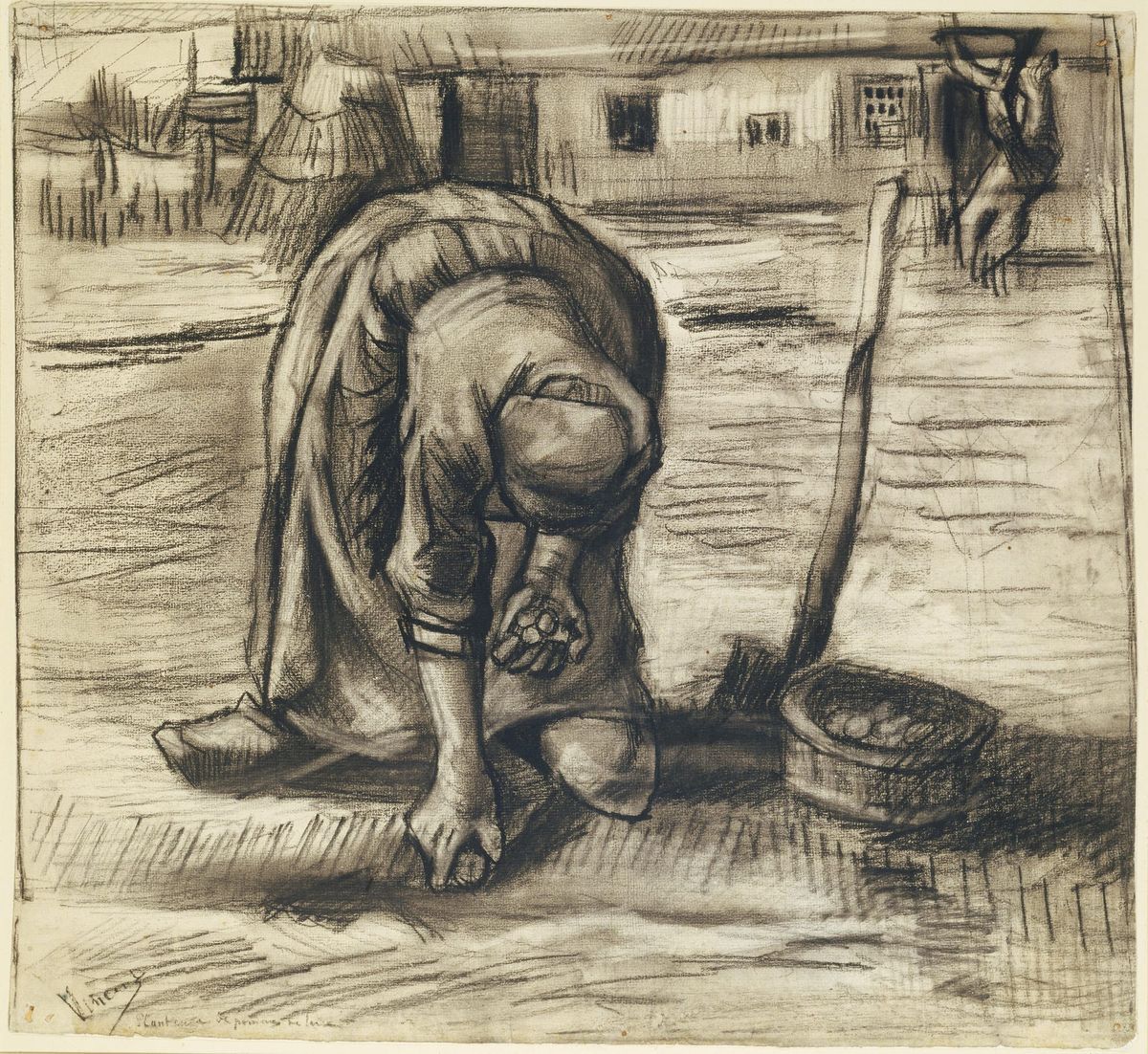
빈센트 반 고흐(Vincent van Gogh)가 1885년 7월에서 8월경, 네덜란드 브라반트주 뉘넌(Nuenen)에서 제작한 드로잉 명작입니다. 현재 네덜란드 암스테르담의 반 고흐 미술관(Van Gogh Museum)에 소장되어 있으며, 작품의 크기는 약 39.5 × 41.5 cm입니다. 종이 위에 흑초크(Black chalk)와 목탄, 연필을 복합적으로 사용하여 완성된 이 작품은 뉘넌 시절 진행된 대규모 농민 습작 연작 중에서도 단연 돋보이는 조형적 완성도를 자랑합니다.
고흐는 이 작품에서 흑연과 흑초크의 굵고 거친 필선을 종이에 강하게 문지르고 겹쳐 쌓아 올리는 방식을 구사했습니다. 마치 조각가가 돌을 깎아내듯 흙을 딛고 선 농민의 다부진 육체와 묵직한 부피감을 평면 위에 생생하게 구축해냈으며, 거친 선묘와 깊은 명암의 대조를 통해 농촌 노동의 고단함과 그에 내재된 강인한 생명력을 손에 잡힐 듯한 촉각적 질감으로 구현했습니다.
이 작품의 배경이 된 뉘넌 체류 시절, 고흐는 자신이 평생의 영적 스승으로 삼았던 프랑스 바르비종파의 거장 장-프랑수아 밀레(Jean-François Millet)의 예술관을 온전히 체화하고자 했습니다. 그는 안락한 화실에서 모델에게 인위적인 포즈를 취하게 하는 상투적인 아카데미즘 미술을 단호히 거부했습니다. 대신 매일같이 햇볕과 비바람이 내리쬐는 척박한 감자밭으로 직접 걸어 나가, 흙먼지를 뒤집어쓴 채 하루 종일 허리를 굽히고 일하는 농민들의 실제 노동 현장을 집요하게 관찰하고 화폭에 옮겼습니다.
고흐는 동생 테오에게 보낸 편지에서 "농민을 그릴 때는 그들이 풍기는 흙냄새와 감자 껍질 냄새, 그리고 땀방울의 진정성이 화면에서 배어 나와야 한다"고 거듭 강조했습니다. 그는 씨감자를 땅에 묻는 단순한 동작 속에서 대지의 섭리에 순응하며 정직하게 살아가는 인간 본연의 숭고한 도덕성을 발견했습니다.
당시 화단에서는 인체의 비례가 투박하고 지나치게 어둡다는 보수적인 비판을 받기도 했으나, 후대 미술사에서는 리얼리즘의 차원을 넘어 인간의 실존적 존엄성을 거친 선 하나로 증명해낸 초기 고흐 예술혼의 결정체로 평가받고 있습니다. 나아가 이 시기의 치열한 인물 탐구는 그의 불멸의 초기 걸작인 『감자 먹는 사람들』을 탄생시킨 결정적인 모태가 되었습니다.
작품을 대하는 관람객의 무의식적인 시선은 화면 중앙을 단단하게 지탱하고 있는 여인의 묵직하게 굽어진 등과 둥근 어깨선에 가장 먼저 닿게 됩니다. 거친 노동으로 단련된 굳건한 신체의 윤곽선은 보는 이로 하여금 화면 속으로 단숨에 빨려 들어가게 만드는 강한 시각적 무게감을 형성합니다.
이어 시선은 팽팽하게 긴장된 팔의 근육을 타고 내려가, 마침내 흙을 파헤치고 씨감자를 굳건히 심어 넣는 투박하고 굳은 손끝의 마디마디로 자연스럽게 이동합니다. 씨앗을 대지에 묻는 이 정적인 동작에 시선이 머무는 순간, 관람객은 대지와 인간이 나누는 가장 원초적이고 신성한 교감을 체감하며 깊은 몰입 속으로 빠져듭니다.
이후 시선은 여인의 곁에 묵직하게 놓인 감자 바구니와 흙에 꽂힌 삽의 소박한 실루엣을 지나, 뒤편으로 아스라이 물러나 있는 소박한 농가의 지붕과 고요한 공기 속으로 부드럽게 번져나갑니다.
주변을 둘러싼 여백과 거친 대지의 질감을 천천히 훑은 시선이 다시금 땅을 굳건히 딛고 있는 여인의 무릎과 흙바닥으로 안착할 때, 관람객의 내면에는 복잡한 현대적 번뇌와 일상의 소음이 씻겨 나가듯 잦아들게 됩니다. 비바람을 견디며 묵묵히 흙을 일구는 농민의 태도에서 전해지는 끈질긴 생명력은 보는 이의 지친 마음에 깊은 영적 정화와 더불어 흔들리지 않는 묵직한 심리적 안도감을 선사합니다.
Woman Planting Potatoes
Created by Vincent van Gogh around July to August 1885 during his pivotal residence in Nuenen, North Brabant, Netherlands, this monumental graphic work is permanently preserved in the collection of the Van Gogh Museum in Amsterdam. Measuring approximately 39.5 × 41.5 cm and executed primarily in black chalk, charcoal, and graphite on paper, it stands as one of the most accomplished and structurally rigorous compositions among his extensive series of peasant studies.
Van Gogh employed vigorous, dense strokes and deep tonal hatching that he rubbed and layered forcefully into the grain of the paper. This technique enabled him to sculpturally carve out the monumental volume of the laborer's body, transforming a two-dimensional drawing into a tactile testament to the physical weight of earthly toil and the raw vitality embedded within manual labor.
During his time in Nuenen, Van Gogh was passionately committed to internalizing the humanitarian ethos of Jean-François Millet, whom he revered as a guiding spiritual and artistic light. Rejecting the artificiality of academic studio poses, Van Gogh ventured daily into the rugged potato fields to observe laborers immersed in their grueling daily rhythms under the open skies, capturing their authentic postures with unwavering dedication.
In letters to his brother Theo, he famously insisted that a peasant painting should genuinely evoke the raw smell of turned earth, chimney smoke, and honest perspiration. He perceived in the act of planting seed potatoes a profound, almost sacred communion with the cycles of nature and an emblem of moral purity.
While conservative critics of the era found his figures coarse and excessively unrefined, modern art history celebrates this work as an extraordinary achievement of raw expressive realism. It proves how rough graphic force can transcend conventional academic rules to convey the moral dignity of human existence, providing the vital aesthetic and conceptual foundation for his early masterpiece, The Potato Eaters.
A viewer’s subconscious gaze is immediately captivated by the massive, curved silhouette of the woman’s arched back and broad shoulders, which anchor the composition with profound physical gravity. This sculptural contour draws the observer effortlessly inward, creating an intense atmosphere of quiet immersion.
The gaze is then guided downward along the muscular tension of her extended arm, arriving directly at her weathered, determined hands pressing a seed potato firmly into the furrow. Lingering upon this pivotal point of contact between flesh and soil, the viewer experiences the intimate, sacred nature of agricultural creation.
From this profound focal point, the eye naturally drifts across the modest still-life elements anchoring the scene—the woven wicker basket filled with potatoes and the sturdy spade planted in the ground—before expanding toward the muted, weathered cottage resting quietly in the background.
As the gaze completes its circuit through the textured, hatched earth and settles back onto the woman's grounded kneeling posture, the observer feels a distinct psychological shift. The superficial anxieties of the modern world give way to a contemplative stillness, where the quiet endurance and dignity of manual labor impart a deeply resonant sense of spiritual elevation, grounded serenity, and enduring comfort.
본 리뷰에서 작품을 제외한 컨텐츠의 저작권은 팔렛트제주에 있습니다.
"퍼블릭도메인 고전명화"를 제외한 모든 창작 콘텐츠는 저작권법 제4조 및 제10조에 의거하여 보호됩니다. 무단 도용시 저작권법 제136조(벌칙)에 의거, 당사의 사전 서면 승인 없는 저작권 침해 행위를 금지합니다.