어머니의 죽음과 천재의 지적 무기력, 멜랑콜리아 I Melencolia I
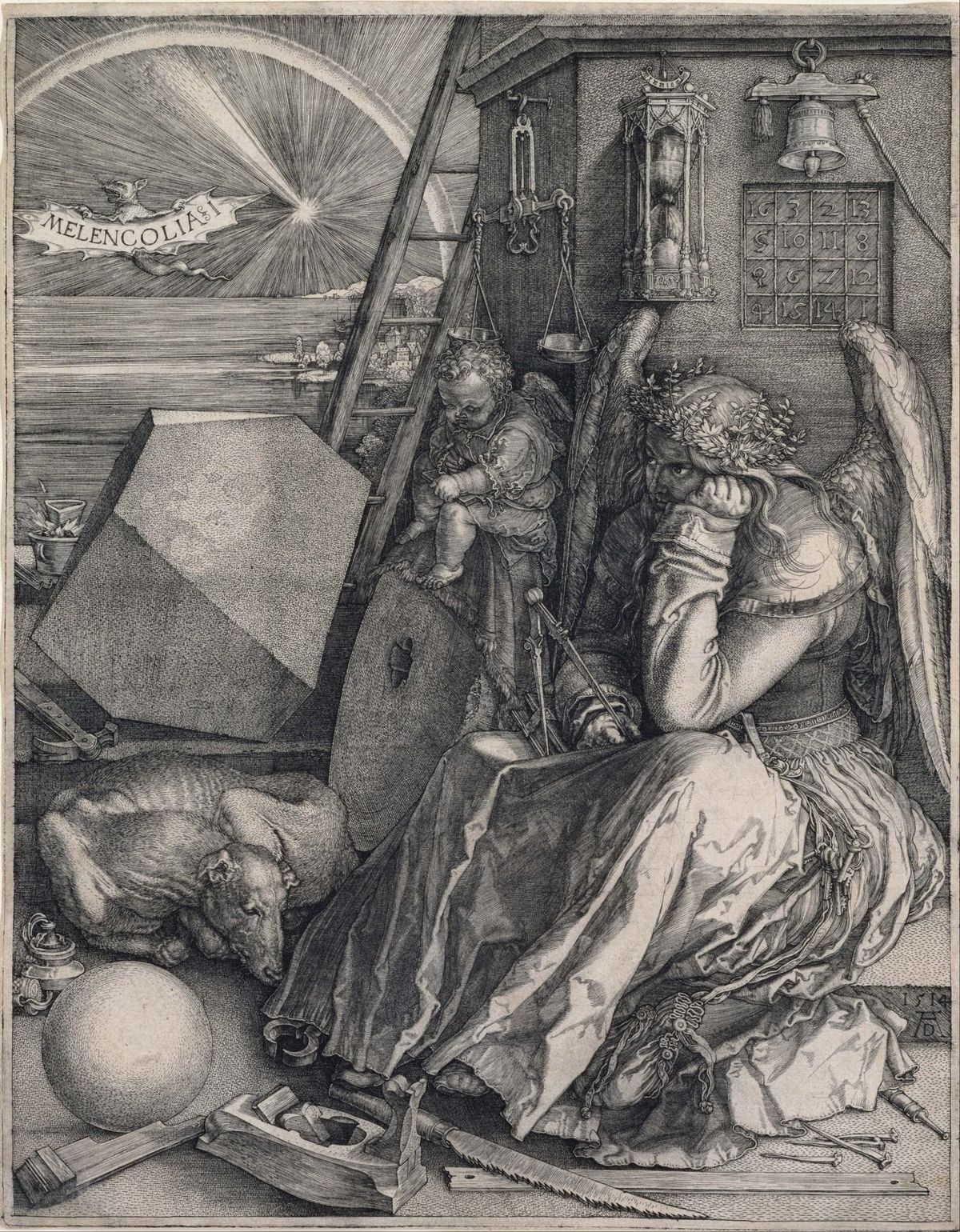
독일 북부 르네상스 회화와 판화의 절대 거장 알브레히트 뒤러(Albrecht Dürer, 1471–1528)가 1514년에 제작한 동판화 멜랑콜리아 I(Melencolia I)은 24.0 cm × 18.8 cm 크기의 정교한 걸작입니다. 현재 영국 런던의 대영박물관(The British Museum, London)을 비롯한 세계 유수의 미술관에 소장되어 있습니다.
어머니의 임종과 화가를 덮친 '창작의 벽'
1514년 5월, 뒤러는 자신을 지극정성으로 뒷바라지하며 18명의 자녀 중 단 셋만을 살려냈던 어머니 바바라 뒤러의 임종을 지켜보았습니다. 어머니의 쇠약해진 모습을 스케치하며 죽음의 비극을 생생하게 목격한 뒤러는 깊은 상실감과 함께 찾아온 지독한 창작의 슬럼프, 즉 '멜랑콜리(우울증)'에 짓눌리게 되었습니다.
당시 르네상스 인문주의자들은 우울질을 단순한 정신병이 아니라, 신의 지혜를 갈망하는 천재적인 예술가와 학자들에게 필연적으로 따르는 '지적 고통'으로 보았습니다. 뒤러는 손에 턱을 괴고 무기력하게 앉아 있는 거대한 날개의 천사를 통해, 우주의 모든 원리를 탐구하고자 했으나 신의 절대적인 섭리 앞에서는 무력할 수밖에 없는 인간 이성의 한계를 자전적으로 고백했습니다.
화면 곳곳에는 뒤러의 천재성과 암호 같은 장치들이 흩어져 있습니다. 천사의 머리 위 벽면에 새겨진 유명한 4×4 '마방진(Magic Square)'은 가로, 세로, 대각선, 심지어 모서리 4개 숫자의 합까지 모두 34가 되는 수학적 기적을 보여줍니다. 특히 마방진의 맨 아래 줄 한가운데에는 어머니가 세상을 떠난 해인 '1514'가 선명하게 암호화되어 박혀 있습니다. 널브러진 컴퍼스와 기하학 다면체, 저울과 모래시계는 인간이 아무리 치밀한 수학과 과학 도구를 동원해도 어머니의 죽음과 삶의 근원적 허무를 막아낼 수 없다는 천재 화가의 서글픈 절규였습니다.
굳어버린 눈동자와 어둠 속 박쥐의 날개, 시선의 심리적 여정
그림을 마주하는 순간 관람객의 무의식적 시선은 손에 컴퍼스를 쥔 채 턱을 괴고 멍하니 허공을 응시하는 거대한 천사의 굳어버린 눈동자로 가장 먼저 빨려 들어갑니다. 우주를 날 수 있는 거대한 날개를 달고서도 깊은 생각의 감옥에 갇혀 한 발짝도 움직이지 못하는 천사의 무거운 침묵은 보는 이의 숨을 멎게 합니다.
이어 시선은 천사의 발치에 어지럽게 흩어져 있는 컴퍼스, 대패, 톱, 기하학 입체 다면체와 구체, 그리고 천사 곁에서 졸고 있는 삐쩍 마른 개와 책판 위에 무언가를 끄적이는 아기 천사(푸토)로 이동합니다. 세상의 모든 지식과 기술을 상징하는 도구들이 완벽하게 무용지물이 되어 바닥에 뒹구는 광경을 확인하는 순간 관람객은 강렬한 지적 허탈감과 마주합니다.
마지막으로 시선은 밤하늘을 가로지르는 혜성과 무지개, 그리고 'Melencolia I'이라는 현수막을 펼쳐 들고 도망치듯 날아가는 기괴한 박쥐 형상의 괴물에 멈춥니다. 칠흑 같은 어둠 속에서 번뜩이는 별빛과 벽에 걸린 1514년의 마방진을 확인하면서, 관람객은 사랑하는 이를 잃고 이성의 한계 앞에서 무너져 내렸던 500년 전 한 천재의 처절한 영혼의 고뇌를 뼈저리게 실감하게 됩니다.
서양 지성사가 낳은 최고의 알레고리 판화, 미술계의 평가
미술계는 멜랑콜리아 I을 서양 미술사상 가장 복잡하고 심오한 상징 체계를 지닌 인문주의 판화의 최고봉이자, 뒤러의 3대 명작 판화(Meisterstiche) 중 으뜸으로 평가합니다.
단순한 종교적 도상을 넘어 인간의 사유, 과학, 예술적 창조의 고통이라는 근대적 실존의 문제를 동판화의 미세한 선묘로 완벽하게 구축했기 때문입니다. 이성에 대한 찬미와 회의를 동시에 담아낸 뒤러의 이 수수께끼 같은 화폭은 오늘날까지도 수많은 수학자, 철학자, 예술가들에게 끝없는 지적 영감을 불어넣고 있습니다.
The Agony of Genius and the Cryptic Grief of 1514, Melencolia I
Executed in 1514 by the supreme master of the Northern Renaissance, Albrecht Dürer (1471–1528), Melencolia I is a celebrated master engraving measuring 24.0 cm × 18.8 cm (9.4 in × 7.4 in), preserved in the permanent collections of prestigious institutions worldwide, including The British Museum in London.
The Death of His Mother and the Paralysis of Human Reason
In May 1514, Albrecht Dürer stood at the deathbed of his beloved mother, Barbara Dürer, who had endured immense hardship raising eighteen children, of whom only three survived into adulthood. Deeply shattered by her passing, Dürer succumbed to a crippling creative block and profound spiritual gloom—what Renaissance humanists classified as the melancholic temperament.
Rather than viewing melancholy merely as a disease of black bile, the Neoplatonic thinkers of the era celebrated it as the agonizing mark of divine genius and intellectual striving. Dürer externalized this internal crisis through the monumental winged personification of Melancholia. Sitting motionless with her chin resting heavily on her fist, she embodies the tragic limit of human knowledge: despite possessing all the tools of geometry, architecture, and mathematics, human intellect remains powerless before mortality and divine mystery.
Embedded throughout the print is a cryptographic labyrinth of astonishing precision. Mounted on the stone wall is a 4×4 'Magic Square' whose numbers in every row, column, quadrant, and diagonal sum up to exactly 34. In the bottom register of this mathematical marvel, Dürer engraved the numbers '15' and '14' side by side—forever memorializing 1514, the year his mother died. The scattered tools of carpentry, the unhewn rhombohedron, and the hourglass represent human intellectual vanity collapsing under the existential weight of grief.
Subconscious Trajectory of the Gaze and the Cosmic Comet
The observer's subconscious gaze is immediately seized by the penetrating, fixed stare of the winged winged protagonist, whose brooding immobility creates an intense aura of psychological paralysis.
The visual path then plunges down to the chaotic litter of instruments surrounding her stone seat—the balance, the sphere, the compass, the sleeping hound, and the focused putto scribbling upon an architectural slate. Witnessing these instruments of mastery rendered dormant and useless, the viewer confronts a sudden epiphany regarding the futility of human endeavor.
Finally, the trajectory ascends into the nocturnal sky, where a blazing comet and lunar rainbow illuminate the horizon while a grotesque, bat-like creature flees across the firmament brandishing the banner of Melencolia I. Contemplating the magic square and the enigmatic celestial geometry, the viewer is drawn into the profound labyrinth of an intellectual titan mourning the fragility of human existence.
The Pinnacle of Humanist Engraving: Critical Legacy
Art historians and scholars regard Melencolia I as one of the most intellectually ambitious and iconographically dense masterworks in the history of graphic art.
By uniting mathematical discipline, astrological lore, and autobiographical vulnerability within the exacting medium of copperplate engraving, Dürer elevated printmaking to the summit of philosophical inquiry. This haunting masterpiece remains a timeless visual monument to the eternal struggle of the creative spirit.
본 컨텐트의 저작권은 팔렛트제주에 있습니다. 허가없는 무단전제를 금지합니다.
Copyright © Palette Jeju. All rights reserved. Unauthorized reproduction or redistribution is strictly prohibited.