어둠 속에서 타오르는 붉은 열정의 꽃다발, 양귀비가 있는 꽃병 Vase with Red Poppies
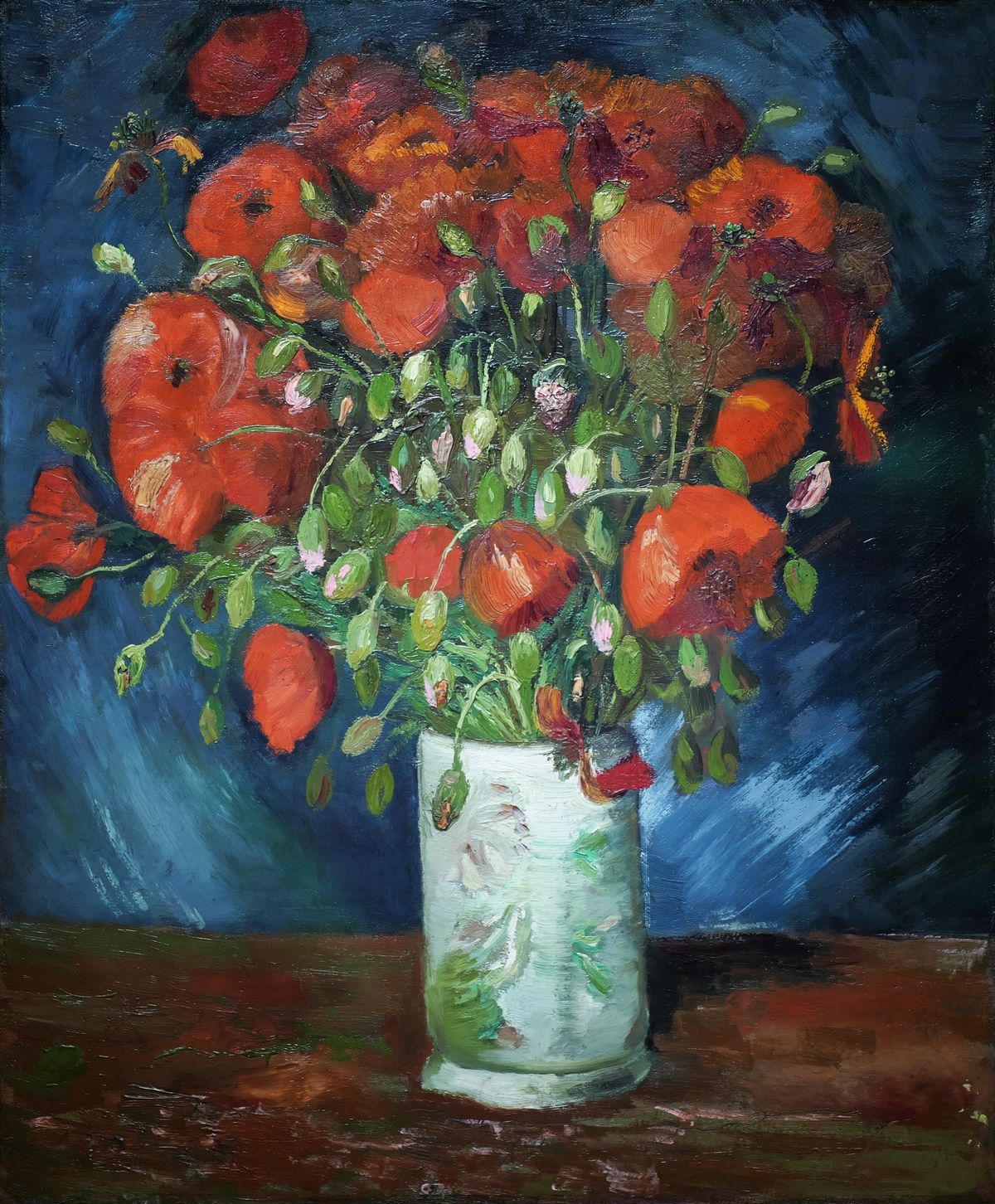
후기 인상주의의 거장 빈센트 반 고흐(Vincent van Gogh, 1853–1890)가 파리 체류 시절인 1886년 여름에 완성한 유화 《양귀비가 있는 꽃병(Vase with Red Poppies, 또는 붉은 양귀비가 꽂힌 화병)》은 56.0 cm × 46.5 cm 크기의 캔버스에 유채로 그린 대표 정물화로, 현재 미국 코네티컷주 하트퍼드의 와즈워스 아테늄 미술관(Wadsworth Atheneum Museum of Art)에 영구 소장되어 있습니다.
진위 논란을 딛고 되살아난 파리 시절의 색채 혁명
1886년 파리에 도착한 고흐는 인상주의의 밝은 빛과 분할 필치를 온몸으로 흡수하며 자신의 어두웠던 화풍을 전면적으로 탈바꿈시키고 있었습니다. 그는 델라크루아의 색채 이론에 깊이 매료되어 강렬한 원색의 상호작용을 실험하기 위해 여름 들판에서 흔히 볼 수 있는 붉은 양귀비를 화폭에 즐겨 담았습니다.
이 작품은 한때 반 고흐의 진작 여부를 두고 수십 년간 격렬한 논쟁에 휩싸였던 드라마틱한 역사를 지니고 있습니다. 1990년 한 미술사가에 의해 위작 의혹이 제기되어 수장고에 보관되었으나, 2019년 암스테르담 반 고흐 미술관 연구진의 첨단 엑스선 분석을 통해 캔버스 물감 아래에서 고흐가 파리 시절 그린 '자화상'의 밑그림이 발견되면서 마침내 명백한 진작으로 공식 공인되었습니다.
가난했던 파리 시절, 기존의 자화상 캔버스 위에 덧칠하여 완성한 이 붉은 꽃다발은 화가가 새로운 색채 세계로 나아가기 위해 치열하게 분투했던 생생한 흔적을 간직하고 있습니다.
무의식 속 시선의 공간 유영과 정열적인 시각적 파동
감상자의 시선은 화폭 상단에서 활활 타오르는 불꽃처럼 피어난 선명한 진홍빛 양귀비 꽃잎들의 군집으로 가장 먼저 빨려 들어갑니다. 두텁게 얹힌 붉은 물감 덩어리와 검붉은 꽃술의 강렬한 존재감은 보는 이의 무의식 속에 뜨거운 생명력과 즉각적인 감정적 고양감을 촉발합니다.
이어 시선은 꽃봉오리 사이를 촘촘히 메운 가느다란 녹색 줄기와 연둣빛 잎사귀들을 따라 하강하여, 은은한 상아색 바탕에 파스텔톤 문양이 새겨진 도자기 화병의 원통형 몸체에 편안히 안착합니다.
그 후 시선은 짙은 갈색 목재 테이블을 스쳐, 배경 전체를 대각선 방향의 거친 붓질로 채운 짙푸른 밤하늘 같은 코발트 블루의 어둠으로 시원하게 확장됩니다. 배경의 서늘한 청록빛 어둠과 꽃잎의 작열하는 붉은색이 자아내는 극명한 보색 충돌 속에서, 관람자는 의식하지 못하는 사이 어둠을 뚫고 솟아오르는 원초적인 생명의 열기와 화가의 벅찬 창작열에 깊이 동화됩니다.
델라크루아의 계승과 표현주의의 태동, 미술사적 평가
미술계는 이 작품을 반 고흐가 파리에서 이룩한 '보색 대비와 마티에르의 완숙'을 증명하는 결정적 정물화로 평가합니다.
프랑스 낭만주의 거장 외젠 델라크루아가 정립한 색채 대비 이론을 자신만의 두터운 임파스토 기법과 결합하여, 정물화라는 전통적 장르를 폭발적인 감정의 표현 장으로 탈바꿈시켰습니다.
형태의 단순한 묘사를 넘어 색채 자체의 진동으로 보는 이의 심장을 울리는 이 걸작은, 훗날 20세기 야수파와 표현주의 화가들에게 결정적인 시각적 영감을 건네며 반 고흐 회화의 눈부신 도약을 상징하는 불멸의 유산으로 빛나고 있습니다.
Crimson Radiance Blazing in the Shadows, Vase with Red Poppies
Painted in the summer of 1886 during his transformative Paris period by Vincent van Gogh (1853–1890), Vase with Red Poppies is an oil on canvas measuring 56.0 cm × 46.5 cm (22.0 in × 18.3 in), preserved in the permanent collection of the Wadsworth Atheneum Museum of Art in Hartford, Connecticut.
The Resolution of an Enigma: A Reclaimed Parisian Masterpiece
Arriving in Paris in the spring of 1886, Van Gogh was immediately inspired by the vibrant avant-garde movements of the capital, embarking on a determined quest to liberate his palette from the somber earth tones of his early Dutch years. Drawing deep inspiration from Eugène Delacroix's treatises on color, he turned to bunches of vibrant red poppies gathered from the Parisian outskirts to experiment with high-contrast color harmonies.
This canvas possesses an extraordinary provenance narrative, having endured decades of skepticism regarding its authenticity. Relegated to museum storage after being questioned by an art historian in 1990, the painting was triumphantly re-authenticated in 2019 following rigorous advanced imaging by the Van Gogh Museum in Amsterdam.
The analysis revealed a hidden self-portrait beneath the paint layers—a testament to Vincent’s extreme poverty, which frequently forced him to reuse older canvases to paint radiant bouquets.
Psychological Trajectory of the Gaze and Chromatic Resonance
The observer’s subconscious gaze is immediately arrested by the explosive cluster of scarlet and vermilion poppies dominating the upper half of the composition. Sculpted with rich impasto, the fiery petals instill an instant sensation of organic vitality and emotional intensity.
From this dense floral apex, visual perception flows gently downward through the network of slender green stems and unopened buds, coming to rest upon the solid cylindrical mass of the pale, patterned ceramic vase.
The eye then glances across the warm mahogany table before dispersing into the dynamic diagonal brushwork of the deep cobalt and Prussian blue background. Navigating the fierce optical tension between the smoldering reds and the cool, shadowy ground, the viewer subconsciously internalizes the raw resilience of life asserting itself against the surrounding dark.
Mastery of Simultaneous Contrast: Critical Significance
Art historians revere Vase with Red Poppies as a vital benchmark of Van Gogh’s early Parisian development, illustrating his mastery of complementary color theory.
By juxtaposing saturated reds against deep blues with vigorous, sculptural brushstrokes, Van Gogh elevated a rustic floral arrangement into an expressive psychological statement. Foreshadowing the emotional liberation of modern art, this masterwork stands as a luminous monument to an artist transforming technical inquiry into enduring spiritual truth.
Copyright © Palette Jeju. All rights reserved. Unauthorized reproduction or redistribution is strictly prohibited.
본 컨텐트의 저작권은 팔렛트제주에 있습니다. 허가없는 무단전제를 금지합니다.