에네리의 연못 (La Mare à Ennery / The Pond at Ennery, 1874)
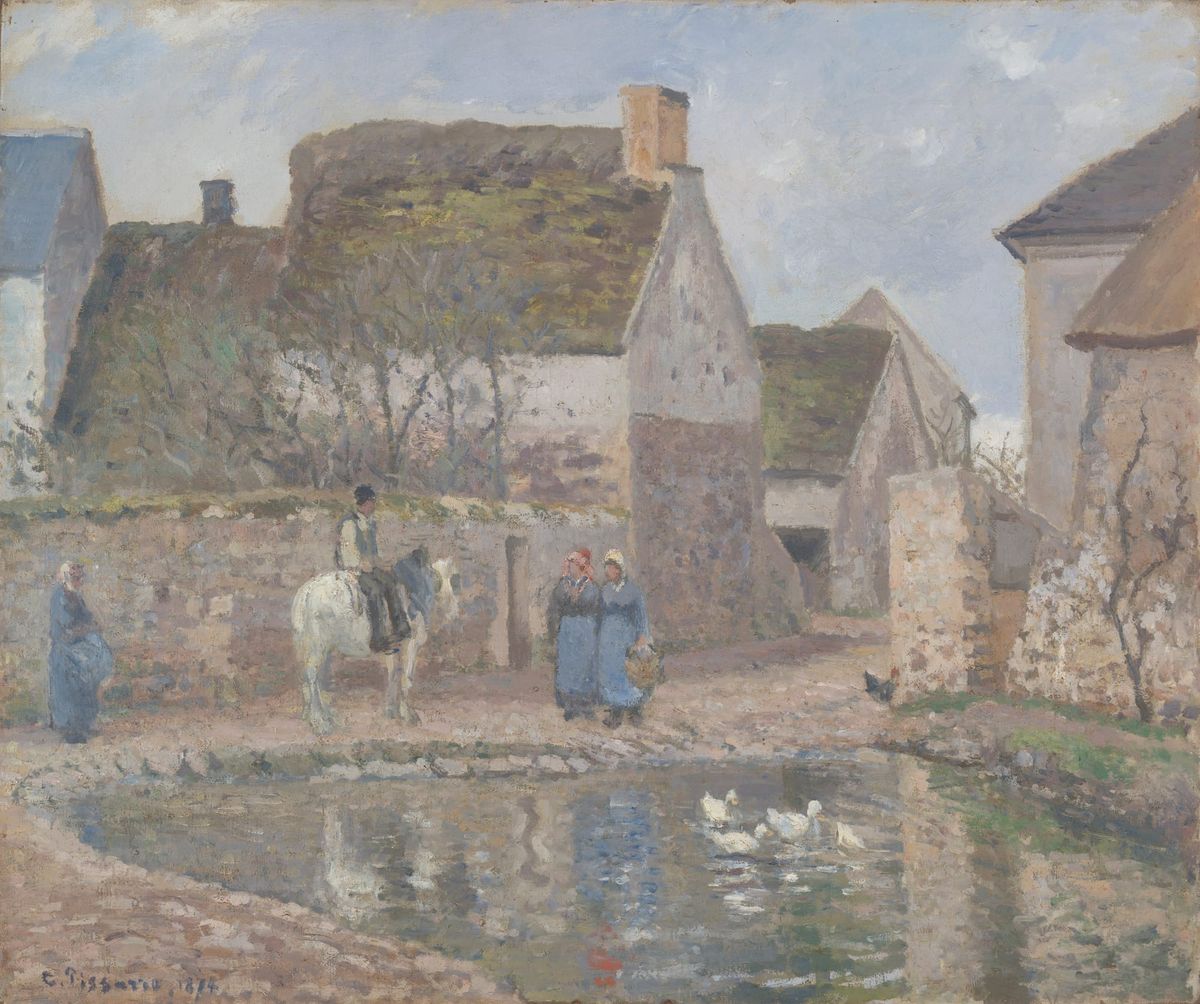
1874년 역사적인 제1회 인상주의 전시회가 열리던 해, 카미유 피사로는 퐁투아즈 북동쪽에 인접한 한적한 전원 마을 에네리를 찾아 마을 어귀 연못가에 머무는 소박한 이웃들의 일상을 캔버스에 담았습니다.
당시 제도권 살롱의 권위에 맞서 독립적인 전시를 조직하며 미술사의 거대한 전환점을 이끌던 피사로는, 고전주의적 영웅 서사 대신 흙과 돌로 지어진 시골 가옥과 가축을 돌보는 민중의 평범한 삶을 화폭의 중심에 세웠습니다. 가로 64.2cm, 세로 53.1cm 크기의 캔버스에 유채로 완성되어 현재 미국 코네티컷주 예일 대학교 미술관에 소장된 이 작품은, 단단한 건축적 공간 구조와 맑은 수면의 반사광을 완벽한 조형적 균형감으로 직조해 낸 피사로 고전 인상주의 전성기의 대표작입니다.
관람자의 시각 인지 체계는 화면 좌측 중경에서 백마를 타고 있는 인물의 밝고 선명한 흰색 실루엣에 가장 먼저 닻을 내립니다. 뒤편의 흙빛 돌담과 짙은 옷을 입은 기수의 형태가 이루는 뚜렷한 명암 대비는 시각 피질의 중심와를 즉각 포획하며 화면의 탄탄한 서정적 구심점을 확립합니다.
이어서 시선은 말을 탄 인물 바로 곁에서 푸른빛 치마를 입고 머리수건을 두른 채 정답게 서 있는 두 시골 여인의 온화한 자태로 도약 안구 운동을 진행합니다.
인물들의 다정한 교감을 확인한 눈길은 화면 하단으로 하강하여, 하늘빛과 가옥의 그림자를 투명하게 머금은 연못 수면 위에서 한가롭게 헤엄치는 흰 오리 무리의 경쾌한 하이라이트를 훑어냅니다.
물결의 촉각적인 붓터치를 지난 시선은 우측 전경의 묵직한 석조 기둥과 붉은 초가지붕 가옥들을 거쳐, 화면 상단을 덮고 있는 은은한 은백색 구름과 맑은 푸른 하늘의 대기감 속으로 시원하게 확장됩니다.
연못에 비치는 은은한 물그림자와 시골길의 포근한 흙빛이 망막 위에서 하나의 완성된 공간으로 통합되는 순간, 관조자는 번잡한 일상의 긴장을 내려놓고 따스한 햇살이 머무는 마을 어귀에 서 있는 듯한 깊은 심리적 안도감과 내면의 평온을 체험하게 됩니다.
이 그림을 그릴 당시 피사로는 폴 세잔과 함께 퐁투아즈와 에네리 일대를 누비며 야외 사생을 진행하고 있었으며, 평면적인 빛의 효과를 넘어 대지의 무게감과 건물의 기하학적 형태를 단단하게 결합하는 독창적인 구도를 완성하고 있었습니다.
그는 인위적인 극적 연출을 배제하고, 자연광 아래서 돌벽의 거친 질감과 연못 물의 투명함을 짧고 굵은 터치로 교차시켜 시골 마을의 진솔한 생명력을 있는 그대로 증언했습니다.
동시대의 동료 화가들과 진보적 비평가들은 화려한 과장 없이 대지의 순수한 호흡을 기록한 피사로의 캔버스를 두고 "자연과 인간의 조화를 가장 정직하고 숭고한 질서로 구현해 낸 진정한 거장의 붓"이라며 높은 찬사를 보냈습니다.
마을 연못가의 평화로운 정취와 서민들의 소박한 삶을 단단한 조형미와 눈부신 빛의 조화로 승화시킨 피사로의 '에네리의 연못'은, 현대 미술사에서 인상주의가 감각적 순간성을 넘어 영원한 대지의 품격을 완성한 독보적인 걸작으로 확고하게 평가받고 있습니다.
The Pond at Ennery (La Mare à Ennery, 1874)
During 1874, the momentous year of the First Impressionist Exhibition, Camille Pissarro explored the tranquil outskirts of Ennery, capturing the unhurried rhythm of villagers gathered around the communal pond.
At a defining crossroads in modern art, when the master was vigorously championing artistic autonomy against academic orthodoxy, Pissarro bypassed grand mythological narratives to elevate the unadorned stone walls and rustic daily encounters of rural people into enduring monuments of visual truth. Measuring 53.1 by 64.2 cm and preserved within the Yale University Art Gallery, this horizontal oil on canvas achieves a masterful synthesis of geometric stability and luminous water reflections, standing as a benchmark of Pissarro's classical Impressionist period.
The observer’s perceptual framework instantly grounds itself upon the luminous white coat of the horse mounted by a local villager along the left-center stone wall. The sharp tonal contrast between the horse’s radiant form and the weathered masonry behind it arrests the fovea, establishing an intuitive and emotionally reassuring structural nucleus for spatial navigation.
From this solid human anchor, the ocular trajectory tracks rightward to the two peasant women clad in soft cerulean skirts and headscarves, paused in quiet conversation along the earthen lane.
Descending to the lower foreground, the gaze sweeps across the shimmering surface of the duck pond, lingering upon the tactile white impasto strokes that define the ducks drifting across the water's gentle reflections.
Ascending past the weathered stone pillar and thatch-roofed cottages on the right, the eye sweeps through the open sky above, where pale blue daylight mingles with shifting cumulus clouds to unify the entire scene into an expansive three-dimensional sanctuary.
As the physical permanence of the stone architecture and the quiet murmur of the cool water integrate into a cohesive visual continuum within the visual cortex, active visual scanning dissolves into profound contemplative stillness, immersed in the restorative simplicity of the countryside.
While executing this canvas, Pissarro was working in close artistic dialogue with Paul Cézanne in the environs of Pontoise, developing a structural method that balanced solid volumetric mass with the flickering vibrations of plein-air daylight.
Rejecting decorative salon formulas, the master applied textured strokes of ochre, slate, and cobalt, capturing the authentic tactile presence of earth, stone, and water.
Progressive critics universally admired this unvarnished integrity, praising Pissarro’s singular capacity to uncover timeless dignity, moral gravity, and profound poetry within the most unpretentious corridors of agrarian life.
Masterfully harmonizing structural weight with delicate atmospheric poetry, Pissarro's view of the pond at Ennery remains celebrated across art history as an enduring pinnacle of nineteenth-century Impressionist landscape art.
본 콘텐츠의 저작권은 저작권자에게 있으며, 무단 전재 및 재배포를 금합니다.