에메랄드빛 바다를 울리는 기괴하고 감미로운 하프 선율, 바다에서 In the Sea
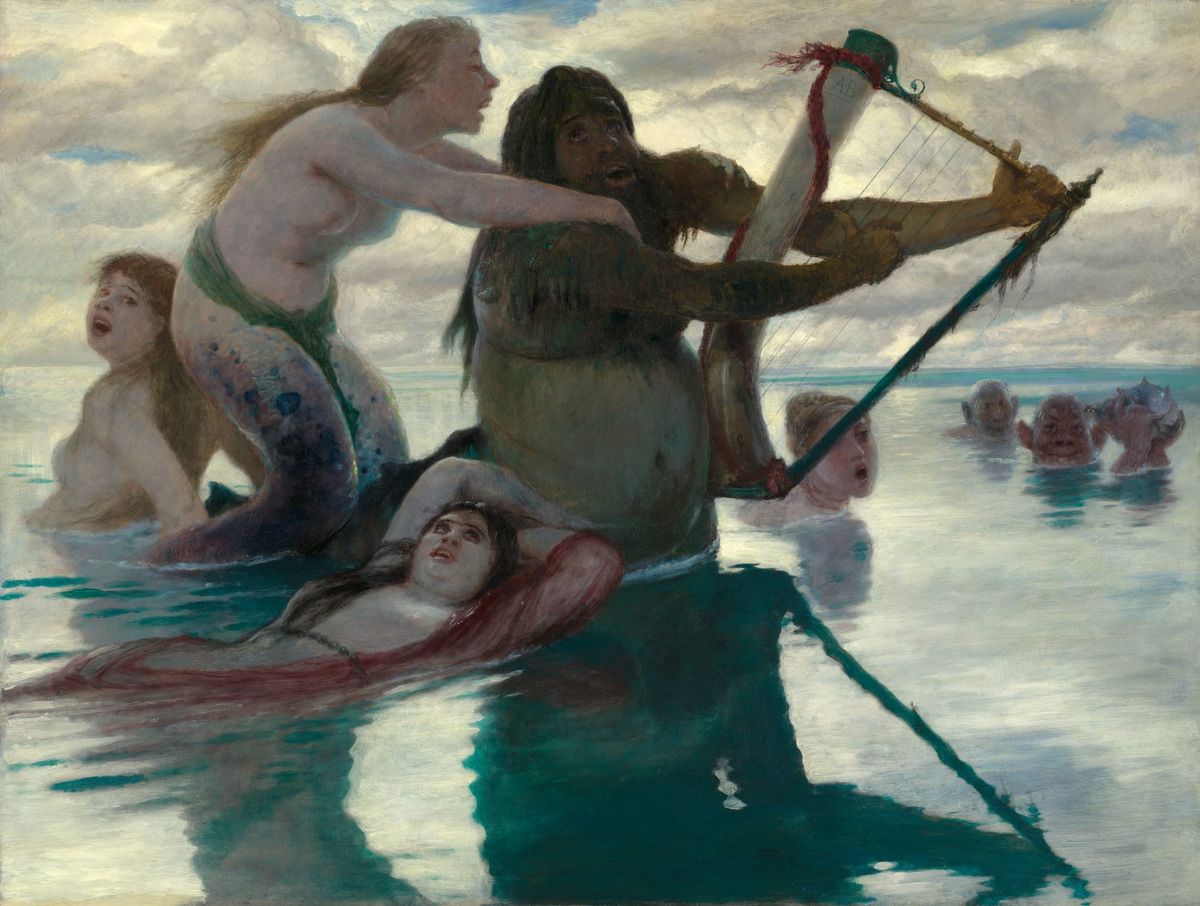
스위스 출신의 상징주의 거장 아놀드 뵈클린(Arnold Böcklin, 1827–1901)이 1883년 스위스 취리히에서 완성한 유화 바다에서(In the Sea, 독일어: Im Meer, 또는 In der See)는 86.5 cm × 115.0 cm 크기의 캔버스에 유채로 그린 대표작입니다. 현재 미국 시카고 미술관(The Art Institute of Chicago, Chicago)과 독일 프랑크푸르트의 슈테델 미술관 등에 소장되어 있습니다.
바다 괴물의 노래에 취한 인어들과 화가의 음악적 상상력
평생 가난과 자식들의 잇따른 죽음이라는 비극을 겪으면서도 뵈클린은 자연과 고대 신화가 건네는 생명력에서 커다란 예술적 위안을 얻었습니다. 그는 지중해의 푸른 바다를 여행할 때마다 파도 소리를 단순한 자연현상이 아니라, 바닷속 신화 속 정령들이 부르는 합창이라고 생각했습니다. 화가는 진지하고 엄숙한 종교화나 역사화의 틀을 깨고, 거친 바다 괴물이 하프를 켜며 노래하고 인어들이 이에 화답하며 화음을 맞추는 독창적인 판타지의 세계를 창조했습니다.
화면 한가운데에는 이끼와 조개껍데기가 덕지덕지 붙은 뚱뚱하고 거대한 바다 괴물 트리톤이 수면 위로 몸을 드러낸 채 진지한 표정으로 하프를 연주하고 있습니다. 그의 어깨를 감싸 안은 금발의 인어와 붉은 천 위에 누워 황홀경에 빠진 여인은 입을 벌려 노래를 따라 부르고 있으며, 저 멀리 물가에서는 늙은 바다 요정들이 소라 고둥을 불며 연주에 동참합니다. 당시 사람들은 괴물과 여인의 에로틱하면서도 기괴한 조합에 깜짝 놀랐지만, 음악과 미술을 하나로 결합하여 바다의 원초적인 생명력을 유쾌하게 풀어낸 뵈클린의 천재성에 찬사를 보냈습니다.
하프를 켜는 바다 괴물의 눈빛에서 누워 있는 인어로, 시선의 심리적 여정
그림을 마주하는 순간 관람객의 무의식적 시선은 화면 한가운데서 커다란 하프를 쥐고 감정에 북받쳐 노래를 부르는 검은 피부의 트리톤과 그의 동그랗게 뜬 눈동자로 가장 먼저 빨려 들어갑니다. 우스꽝스러우면서도 한없이 진지하게 음악에 몰입하고 있는 바다 괴물의 표정은 보는 이에게 신선한 충격과 호기심을 선사합니다.
이어 시선은 트리톤의 어깨에 기대어 함께 입을 벌리고 노래하는 풍만한 금발 인어의 매끄러운 피부와 점박이 물고기 꼬리로 이동합니다. 시선은 곧바로 화면 아래쪽 붉은 천을 깔고 물 위에 누워 몽환적인 눈빛으로 하늘을 바라보는 여인의 관능적인 몸짓과, 맑고 투명한 에메랄드빛 바닷물 속으로 길게 드리운 하프의 푸른 그림자로 떨어져 내립니다.
마지막으로 시선은 잔잔한 수평선 너머에서 소라 나팔을 불며 다가오는 늙은 바다 요정들의 익살스러운 얼굴과 은은한 햇살이 번지는 하늘의 뭉게구름에 멈춥니다. 바다 위에서 울려 퍼지는 환상적인 음악 소리를 눈으로 확인하는 순간, 관람객은 문명의 규율에서 벗어나 대자연의 품 안에서 순수한 기쁨을 노래하는 신화 속 존재들의 유쾌하고 원초적인 생명력을 가슴 깊이 체감하게 됩니다.
시각 예술로 번역된 음악의 환상성, 미술계의 평가
미술계는 바다에서를 보이지 않는 소리와 음악적 감성을 회화의 시각적 요소로 완벽하게 번역해 낸 상징주의 예술의 독보적인 수작으로 평가합니다.
사실주의의 메마른 묘사를 거부하고, 물결의 반짝임과 피부의 감촉, 그리고 소리의 울림을 강렬한 색채와 상상력으로 버무려 냈기 때문입니다. 신화 속 괴물조차 예술과 음악 앞에서는 순수한 감정에 젖어들 수 있음을 보여준 뵈클린의 이 감미롭고 기괴한 캔버스는 훗날 아르누보와 초현실주의 예술가들에게 무한한 영감을 불어넣었습니다.
The Mythic Harmony of the Emerald Deep, In the Sea
Painted in 1883 in Zurich by the visionary Swiss Symbolist master Arnold Böcklin (1827–1901), In the Sea (German: Im Meer, also titled In der See) is an oil on canvas measuring 86.5 cm × 115.0 cm (34.1 in × 45.3 in), preserved in the permanent collection of the Art Institute of Chicago in Chicago, United States.
The Melodic Siren Song and the Pagan Vitality of the Ocean
Throughout a lifetime shadowed by crushing financial insecurity and the loss of eight young children, Arnold Böcklin found enduring spiritual renewal in the vibrant folklore of Mediterranean antiquity. Rejecting sterile academic decorum, he imagined the rhythmic crash of the waves not as inert nature, but as the pulsating choral song of primordial marine spirits.
At the center of the composition, a massive, moss-encrusted sea titan emerges from the azure water, playing a wooden harp while singing with earnest passion. Entranced by the strange melody, voluptuous Nereids with iridescent scales harmonize beside him, while a nymph reclines upon a floating crimson cushion in sensory bliss. In the distance, elder sea fauns sound their conch trumpets to join the oceanic hymn. Böcklin seamlessly fused the grotesque with the lyric, presenting mythical creatures not as cold marble allegories, but as flesh-and-blood entities governed by primal musical ecstasy.
Subconscious Trajectory of the Gaze: From Titan's Visage to the Floating Siren
The observer's subconscious gaze is immediately seized by the earnest, upturned face of the dark-skinned sea titan at the center. His wide, glistening eyes and parted lips, entirely absorbed in his instrumental performance, generate an immediate sense of dramatic curiosity.
The visual path then follows his muscular arms to the taut strings of the wooden harp, before sweeping across the pale torso and spotted tail of the golden-haired siren clinging to his back. The gaze descends to the foreground, resting upon the sensual contour of the nymph drifting upon the floating cloth, while taking in the deep emerald reflection cast into the transparent water.
Finally, the trajectory travels across the calm marine horizon toward the grotesque, sun-weathered mermen blowing conch shells against the sunlit clouds. Observing how sound dissolves the boundary between human sensuality and wild nature, the viewer encounters a joyful celebration of life’s untamed, pagan vitality that defies mortal melancholy.
The Visual Symphony of Late Symbolism: Critical Legacy
Art historians recognize In the Sea as an exceptional masterpiece that translated acoustic vibration and emotional reverie into luminous visual poetry.
By orchestrating rich color harmonies and celebrating uninhibited bodily sensuality, Böcklin anticipated the decorative fluidities of Art Nouveau and the subconscious dreamscapes of early Modernism. This enchanting marine fantasy endures as an inspiring testament to the artist's enduring capacity to find joy, music, and mythic wonder amidst life's deep tempests.
본 컨텐트의 저작권은 팔렛트제주에 있습니다. 허가없는 무단전제를 금지합니다.
Copyright © Palette Jeju. All rights reserved. Unauthorized reproduction or redistribution is strictly prohibited.