에브라임과 므낫세를 축복하는 야곱 Jacob Blessing Ephraim and Manasseh
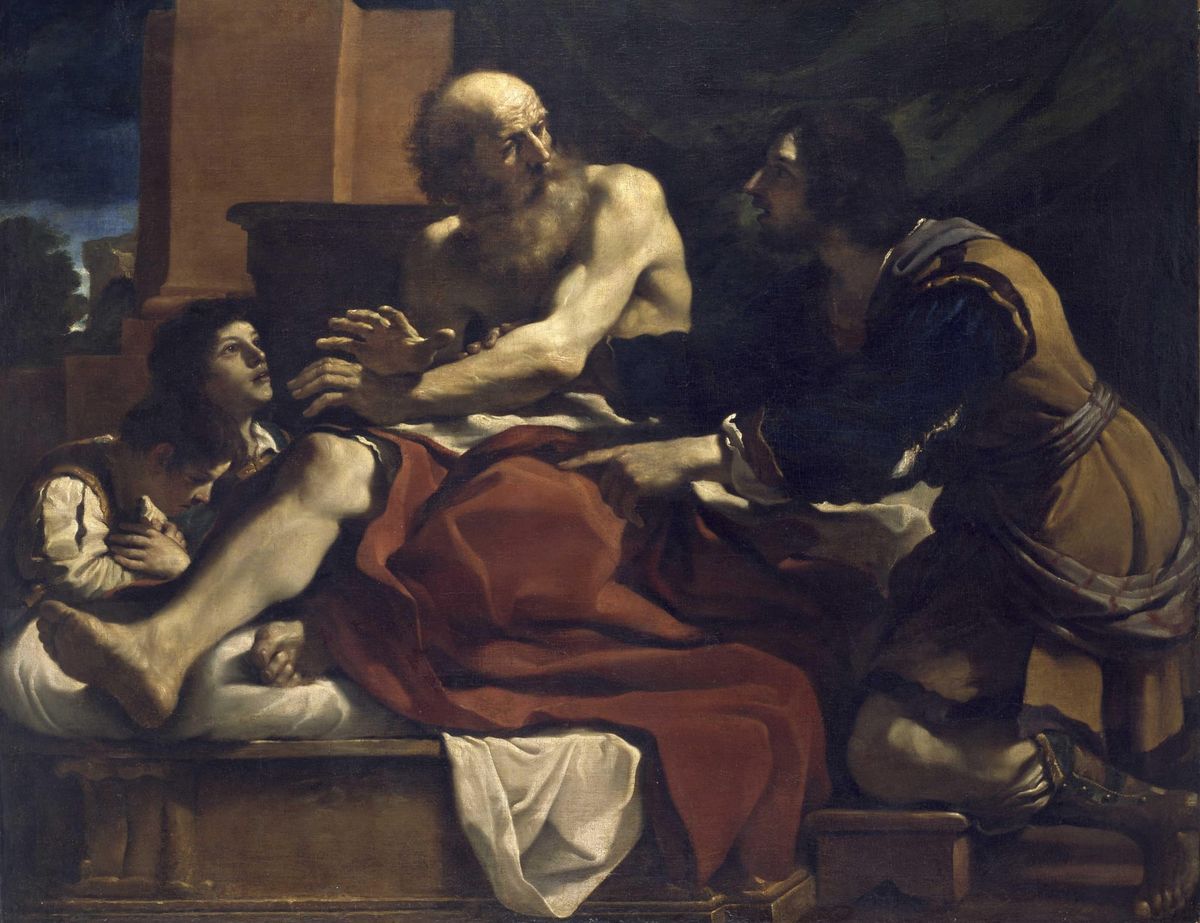
17세기 이탈리아 바로크 회화의 거장 조반니 프란체스코 바르비에리, 널리 귀에르치노(Guercino, 1591–1666)로 불리는 화가가 1620년경 청년 시절에 완성한 대작 유화 에브라임과 므낫세를 축복하는 야곱(Jacob Blessing Ephraim and Manasseh, 이탈리아어: Giacobbe benedice i figli di Giuseppe)은 170.0 cm × 211.5 cm 크기의 웅장한 캔버스에 유채로 그린 대표적인 구약성경 역사화 최고 걸작입니다. 현재 아일랜드 더블린의 아일랜드 국립미술관(National Gallery of Ireland, Dublin)에 소장되어 있습니다.
구약성경 창세기의 엇갈린 축복과 후원자 산피에리 가문의 주문
귀에르치노의 초기 걸작 중 하나인 이 작품은 볼로냐의 유력 귀족이자 화가의 오랜 후원자였던 산피에리(Sampieri) 가문의 주문으로 제작되었습니다. 그림의 주제는 구약성경 창세기 48장에 기록된 극적인 순간으로, 임종을 앞둔 이스라엘의 족장 야곱이 아들 요셉이 데려온 두 손자 에브라임과 므낫세를 축복하는 장면입니다. 장자인 므낫세가 오른손 축복을, 차남인 에브라임이 왼손 축복을 받아야 마땅한 관습이었으나, 시력이 희미해진 노인 야곱은 성령의 이끄심에 따라 두 팔을 엑스(X) 자로 교차하여 오른손을 어린 차남 에브라임의 머리 위에 얹었습니다.
당시 20대 후반의 젊은 귀에르치노는 이 장면을 그리며 구약의 족장 계승이라는 신학적 무게감과, 부모와 자식 간의 팽팽한 감정적 대립을 한 화면에 담기 위해 깊은 조형적 고민에 빠졌습니다. 아버지 요셉은 장자 상속의 질서가 깨지는 것에 당황하여 손가락으로 아버지의 손을 제지하려 들고, 죽음을 앞둔 야곱은 눈이 보이지 않음에도 완고하게 자신의 뜻을 관철하며 아들을 타이릅니다. 화가는 침상에 기댄 노인의 메마른 가슴과 굵은 뼈마디, 장막 너머로 쏟아지는 어두운 밤하늘과 먹구름, 그리고 침대 위를 덮고 있는 붉은 모직 천의 강렬한 색채를 카라바조식 테네브리즘의 극적인 명암법으로 완벽하게 연출했습니다.
빛나는 야곱의 이마에서 엇갈린 두 손과 간청하는 요셉의 손짓으로, 시선의 심리적 여정
그림을 마주하는 순간 관람객의 무의식적 시선은 화면 중앙 어둠 속에서 은은한 천상의 빛을 받아 눈부시게 밝게 빛나는 늙은 야곱의 벗겨진 이마와 주름진 어깨 근육으로 가장 먼저 빨려 들어갑니다. 육체의 기력이 쇠하여 눈이 어두워졌음에도 영적인 통찰력으로 신의 섭리를 응시하는 노족장의 굳센 표정은 보는 이에게 깊은 시각적 압도감과 함께 역사의 거대한 무게감을 선사합니다.
이어 시선은 야곱이 엑스 자로 엇갈려 뻗은 두 팔과 손가락을 따라 화면 왼쪽 아래로 이동하여, 할아버지의 축복을 경건하게 기다리는 어린 에브라임의 촉촉한 눈망울과 고개 숙인 형 므낫세의 머리로 옮겨갑니다. 관습을 깨고 차남의 머리 위에 얹히는 축복의 손길과 이를 놀란 눈으로 바라보는 소년의 얼굴을 확인하는 순간, 관람객은 인간의 예상을 뛰어넘는 신의 은밀한 섭리와 세대 간의 숭고한 계승의 현장 속으로 온몸이 빨려 들어가게 됩니다.
마지막으로 시선은 화면 오른쪽에서 무릎을 꿇은 채 야곱을 향해 다급하게 손가락을 뻗고 있는 요셉의 간절한 옆얼굴을 지나, 침상을 풍성하게 덮고 있는 붉은색과 흰색 모직 천의 두터운 주름에 멈춥니다. 칠흑 같은 침실의 어둠을 뚫고 솟아오르는 빛과 가족 간의 뜨거운 심리적 대화를 마주하며, 관람객은 인간의 질서를 초월하는 신성한 약속의 가치와 젊은 귀에르치노가 건네는 묵직한 조형적 감동을 가슴 깊이 마주하게 됩니다.
17세기 볼로냐 바로크 역사화의 초기 기념비와 조형미, 미술계의 평가
미술계는 에브라임과 므낫세를 축복하는 야곱을 귀에르치노가 청년 시절 카라바조와 루도비코 카라치의 영향을 받아 폭발적인 명암 대비와 생생한 인간미를 성취한 초기 대표작으로 평가합니다.
빛과 어둠의 강렬한 대립 속에서 노인의 뼈대와 피부 질감, 인물들의 팽팽한 심리적 상호작용, 붉은 천과 침구의 촉각적 물질감을 극도로 섬세한 명암법으로 완벽하게 구현했을 뿐만 아니라, 성경의 복잡한 가족 서사를 한 치의 흐트러짐 없는 고전적 기념비성으로 승화시켰기 때문입니다. 젊은 거장의 과감한 조형적 실험과 깊이 있는 신학적 해석이 빛나는 이 걸작 화폭은, 오늘날까지도 전 세계 수많은 감상자들에게 깊은 전율과 잊을 수 없는 시각적 감동을 전해주는 불멸의 명작으로 손꼽히고 있습니다.
Jacob Blessing Ephraim and Manasseh
Painted around 1620 in Cento and Bologna by the preeminent Italian Baroque master Giovanni Francesco Barbieri, universally celebrated as Guercino (1591–1666), Jacob Blessing Ephraim and Manasseh (Italian: Giacobbe benedice i figli di Giuseppe) is a monumental oil on canvas measuring 170.0 cm × 211.5 cm (66.9 in × 83.3 in), preserved in the distinguished permanent collection of the National Gallery of Ireland in Dublin, Ireland.
The Biblical Narrative of Genesis, the Crossed Hands, and the Sampieri Patronage
Commissioned by the noble Sampieri family of Bologna, one of Guercino’s most prominent early patrons, this monumental masterwork depicts the pivotal Genesis narrative of the elderly patriarch Jacob on his deathbed. When his son Joseph presents his two sons, Manasseh and Ephraim, expecting the primary right-handed blessing for the firstborn Manasseh, the failing patriarch deliberately crosses his arms in the sign of an X, placing his favored right hand upon the head of the younger brother, Ephraim.
The youthful Guercino focused intently on the dynamic emotional and ideological friction between father and son. Joseph kneels urgently on the right, gesturing toward his father's hands to correct what he perceives as a blind misstep of primogeniture, while Jacob, illuminated by divine insight despite his physical infirmity, resolutely maintains his prophetic decree. Guercino rendered the gaunt, muscular torso of the patriarch, the rich vermilion blanket draping the bedside, and the dark atmospheric sky outside the tent with vigorous Caravaggesque naturalism, imbuing an ancient scriptural succession with palpable dramatic immediacy.
Subconscious Trajectory of the Gaze: From Venerable Patriarch to the Crossed Blessing
The observer's subconscious gaze is immediately magnetized by the upper-central register, drawn to the luminous, weathered brow and muscular bare shoulders of the aged Jacob illuminated against the dark canopy. His resolute expression, thick grey beard, and sightless yet visionary countenance establish an instant focal point of sovereign patriarchate and sacred prophecy.
The visual path then follows the diagonal momentum of Jacob's crossed arms toward the lower-left register, arriving at the upturned, radiant face of young Ephraim and the bowed head of Manasseh. Taking in the boy's awe-filled gaze and the gentle weight of the patriarch's blessing hand, the viewer directly experiences the profound theological turning point where divine favor supersedes mortal tradition.
Finally, the visual trajectory sweeps toward the right register, taking in the urgent, kneeling profile of Joseph whose pointing finger attempts to intervene, before descending through the sculptural folds of the deep crimson drapery and white linen sheets pooling at the bedside. Observing the harmonious equilibrium between intense tenebristic lighting, tactile anatomical realism, and psychological complexity, the spectator perceives the timeless nobility of sacred faith and the profound aesthetic solace Guercino embedded within the monumental canvas.
The Monument of Early Bolognese Baroque Realism: Critical Legacy
Art historians revere Jacob Blessing Ephraim and Manasseh as a supreme pinnacle of Guercino’s early Cento period, illustrating his synthesis of Caravaggio's dramatic chiaroscuro with the expressive emotional energy of Ludovico Carracci.
By orchestrating delicate textural contrasts between weathered skin, soft youthful faces, heavy woolen mantles, and polished bed frames within a unified lighting scheme, Guercino elevated a complex Old Testament narrative into an exquisite aesthetic meditation. This magnificent historical canvas endures as an inspiring testament to the master's creative genius, celebrating the poetic power of sacred destiny and the transformative grace of living art.
본 컨텐트의 저작권은 팔렛트제주에 있습니다. 허가없는 무단전제를 금지합니다.
Copyright © Palette Jeju. All rights reserved. Unauthorized reproduction or redistribution is strictly prohibited.