도르래 골목, 퐁투아즈 (Ruelle des Poulies, Pontoise, 1872)
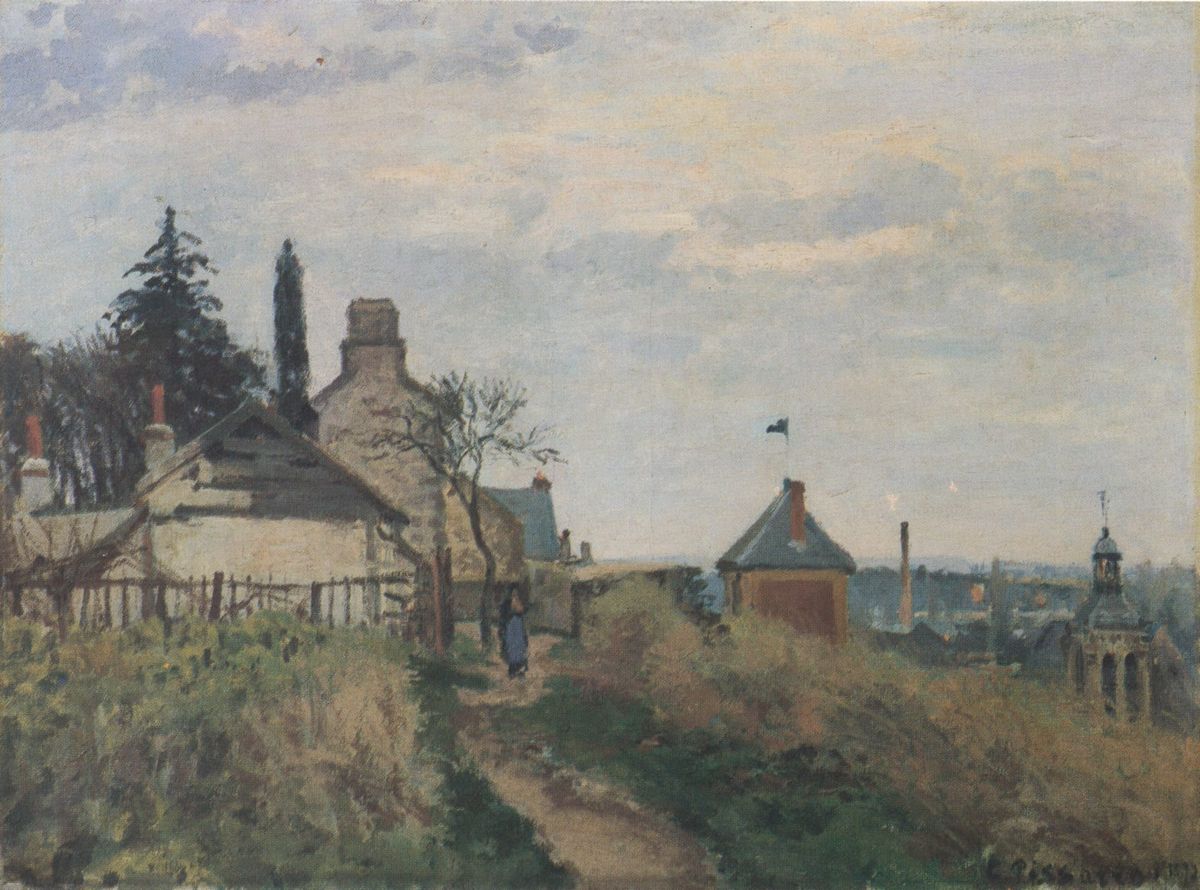
1872년 보불전쟁의 상흔을 뒤로하고 퐁투아즈로 돌아온 카미유 피사로는 언덕 지대에 자리 잡은 소박한 골목길과 그 너머로 서서히 다가오는 근대 도시의 풍경을 화폭에 담았습니다.
당시 그는 전통적인 목가적 정취를 간직한 시골 가옥들과 언덕 아래 우아즈강 변에 들어서기 시작한 공장 지대의 굴뚝을 하나의 시선 속에 포괄하며, 옛 전원의 고요함과 새로운 시대의 호흡이 공존하는 독창적인 공간 구성을 모색했습니다. 가로 55.5cm, 세로 40.5cm 크기의 캔버스에 유채로 완성되어 현재 파리 오르세 미술관에 소장된 이 작품은, 단단한 건축적 조형미와 섬세한 대기 표현을 바탕으로 피사로의 퐁투아즈 전성기 양식을 확립한 대표적인 풍경화입니다.
관람자의 시각 인지 체계는 화면 좌측 중경에 자리 잡은 단단한 석조 시골 가옥의 밝은 회벽과 짙은 지붕선에 가장 먼저 닻을 내립니다. 햇빛을 받아 부드럽게 반사되는 건물 벽면과 주변 나무들의 어두운 실루엣이 자아내는 뚜렷한 명암 대비는 시각 피질의 중심와를 즉각 포획하며 화면의 든든한 조형적 닻을 형성합니다.
이어서 시선은 가옥 앞을 지나는 좁은 흙길 위에서 푸른 옷을 입고 걸어가는 작은 여인의 실루엣을 스쳐, 흙길의 완만한 대각선 축을 따라 화면 중앙의 작은 정자형 건물과 깃발로 자연스러운 도약 안구 운동을 진행합니다.
언덕 가장자리를 확인한 시선은 우측 하단의 울창한 풀밭을 훑은 뒤, 언덕 아래 멀리 아스라하게 솟아오른 공장 굴뚝과 교회의 종탑, 그리고 상단을 넓게 채운 은은한 은회색 구름 하늘의 투명한 대기감 속으로 시원하게 확장됩니다.
언덕 위 시골길의 촉각적인 흙빛과 공기 중에 퍼져나가는 부드러운 자연광이 망막 위에서 하나의 완성된 공간으로 통합되는 순간, 관조자는 번잡한 일상의 긴장을 내려놓고 언덕 꼭대기에서 시원한 바람을 마주하는 듯한 깊은 심리적 해방감과 내면의 평온을 체험하게 됩니다.
이 그림을 그릴 당시 피사로는 퐁투아즈에 머물던 폴 세잔과 거의 매일 야외 이젤을 나란히 펼치고 작업하며 풍경화의 구조적 질서를 새롭게 구축하고 있었습니다.
피사로는 전형적인 살롱 풍경화처럼 시골의 목가적 아름다움만을 미화하지 않고, 멀리 보이는 산업화의 흔적인 굴뚝 연기까지 풍경의 진실한 일부로 담담히 포용했습니다. 이러한 피사로의 엄격하면서도 개방적인 구도 설정은 세잔이 자연의 형태를 입체적인 평면 구조로 해석하는 데 결정적인 영감을 주었습니다.
동시대 미술계와 평론가들은 과장된 기교 없이 대지의 실제 숨결과 근대의 변화를 정직하게 기록한 피사로의 캔버스를 두고 "풍경의 형태적 뼈대와 투명한 빛을 가장 진솔하게 결합한 거장의 시선"이라며 아낌없는 찬사를 보냈습니다.
전원 마을의 고요한 숨결과 시대의 새로운 활력을 완벽한 균형감과 은은한 빛의 조화로 승화시킨 피사로의 '도르래 골목'은, 현대 미술사에서 초기 인상주의가 성취한 가장 단단하고 정직한 풍경화의 모범으로 확고하게 평가받고 있습니다.
Ruelle des Poulies, Pontoise (Ruelle des Poulies, Pontoise, 1872)
In 1872, having re-established his studio in Pontoise after the turmoil of the Franco-Prussian War, Camille Pissarro captured the quiet hillside alleyways of the town alongside the distant, encroaching signs of the modern era.
Gazing down from the elevated ridge of the Hermitage district, the master framed traditional stone cottages alongside the slender smokestacks rising along the banks of the Oise River, pioneering a compositional dialogue between rural permanence and industrial emergence. Measuring 40.5 by 55.5 cm and preserved in the Musée d'Orsay, this horizontal oil on canvas achieves an exceptional balance between tectonic architectural solidity and subtle atmospheric light, marking a pivotal breakthrough in Pissarro's classical Impressionist period.
The observer’s perceptual framework instantly grounds itself upon the pale masonry and dark gables of the rustic cottage standing firmly along the left midground. The clear tonal contrast between the sun-bleached walls and the deep green foliage of the sheltering grove arrests the fovea, establishing an intuitive and reassuring structural foundation.
From this grounded domestic anchor, the ocular trajectory tracks past the minute, solitary figure in blue walking along the narrow path, following the gentle crest of the ridge toward the charming pavilion crowned with a slender flagpole in the center.
Scanning past the weathered embankment on the right, the gaze descends into the distant plain below, where industrial smokestacks and church spires merge into the silvery, cloud-streaked expanse of the open sky, synthesizing these layered planes into an expansive three-dimensional sanctuary.
As the physical permanence of the hillside path and the gentle breath of the cool afternoon air integrate into a cohesive visual rhythm within the visual cortex, active scanning dissolves into profound contemplative stillness, attuned to the quiet transition of the French landscape.
While executing this canvas, Pissarro worked in close creative camaraderie with Paul Cézanne in Pontoise, passionately exploring how to unite geometric stability with the luminous truth of open-air daylight.
Rather than filtering out the chimney smoke to preserve an artificial pastoral romance, Pissarro honestly recorded the living fabric of contemporary France, an uncompromised realism that deeply guided Cézanne in structuring pictorial space.
Contemporary peers and progressive critics widely admired his unembellished vision, celebrating his singular capacity to uncover timeless dignity and poetic gravity within the ordinary corners of a changing world.
Masterfully harmonizing structural weight with delicate atmospheric poetry, Pissarro's view of the Ruelle des Poulies remains celebrated across art history as an enduring cornerstone of early Impressionist landscape painting.
본 콘텐츠의 저작권은 저작권자에게 있으며, 무단 전재 및 재배포를 금합니다.