동양의 선묘와 서양의 색채가 빚어낸 찬란한 오마주, 꽃피는 매화나무 Flowering Plum Tree (after Hiroshige)
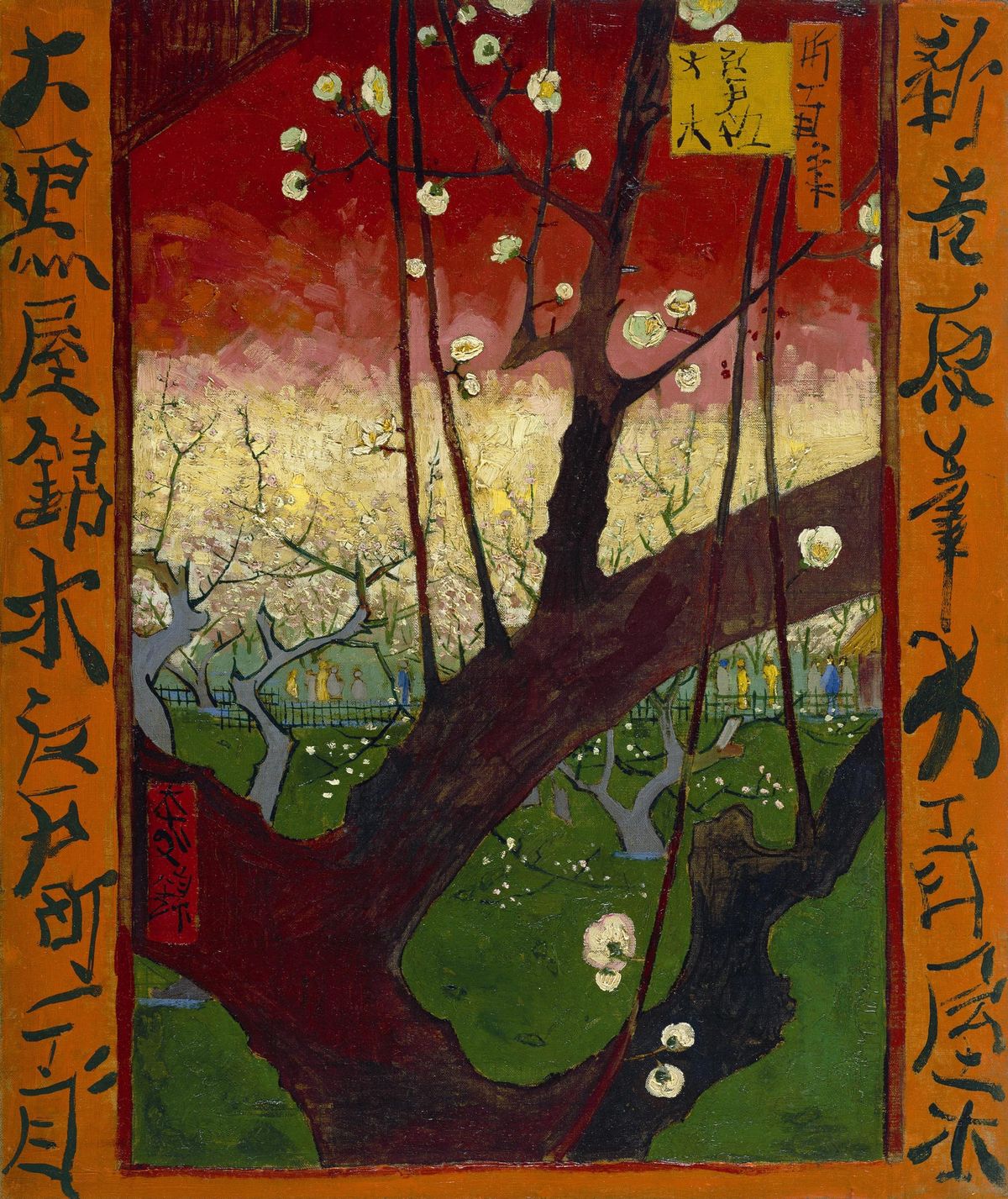
후기 인상주의의 거장 빈센트 반 고흐(Vincent van Gogh, 1853–1890)가 1887년 가을 프랑스 파리에서 완성한 유화 꽃피는 매화나무(Flowering Plum Tree, after Hiroshige, 또는 히로시게를 모사한 꽃피는 자두나무)는 55.0 cm × 46.0 cm 크기의 캔버스에 유채로 그린 대표작으로, 현재 네덜란드 암스테르담의 반 고흐 미술관(Van Gogh Museum)에 영구 소장되어 있습니다.
자포니슴의 열병과 히로시게 목판화의 재해석
1886년부터 1888년 초까지 파리에 머물던 반 고흐는 당시 유럽 예술계를 강타했던 일본 미술의 열풍인 자포니슴(Japonisme)에 깊이 심취했습니다. 그는 수백 점의 일본 우키요에 목판화를 직접 수집하고 화상 지크프리트 빙(Siegfried Bing)의 갤러리를 드나들며 동양 미술의 파격적인 구도와 순수한 평면 색채에 매료되었습니다.
이 작품은 우키요에의 거장 우타가와 히로시게(Utagawa Hiroshige)의 명작 연작 명소에도백경 중 하나인 가메이도의 매화 찻집을 고흐가 자신만의 유화 기법으로 재해석하여 모사한 기념비적인 그림입니다. 고흐는 원작의 섬세한 수성 목판화 선을 서양의 두터운 유화 물감과 역동적인 붓 터치로 바꾸어 물질감을 극대화했습니다.
나아가 원작의 분홍빛 하늘을 타오르는 듯한 진홍빛과 호박색 그러데이션으로 한층 강렬하게 변주하고, 캔버스 좌우 가장자리에 한자 서예를 장식용 테두리로 직접 그려 넣어 이국적인 정취를 극대화했습니다. 동생 테오에게 보낸 편지에서 그는 "일본 미술을 연구할수록 우리는 훨씬 더 쾌활하고 행복해지며, 자연으로 돌아가게 된다"고 고백하며 동양적 시각 예술이 자신에게 안겨준 해방감을 찬미했습니다.
무의식 속 시선의 공간 도약과 이국적 심리 파동
감상자의 시선은 화폭의 전면 하단을 묵직하게 가로지르며 위로 솟구치는 거대한 매화나무 줄기의 짙은 갈색 실루엣으로 가장 먼저 빨려 들어갑니다. 화면을 대담하게 양분하는 고목의 굵은 뼈대와 꿈틀거리는 붓질은 보는 이의 무의식 속에 강렬한 시각적 충격과 함께 단단한 구조적 안정감을 동시에 형성합니다.
이어 시선은 줄기 끝에서 사방으로 뻗어 나간 가느다란 가지들과 그 위에 별처럼 점점이 박힌 순백의 매화꽃 송이들 사이를 경쾌하게 건너뜁니다.
그 후 시선은 매화 가지 틈새 너머로 펼쳐진 연둣빛 정원과 그곳을 거니는 작은 사람들의 실루엣을 스쳐, 화면 상단을 붉게 물들인 작열하는 진홍빛 하늘로 시원하게 도약합니다. 전면의 짙은 나무 덩어리와 배경의 강렬한 붉은빛이 이루는 극적인 명암 대비, 그리고 좌우 테두리의 주황색 여백이 자아내는 평면성 속에서, 관람자는 의식하지 못하는 사이 서양의 깊은 공간감과 동양의 평면적 장식미가 결합한 신비로운 시각적 도취감에 깊이 빠져들게 됩니다.
현대 회화의 평면성과 장식미를 연 역사적 교두보, 미술사적 평가
미술계는 꽃피는 매화나무를 반 고흐가 서양의 전통적 원근법과 명암법을 완전히 탈피하고 독창적인 모더니즘 조형 언어로 나아가는 데 결정적 징검다리가 된 명작으로 평가합니다.
대상을 정면에서 극단적으로 잘라내는 클로즈업 프레이밍과 순도 높은 원색의 평면적 병치 기법은 훗날 남프랑스 아를과 생레미 시기에 완성될 고흐 특유의 화풍을 형성하는 핵심 자산이 되었습니다. 단순한 동양 판화의 모방을 넘어 서로 다른 두 문화권의 시각 예술을 창조적으로 융합한 이 작품은, 20세기 현대 미술의 평면성과 색채 해방을 예고한 미술사상 가장 찬란한 오마주로 빛나고 있습니다.
A Luminous Synthesis of Eastern Line and Western Color, Flowering Plum Tree (after Hiroshige)
Painted in the autumn of 1887 during his transformative Paris period by Vincent van Gogh (1853–1890), Flowering Plum Tree (after Hiroshige) is an oil on canvas measuring 55.0 cm × 46.0 cm (21.7 in × 18.1 in), preserved in the permanent collection of the Van Gogh Museum in Amsterdam, Netherlands.
The Fever of Japonisme: Reinterpreting Hiroshige’s Woodblock Masterpiece
During his stay in Paris between 1886 and early 1888, Van Gogh was swept up in the wave of Japonisme that revitalized the French avant-garde. Amassing an extensive personal collection of Japanese ukiyo-e woodblock prints, Vincent was profoundly inspired by their radical asymmetry, flattened decorative planes, and pure calligraphic clarity.
This canvas represents a magnificent, deliberate homage to Utagawa Hiroshige’s celebrated print Plum Park in Kameido from the series One Hundred Famous Views of Edo. Rather than merely duplicating the original watercolor woodcut, Vincent translated the delicate Japanese medium into the muscular impasto of Western oil painting.
He intensified the subtle pink flush of Hiroshige’s sky into a smoldering crimson and amber gradient and framed the central image with wide orange borders adorned with carefully copied Japanese characters borrowed from other prints. Writing to his brother Theo, Vincent affirmed that studying Japanese art was the ultimate key to unlocking pure joy and returning to the elemental truths of nature, using Eastern aesthetics to completely liberate his own artistic imagination.
Psychological Trajectory of the Gaze and Unconscious Spatial Expansion
The observer’s subconscious gaze is immediately arrested by the muscular, dark silhouette of the gnarled plum trunk dominating the lower foreground. Cropped radically to divide the pictorial space, this heavy wooden anchor creates an instantaneous optical shock, grounding visual attention in the tactile materiality of the paint.
From this monumental stem, visual perception ascends effortlessly through the branching network of slender boughs, tracing the staccato rhythm of delicate white blossoms floating like celestial sparks.
The eye then slips past the dark arbor into the luminous jade-green meadow beyond, registering the diminutive silhouettes of strolling park visitors before soaring into the saturated vermilion heavens above. Navigating this thrilling tension between the heavy foreground barrier and the radiant, flattened chromatic backdrop, the viewer subconsciously internalizes an exhilarating sense of spatial modernism, atmospheric heat, and poetic tranquility.
The Emancipation of Space and the Prelude to Modernism: Critical Legacy
Art historians revere Flowering Plum Tree (after Hiroshige) as a monumental turning point in Van Gogh’s oeuvre, signaling his final rupture with traditional Western perspective and chiaroscuro.
The bold cropped framing, the elimination of atmospheric gradation in favor of saturated color blocks, and the rhythmic integration of decorative calligraphy directly laid the foundation for the visual language Vincent would unleash in Arles. Transcending conventional copying to achieve a brilliant cross-cultural synthesis, this masterwork endures as a vital catalyst for 20th-century Expressionism and Modernist spatial design.
Copyright © Palette Jeju. All rights reserved. Unauthorized reproduction or redistribution is strictly prohibited.
본 컨텐트의 저작권은 팔렛트제주에 있습니다. 허가없는 무단전제를 금지합니다.