등을 바닥에 댄 게 - Crab on its Back
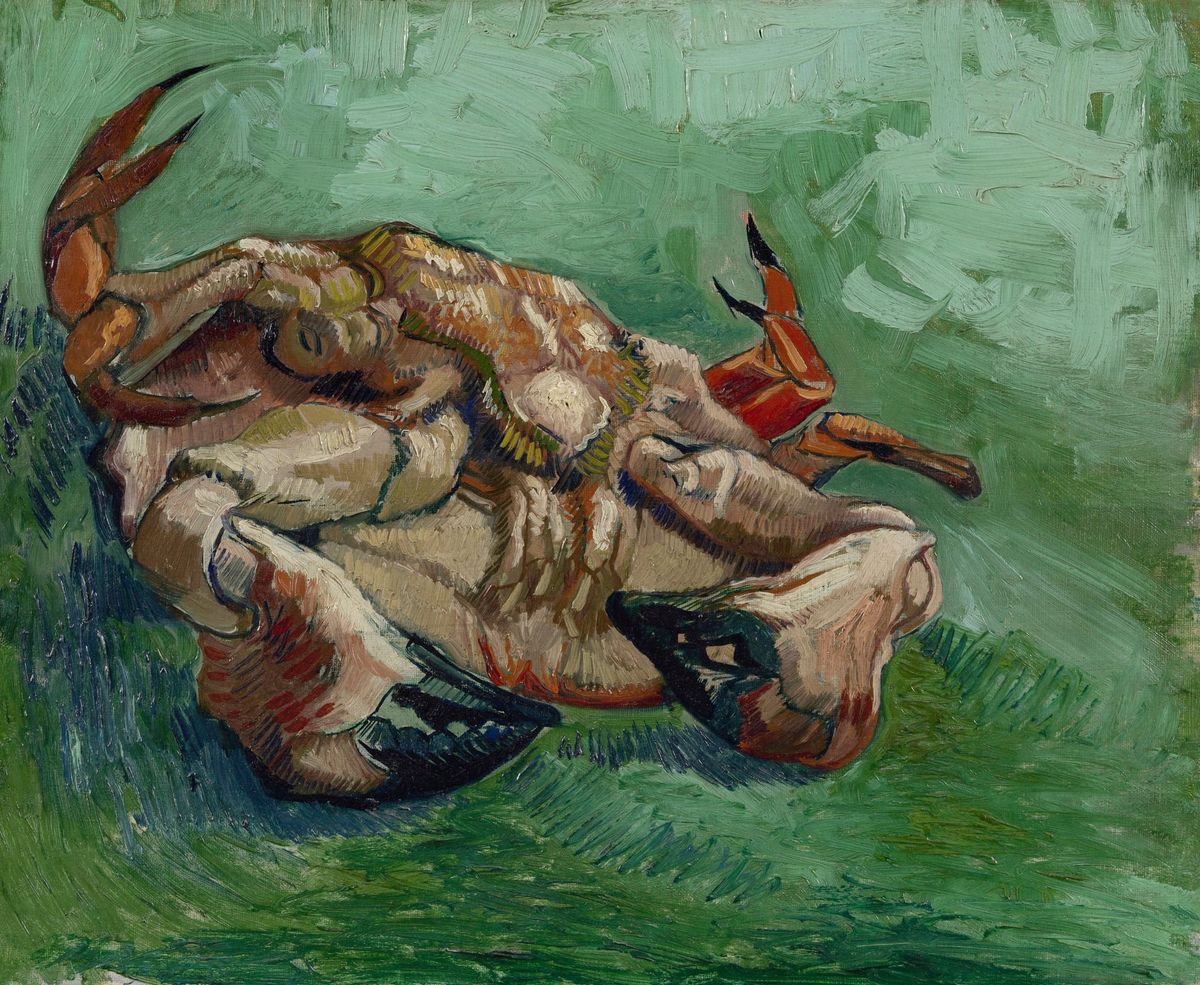
빈센트 반 고흐(Vincent van Gogh, 1853–1890)가 1889년 1월 프랑스 아를(Arles)에서 완성한 '등을 바닥에 댄 게(Crab on its Back)'는 캔버스에 유채(Oil on canvas)로 제작된 정물화입니다. 작품의 실제 규격은 세로 38.0cm, 가로 47.0cm이며, 현재 네덜란드 암스테르담의 반 고흐 미술관(Van Gogh Museum)에 영구 소장되어 있습니다.
고흐는 이 작품에서 형태의 경계를 짓는 어둡고 굵은 윤곽선과 함께 물감을 두껍게 쌓아 올리는 특유의 임파스토(Impasto) 기법을 밀도 높게 구사했습니다. 게의 등껍질과 다리 관절마다 붉은 오커, 테라코타, 짙은 암갈색을 교차시켜 갑각류 특유의 단단하고 거친 질감을 완벽하게 촉각화했으며, 바닥 면은 청록색과 에메랄드 그린의 붓질을 짧고 율동감 있게 교차시켜 평면적이면서도 깊이 있는 공간감을 완성했습니다.
이 그림은 반 고흐의 생애에서 가장 참혹했던 위기 직후에 탄생했습니다. 1888년 12월 말, 함께 '노란 집'에서 예술적 유토피아를 꿈꾸던 동료 화가 폴 고갱과의 치열한 갈등 끝에 자신의 왼쪽 귀를 자르는 극단적인 신경 쇠약을 겪은 그는 아를 시립병원에 긴급 입원했습니다. 1889년 1월 7일 퇴원하여 텅 빈 아틀리에로 돌아온 고흐는 떨리는 손과 무너져 내린 정신을 오직 그림에 대한 몰입으로 붙잡고자 했습니다.
그는 당시 유럽 화단을 매료시켰던 일본 우키요에 미술 잡지인 '르 자퐁 아티스티크(Le Japon Artistique)' 1888년 5월호에 수록된 가쓰시카 호쿠사이의 게 판화를 떠올렸습니다. 뒤집혀서 배를 드러낸 채 허공을 향해 다리를 버둥거리는 게의 형상은, 세상의 냉대와 병마라는 거대한 힘에 밀려 바닥으로 곤두박질쳤지만 결코 숨을 거두지 않고 살아남으려 발버둥 치는 고흐 자신의 처절한 자화상이자 생존의 의지였습니다.
후대의 미술사학자들과 평단은 이 작품을 단순한 정물화가 아닌, 서양 회화사에서 가장 감동적인 '극복과 회복의 징표'로 재평가합니다. 비극적인 자기 파괴 직후 고흐가 보여준 극도의 정밀한 관찰력과 절제된 색채 대비는 그가 광기에 지배당한 것이 아니라, 그림을 그리는 행위 자체를 영혼의 구원과 치유의 통로로 삼았음을 명백히 입증하는 걸작으로 추앙받고 있습니다.
작품을 마주하는 관람자의 시선은 가장 먼저 화면 전면 하단에 묵직하게 놓인 칠흑 같은 집게발의 날카로운 끝부분과 둥근 몸통 중심으로 빨려 들어갑니다. 이어 뒤집힌 채 팽팽한 긴장감을 유지하며 허공을 지탱하는 다리 관절의 사선 방향을 따라 시선이 위로 이동한 뒤, 대상을 감싸 안으며 굽이치는 청록색 배경의 역동적인 붓 터치 궤적으로 부드럽게 분산됩니다.
심리적으로 관람자는 처음에 뒤집힌 생명체가 전달하는 취약함과 위기감을 무의식중에 감지하지만, 이내 따뜻한 흙빛과 차분한 바다색이 이루는 절묘한 보색 조화 속에서 깊은 정서적 안정감을 찾게 됩니다. 취약함을 당당히 드러낸 상태에서도 단단한 껍질과 살아 있는 힘을 잃지 않는 게의 조형적 균형은 보는 이의 억압된 불안을 어루만져 주며, 삶의 바닥에서도 다시 일어설 수 있다는 강인한 내적 생명력과 회복 탄력성을 심어줍니다.
Crab on its Back
Painted by Vincent van Gogh (1853–1890) in Arles in January 1889, Crab on its Back is an oil on canvas still life measuring 38.0 cm in height and 47.0 cm in width. This masterwork is permanently preserved in the collection of the Van Gogh Museum in Amsterdam, Netherlands.
Van Gogh employed bold, deliberate outlines alongside his hallmark heavy impasto technique, applying thick layers of paint to sculpt the physical reality of the subject. By juxtaposing warm ochres, terracotta hues, and deep umber across the shell and articulated joints, he captured the rugged texture of the exoskeleton, while the surrounding field of dynamic, crosshatched viridian brushwork creates a vibrant yet disciplined atmospheric space.
The painting was conceived immediately after the most catastrophic crisis of Van Gogh's life. Following the dramatic collapse of his shared studio dream with Paul Gauguin and the agonizing mental breakdown that resulted in the severing of his left ear in late December 1888, Van Gogh was admitted to the hospital in Arles. Returning to the Yellow House on January 7, 1889, with fragile health and a wounded spirit, he turned to painting as his sole salvation and means of reclaiming psychological order.
Seeking inspiration, he referenced a woodcut of a crab by Katsushika Hokusai, published in the May 1888 issue of the journal Le Japon Artistique. The motif of the overturned crustacean, exposed on its shell yet fiercely reaching into the void, served as an intimate metaphor for the artist himself—prostrated by tragedy, yet fundamentally unbroken and fiercely asserting his vital presence against overwhelming odds.
Art historians and modern critics celebrate this still life not merely as a technical study, but as a monumental testament to human resilience. The extraordinary precision, structural clarity, and harmonic color balance executed in the wake of emotional collapse demonstrate that Van Gogh's artistic intellect remained supremely intact, transforming personal agony into a transcendent vision of endurance.
A viewer’s gaze instinctively anchors upon the dark, prominent claws positioned in the lower foreground before moving inward across the curved ridges of the exposed abdomen. From this central axis, the eyes travel upward along the dynamic diagonals of the splayed legs, ultimately dissolving into the undulating, rhythmic currents of the sea-green background that frame the creature.
Psychologically, the initial subconscious tension provoked by the vulnerable, upturned subject is swiftly soothed by the complementary harmony between warm terrestrial tones and the calming emerald field. Witnessing this resilient creature, which retains its inner strength despite its inverted posture, offers the observer a profound sense of catharsis, replacing latent anxieties with emotional equilibrium, grounded serenity, and renewed inner fortitude.
본 리뷰에서 작품을 제외한 컨텐츠의 저작권은 팔렛트제주에 있습니다.
"퍼블릭도메인 고전명화"를 제외한 모든 창작 콘텐츠는 저작권법 제4조 및 제10조에 의거하여 보호됩니다. 무단 도용시 저작권법 제136조(벌칙)에 의거, 당사의 사전 서면 승인 없는 저작권 침해 행위를 금지합니다.