들판의 여인들 (Femmes dans un champ, 1879)
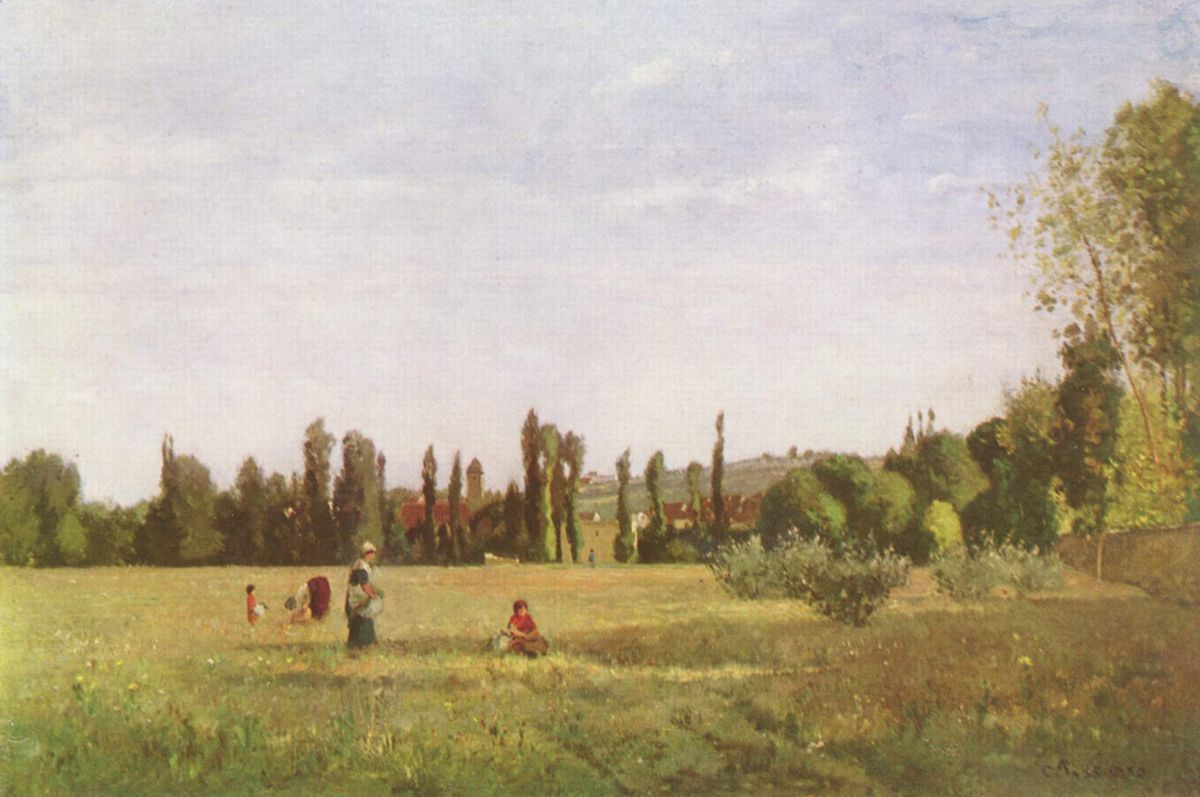
1870년대 후반 퐁투아즈의 광활한 들판을 무대로 활동하던 카미유 피사로는 장 프랑수아 밀레의 바르비종 화풍이 지닌 농촌의 경건함에 인상주의 특유의 투명하고 찬란한 자연광을 융합하는 독창적인 조형 실험에 집중했습니다.
그는 고된 육체노동의 비장미를 강조하기보다, 햇살이 은은하게 부서지는 들판에서 이웃과 함께 풀을 뜯고 담소를 나누는 농가 여성들의 평화로운 일상을 따뜻한 휴머니즘으로 관찰했습니다. 가로 65cm, 세로 46cm 크기의 캔버스에 유채로 완성된 이 작품은 퐁투아즈 시기 피사로의 유려한 공간 감각과 서정적인 색채 조화가 눈부시게 빛나는 대표작입니다.
관람자의 시각 인지 체계는 캔버스 하단 좌측의 연둣빛 풀밭 위에서 일하고 있는 여인들과 아이의 붉고 푸른 옷차림에 가장 먼저 닻을 내립니다. 드넓은 초원의 잔잔한 색면 속에서 점경 인물들이 만들어내는 선명한 색채 대비는 시각 피질의 중심와를 자극하며 화면의 명확한 서사적 구심점을 확립합니다.
이어서 시선은 전경의 풀밭을 비스듬히 가로지르는 따스한 햇빛의 띠를 따라 우측 중경의 나직한 수풀과 길게 뻗은 담장으로 자연스러운 도약 안구 운동을 이어갑니다. 중경의 울창한 미루나무 숲과 그 사이로 언뜻 드러난 붉은 기와지붕의 마을 가옥들을 거쳐 캔버스의 절반을 차지하는 맑고 은은한 하늘로 이어지는 시선의 상승 궤적은, 2차원의 평면을 탁 트인 3차원 공간감으로 시원하게 확장합니다.
눈부신 여름날의 대기 질감과 평화로운 전원의 정취가 망막 위에서 하나의 조화로운 풍경으로 결합하는 순간, 관람자는 복잡한 현대적 감각의 긴장을 내려놓고 대지가 품어내는 근원적인 안도감과 내면의 깊은 평온에 도달하게 됩니다.
이 작품을 완성할 당시 피사로는 제4회 인상주의 전시회를 준비하며 폴 고갱과 메리 카사트 등 젊은 예술가들을 인상주의 진영으로 이끌고 격려하는 데 힘을 쏟고 있었습니다. 특히 가난과 비평가들의 혹평 속에서도 흔들림 없이 매일 아침 들판으로 나아가 자연의 빛을 관찰하던 그의 성실한 창작 태도는 후배들에게 거대한 예술적 이정표가 되었습니다.
고갱은 당시 피사로의 퐁투아즈 풍경화를 두고 "자연을 바라보는 가장 겸허하고 정직한 눈"이라며 깊은 경의를 표했습니다. 인위적인 연출을 배제하고 대지의 솔직한 호흡을 담아낸 피사로의 화면 구성은 훗날 후기 인상주의 화가들이 자연의 본질적 형태를 탐구하는 데 결정적인 디딤돌이 되었습니다.
자연의 거대한 포용력과 그 안에서 살아가는 인간의 소박한 존엄을 조화롭게 직조해 낸 피사로의 들판 풍경은, 현대 미술사에서 인상주의의 감각적 서정성과 바르비종파의 인간주의적 전통이 가장 아름답게 결합한 걸작으로 확고하게 평가받고 있습니다.
Women in a Field (Femmes dans un champ, 1879)
During the late 1870s across the sunlit fields of Pontoise, Camille Pissarro dedicated himself to uniting the profound agrarian dignity of the Barbizon school with the luminous, vibrating clarity of Impressionist plein-air painting.
Rather than dramatizing rural hardship, he cast a gentle humanist eye upon peasant women resting and working together amid the shimmering grasses of the French countryside. Measuring 46 by 65 cm, this exquisite oil on canvas represents a masterwork from his mature Pontoise era, embodying a harmonious balance between expansive spatial openness and pastoral intimacy.
The viewer's perceptual apparatus naturally anchors upon the group of peasant women and a small child positioned in the lower-left foreground, where touches of deep indigo and earthy red stand in vibrant contrast against the sunlit meadow. This focal cluster immediately captures the fovea, establishing an intuitive narrative center for the composition.
From this grounded nexus, the ocular trajectory glides across the delicate diagonal band of sunlight brushing the field toward the low shrubs and ancient stone wall on the right. Ascending through the vertical rhythm of slender poplars and the warm terracotta roofs peeking between the trees, the visual cortex synthesizes Pissarro's subtle brushwork into an expansive three-dimensional atmosphere framed by the serene, pale sky.
As the soft ambient daylight and quiet agrarian rhythm integrate into a cohesive whole within the observer's mind, active visual scanning dissolves into a state of meditative tranquility, deeply attuned to the peaceful sanctuary of the earth.
While creating this piece ahead of the Fourth Impressionist Exhibition, Pissarro was tirelessly supporting the next generation of painters, welcoming figures like Paul Gauguin and Mary Cassatt into the Impressionist circle. Despite persistent financial struggle and critical skepticism, his steadfast habit of painting in the fields every morning served as a moral beacon for his contemporaries.
Gauguin later celebrated Pissarro’s landscape compositions as the purest and most honest observation of nature in modern art. Pissarro's structural clarity and refusal of decorative sentimentality directly catalyzed the structural innovations of Post-Impressionism.
Masterfully celebrating the harmony between human life and the eternal expanse of nature, Pissarro's view of women in the field stands celebrated across art history as a timeless pinnacle of humanist Impressionism.
본 콘텐츠의 저작권은 저작권자에게 있으며, 무단 전재 및 재배포를 금합니다.