대지를 일구는 인간과 영원한 자연의 순환, 쟁기질하는 농부와 들판 Enclosed Field with Ploughman
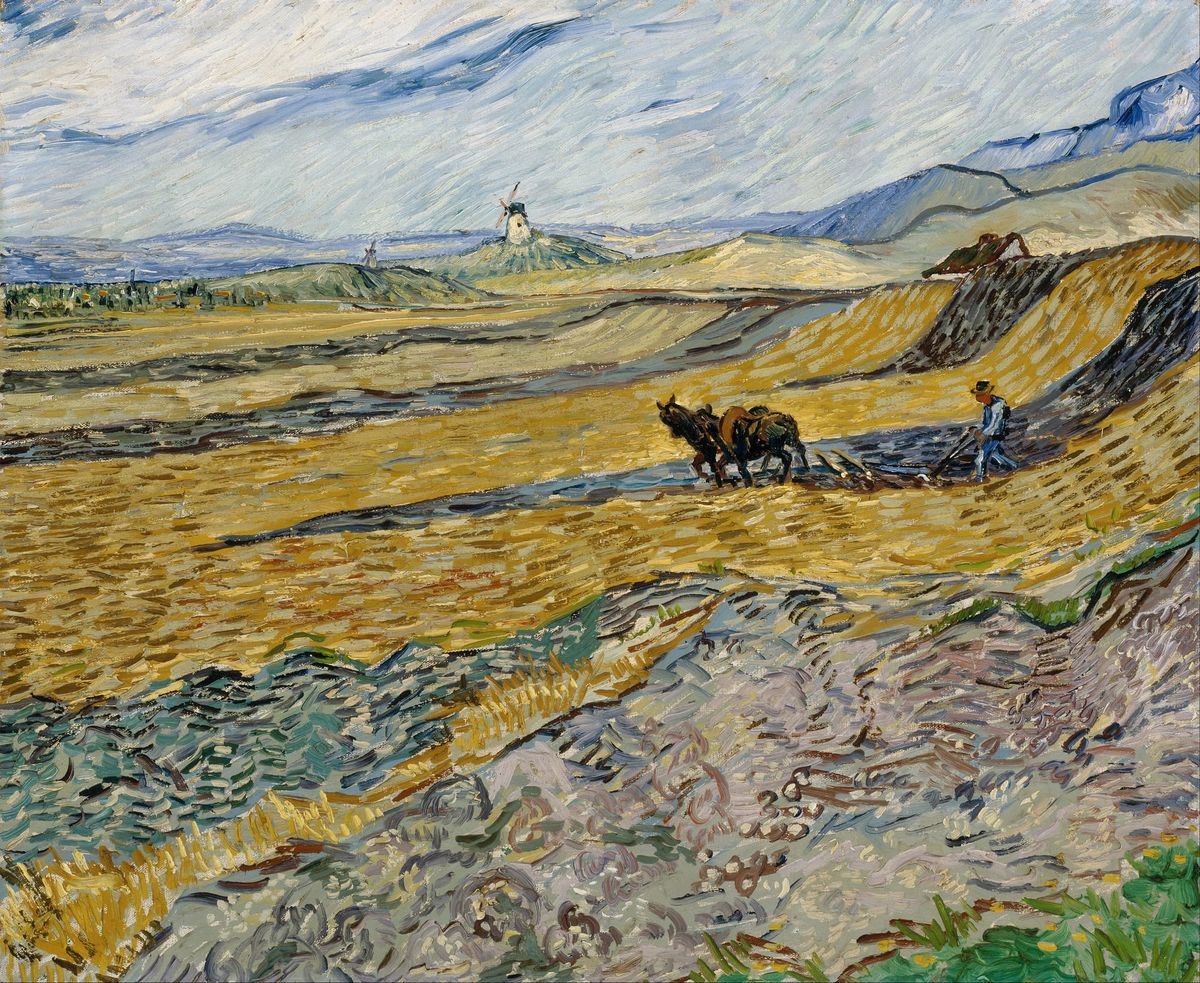
후기 인상주의의 거장 빈센트 반 고흐(Vincent van Gogh, 1853–1890)가 1889년 8월 말부터 9월 초 사이에 프랑스 생레미의 생폴 드 모졸 요양원에서 완성한 유화 쟁기질하는 농부와 들판(Enclosed Field with Ploughman, 또는 쟁기질하는 사람이 있는 밭)은 71.0 cm × 90.5 cm 크기의 캔버스에 유채로 그린 대표작으로, 현재 미국 매사추세츠주 보스턴 미술관(Museum of Fine Arts, Boston)에 영구 소장되어 있습니다.
요양원의 창살 너머로 마주한 대지의 부활과 치유
1889년 7월 중순, 야외에서 작업하던 중 심각한 정신적 발작을 겪은 고흐는 약 한 달 반 동안 병실 밖으로 나가지 못하고 극심한 우울과 불안 속에 갇혀 있었습니다. 8월 말에 이르러 비로소 붓을 다시 잡을 수 있을 만큼 기력을 회복한 그는, 병실 창문 너머로 내려다보이는 담장 안의 들판을 바라보며 이 그림을 그리기 시작했습니다.
밀 수확이 끝나 텅 빈 대지 위에서 말을 몰며 흙을 갈아엎는 농부의 모습은 고흐에게 단순한 전원 풍경 이상의 깊은 의미로 다가왔습니다. 그는 쟁기질을 거쳐야만 이듬해 봄에 새로운 싹이 돋아나듯, 고통스러운 발작과 절망을 겪은 자신의 영혼 역시 예술을 통해 다시 소생할 수 있다는 굳은 희망을 발견했습니다. 동생 테오에게 보낸 편지에서 그는 "밀밭에 나간 농부가 쟁기로 흙을 뒤엎는 광경을 그리고 있다. 흙의 두터운 질감과 대지의 리듬 속에서 일할 때 내 마음은 비로소 진정한 평온을 되찾는다"고 적었습니다. 병마와의 사투 끝에 다시 태어난 이 캔버스는 삶에 대한 화가의 꺾이지 않는 의지와 자연을 향한 숭고한 경외심이 빚어낸 감동적인 기록입니다.
무의식 속 시선의 공간 유영과 정서적 안정
감상자의 시선은 화폭 전면 하단에 파도치듯 두텁게 융기된 흙더미와 돌밭의 거친 질감으로 가장 먼저 이끌립니다. 보랏빛과 회청색, 연갈색의 붓 터치들이 층층이 쌓인 밭이랑의 강렬한 마티에르는 보는 이의 무의식 속에 대지의 묵직한 무게감과 촉각적 실재감을 생생하게 전달합니다.
이어 시선은 대각선으로 시원하게 뻗은 고랑의 결을 타고 화면 중앙으로 미끄러져 올라가, 묵묵히 쟁기를 끌고 가는 흑갈색 말과 푸른 옷을 입은 농부의 실루엣에 자연스럽게 도달합니다.
그 후 시선은 밭을 일구는 농부의 움직임을 지나, 저 멀리 완만한 구릉 위에 우뚝 선 하얀 풍차와 알피유 산맥의 서늘한 푸른 능선, 그리고 부드러운 바람이 흐르는 파스텔톤 하늘로 시원하게 확장됩니다. 대지의 따스한 황갈색과 산맥 및 하늘의 시원한 청록빛이 이루는 정교한 색채 대비 속에서, 관람자는 의식하지 못하는 사이 고된 노동 뒤에 찾아오는 평화로운 안식과 대자연의 광활한 품에 안기는 듯한 심리적 정화를 경험하게 됩니다.
질감의 조형성과 20세기 모더니즘의 가교, 미술사적 성취
미술계는 쟁기질하는 농부와 들판을 생레미 시기 반 고흐가 도달한 공간 구성력과 임파스토 기법의 절정을 보여주는 걸작으로 평가합니다.
원근에 따라 대지의 각도를 과감하게 들어 올려 감상자가 마치 밭 한가운데 서 있는 듯한 현장감을 부여했으며, 굵고 리드미컬한 필선으로 흙의 입체감을 조각하듯 구축해 냈습니다. 형태와 색채를 자연의 단순한 모사에서 해방시켜 화가의 내면적 회복 의지와 영적 구원의 메시지를 담아낸 이 작품은, 훗날 20세기 표현주의와 현대 풍경화의 지평을 넓힌 독보적인 예술적 기념비로 빛나고 있습니다.
Resurrecting the Earth Beneath Restless Skies, Enclosed Field with Ploughman
Painted between late August and early September 1889 during his momentous stay at the Saint-Paul de Mausole asylum in Saint-Rémy-de-Provence by Vincent van Gogh (1853–1890), Enclosed Field with Ploughman (also known as Landscape with Ploughman) is an oil on canvas measuring 71.0 cm × 90.5 cm (28.0 in × 35.6 in), preserved in the permanent collection of the Museum of Fine Arts in Boston, Massachusetts.
Awakening from the Abyss: A Vision of Renewal Through the Bars
In mid-July 1889, while painting outside the asylum walls, Van Gogh suffered a devastating psychological collapse that incapacitated him for over a month. Confined to his room in severe despair, he was finally permitted to handle his brushes again in late August. Looking through the barred window of his studio, his gaze fell upon the walled wheat field behind the monastery, where a solitary farmer was laboring to turn the soil.
To Vincent, the act of ploughing was deeply symbolic of spiritual death and rebirth. Just as the scarred earth had to be cleaved before yielding new life in spring, his own fractured psyche sought regeneration through relentless artistic creation. Writing to his brother Theo, Vincent revealed that he was working on a canvas of the enclosed field with a ploughman and horses, emphasizing that immersing himself in the dense materiality of the earth was his ultimate solace against recurring madness. The painting stands as a moving testament to human resilience and the therapeutic power of nature.
Psychological Trajectory of the Gaze and the Rhythm of the Furrows
The observer’s subconscious gaze is immediately welcomed by the dynamic foreground strata of upturned soil and scattered stones. Rendered with muscular ribbons of violet, slate-blue, and warm ochre, this sculptural impasto provides a grounded tactile foundation that anchors initial visual awareness.
From this textured earth, visual perception travels along the sweeping diagonal furrows toward the center of the canvas, converging upon the horse team and the blue-clad ploughman.
The eye then sweeps past the laboring figure, ascending toward the distant white windmill perched atop the hill, the pale silhouettes of the Alpilles mountains, and the luminous, windswept sky above. Navigating this majestic counterpoint between the warm, sun-baked earth and the cool azure horizon, the viewer subconsciously internalizes the elemental harmony of rural labor and the boundless tranquility of the open landscape.
Sculptural Impasto and Spatial Mastery: Critical Legacy
Art historians celebrate Enclosed Field with Ploughman as a towering pinnacle of Van Gogh’s late oeuvre, illustrating his revolutionary handling of surface texture and elevated perspective.
By tilting the ground plane upward and structuring the composition through dynamic, undulating lines, Van Gogh synthesized Eastern spatial sensibilities with the visceral power of Western oil painting. Emancipating the brushstroke to serve as a direct conduit of emotional truth and spiritual endurance, this masterwork endures as a vital bridge to modern Expressionism, celebrating the eternal triumph of life over despair.
Copyright © Palette Jeju. All rights reserved. Unauthorized reproduction or redistribution is strictly prohibited.
본 컨텐트의 저작권은 팔렛트제주에 있습니다. 허가없는 무단전제를 금지합니다.