최후의 만찬 (The Last Supper / Il Cenacolo)
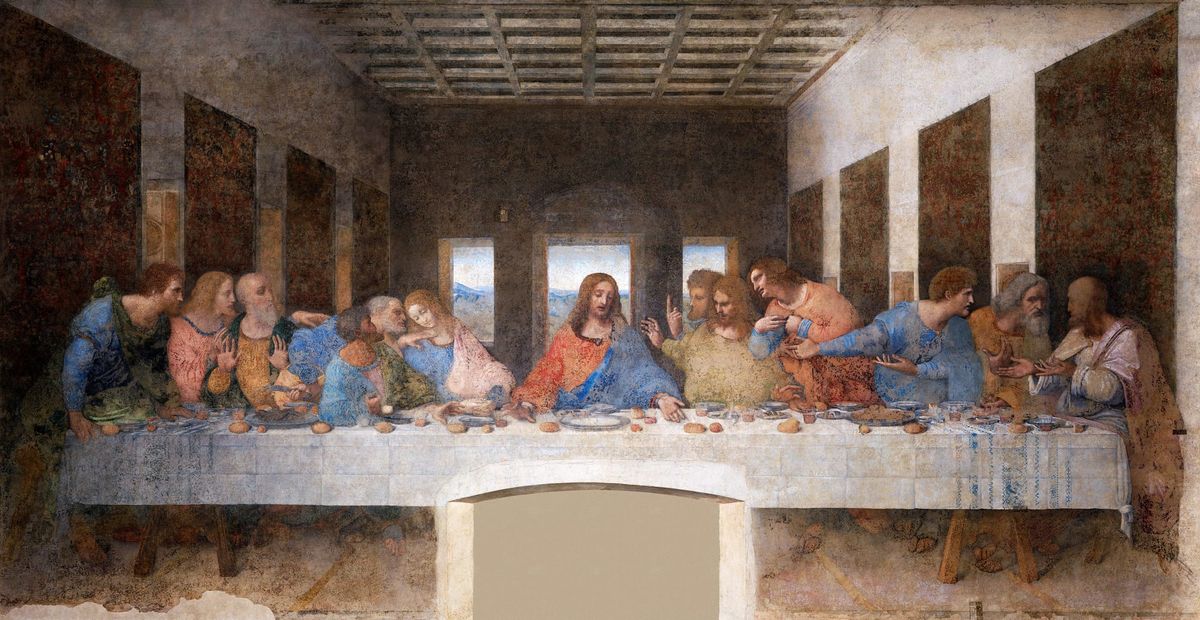
이 작품은 르네상스 시기 천재 거장 레오나르도 다 빈치(Leonardo da Vinci, 1452–1519)가 1495–1498년경 완성한 인류 역사상 가장 위대한 벽화 <최후의 만찬 (The Last Supper / Il Cenacolo)>으로, 현재 이탈리아 밀라노의 산타 마리아 들레 그라치에 성당(Santa Maria delle Grazie) 수도원 식당 벽면에 소장되어 있습니다. 화면에는 예수가 수난을 앞두고 12제자와 함께한 마지막 식사 자리에서 "너희 중 한 사람이 나를 배신할 것이다"라고 선언하는 극적인 순간을 정교하게 담아내고 있습니다.
미술사학계의 도상학적 분석에 따르면, 화면 중앙에 좌정해 계신 예수 그리스도는 완벽한 삼각형 구도를 이루며 신성한 평정심과 절대적인 존재감을 나타냅니다. 충격적인 예언 직후 12명의 제자들은 3명씩 4개의 그룹으로 짝을 지어 경악, 의문, 분노, 억울함 등 인간이 느낄 수 있는 다채로운 심리 상태를 손짓과 몸짓으로 분출하고 있습니다. 특히 예수 오른쪽 세 번째에 위치한 배신자 유다의 손에 쥐어진 돈주머니와 어두운 그늘, 그리고 예수 뒤편 창문 너머로 보이는 아득한 풍경은 구원과 비극의 대조를 입체적으로 암시합니다.
이 화폭에는 르네상스 미술사에서 가장 손꼽히는 비하인드 스토리와 역사적 평가가 담겨 있습니다. 밀라노 공작 루도비코 스포르차의 의뢰로 그려진 이 작품은, 다 빈치가 촉촉한 습식 프레스코 기법 대신 느리게 작업할 수 있는 계란 템페라와 유채 혼합 기법을 시도했습니다. 이로 인해 완성 직후부터 박리 현상이 시작되어 수세기에 걸쳐 수많은 손상과 수난을 겪었으나, 20세기 말 수행된 20여 년간의 대대적인 과학적 복원 작업을 통해 거장의 원본 필치가 극적으로 되살아났습니다. 후대 미술사학자들은 이 작품을 1점 투시도법(Linear Perspective)의 완벽한 적용과 인간 심리 묘사의 극치를 보여주는 인류 문화유산의 수작으로 극찬합니다.
이 그림을 바라보고 있으면 보는 이의 무의식 속에서 중앙 수렴형 시선 연결 구조가 완벽하게 작동합니다. 천장격자와 좌우 벽면 태피스트리의 원근법 선을 따라 시선이 화면 한가운데에 위치한 예수 그리스도의 고요한 얼굴로 자연스럽게 모여듭니다. 이후 좌우로 격렬하게 번져나가는 12제자들의 손짓과 시선의 파동을 따라 흘러갔다가, 예수 뒤편 밝은 창문의 빛을 거쳐 다시 중앙의 예수에게로 돌아오는 완벽한 방사형 순환 구조를 이룹니다. 이러한 시각적 순환 유도는 대뇌 인지 영역에서 찰나의 피로와 시각적 긴장을 풀어주고, 거대한 서사적 전율 속에서 깊은 내면의 안식과 평온을 선사합니다.
This masterpiece, titled The Last Supper (Il Cenacolo), was created between 1495 and 1498 by Renaissance genius Leonardo da Vinci (1452–1519) and is permanently preserved on the refectory wall of the Convent of Santa Maria delle Grazie in Milan, Italy. Capturing the dramatic climax when Jesus announces to His twelve apostles that one of them will betray Him, the mural stands as an unmatched monument of Western art.
Art historical scholarship highlights the flawless compositional symmetry and psychological depth of the scene. Christ sits at the exact center forming a serene, divine triangle, contrasting sharply with the turbulent reactions of the apostles grouped in four rhythmic triads of three. From Peter's protective anger to John's mournful stance and Judas recoiling into the shadows while clutching his purse of silver, Leonardo synthesized emotional realism with mathematical precision, anchored by the three illuminated background windows framing Christ.
Fascinating historical backstories and legendary modern evaluations surround this monumental mural. Commissioned by Ludovico Sforza, Duke of Milan, Leonardo experimented with an unconventional dry technique using tempera and oil on gesso to allow for meticulous detail, leading to rapid deterioration over centuries. Despite war, moisture, and ill-fated early touch-ups, a monumental twenty-year restoration completed in 1999 revealed Leonardo's original brushwork. Modern art historians revere this mural as the ultimate triumph of High Renaissance perspective, spatial geometry, and human emotion.
Gazing upon this iconic narrative gently awakens a powerful subconscious visual rhythm. The linear perspective lines formed by the ceiling coffers and side tapestries draw the viewer's eye inexorably toward Christ's calm, central face. The gaze then ripples outward along the dramatic gestures of the surrounding apostles, sweeps across the bright horizon beyond the central window, and returns fluidly to Christ. This harmonious, convergent visual loop dissolves cognitive friction, inviting the mind into a quiet sanctuary of profound awe and serene contemplation.
본 리뷰에서 작품을 제외한 컨텐츠의 저작권은 팔렛트제주에 있습니다.
"퍼블릭도메인 고전명화"를 제외한 모든 창작 콘텐츠는 저작권법 제4조 및 제10조에 의거하여 보호됩니다. 무단 도용시 저작권법 제136조(벌칙)에 의거, 당사의 사전 서면 승인 없는 저작권 침해 행위를 금지합니다.