첫걸음 - First Steps, after Millet
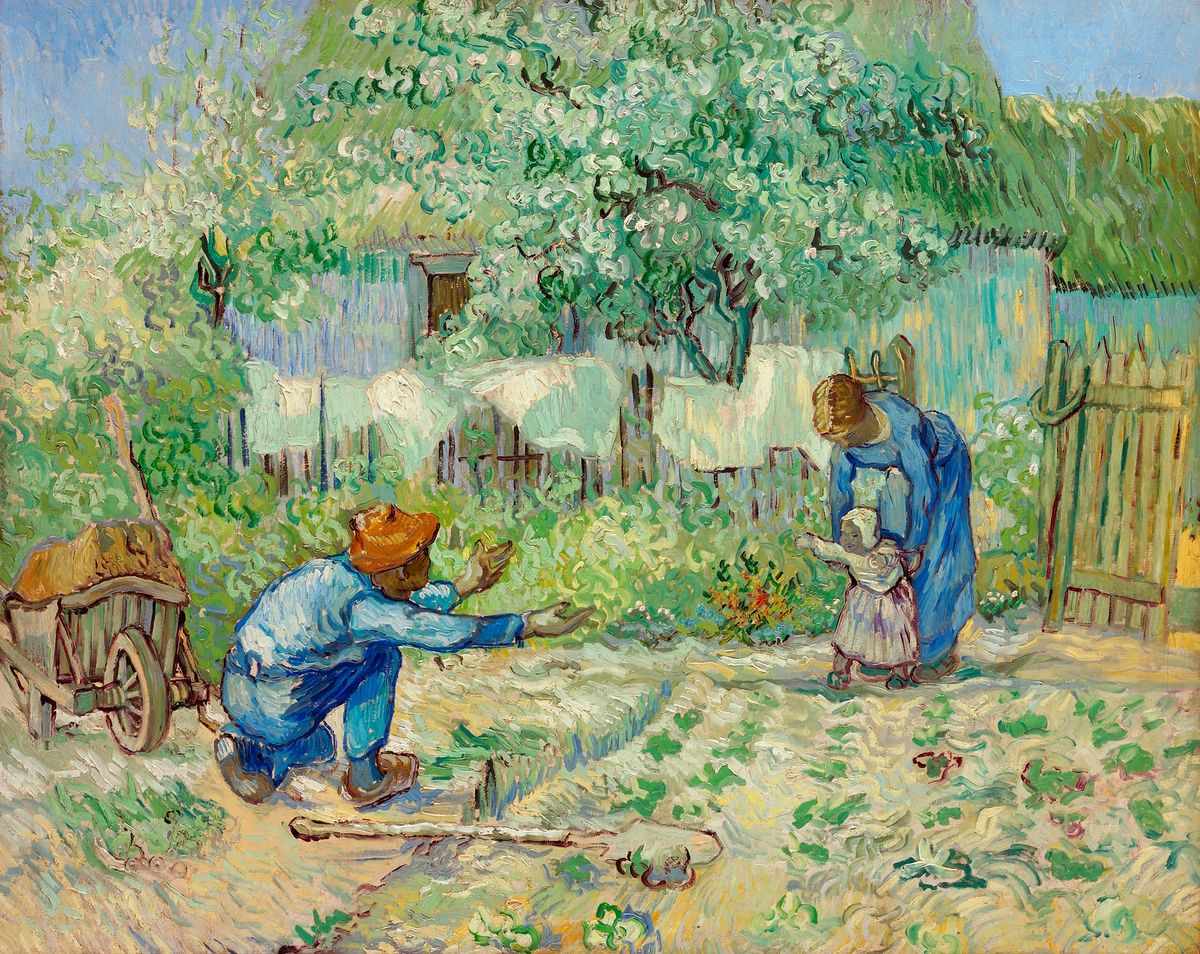
빈센트 반 고흐(Vincent van Gogh)가 프랑스 생레미의 생폴 드 모졸 요양원에 머물던 1890년 1월에 완성한 대표적인 유화 걸작입니다. 현재 미국 뉴욕의 메트로폴리탄 미술관(The Metropolitan Museum of Art)에 소장되어 있으며, 캔버스 위에 유채로 제작된 이 작품의 실제 사이즈는 약 72.4 × 91.1 cm입니다. 장 프랑수아 밀레(Jean-François Millet)의 파스텔화를 모티프로 삼아, 텃밭에서 일하던 농부 아버지가 양팔을 벌려 아기의 첫걸음을 맞이하는 가족의 따스한 순간을 두텁고 역동적인 임파스토(Impasto) 기법과 눈부신 봄의 색채로 완벽하게 재창조해냈습니다.
고흐는 물감을 캔버스 위에 두껍게 얹어 만개한 꽃나무의 풍성한 질감, 텃밭 흙이랑의 결, 수레에 담긴 짚더미와 인물들의 푸른 작업복을 조각하듯 입체적으로 빚어냈습니다. 햇살을 가득 머금은 화사한 연둣빛과 황금빛 텃밭은 인물들이 입은 코발트블루 작업복과 강렬하고 따뜻한 보색 대비를 이룹니다. 밭에 내려놓은 삽과 짚을 실은 외바퀴 손수레는 정직한 노동의 현장을 보여주며, 울타리 너머로 활짝 피어난 꽃나무와 빨랫줄에 널린 흰 천들은 소박한 시골 가정의 포근한 온기를 한층 돋보이게 합니다.
1890년 초, 요양원에 머물며 동생 테오의 아들(조카 빈센트) 출생 소식을 기다리던 고흐는 평생 깊이 존경했던 밀레의 작품 사진을 바탕으로 유화 번안 작업을 진행했습니다. 고흐에게 흑백 판화나 사진을 색채로 번역하는 일은 단순한 모사가 아니라 '음악 연주자가 악보를 해석해 연주하는 것'과 같은 창조적 행위였습니다. 그는 갓 태어날 조카와 새로운 생명의 탄생을 축복하며, 가족의 유대와 대지 위에서 살아가는 인간의 순수한 행복을 화폭 가득 쏟아부었습니다.
아기를 향해 무릎을 꿇고 팔을 벌린 아버지와 조심스레 아이를 부축하는 어머니의 다정한 몸짓은 대자연과 가족 사랑의 완벽한 조화를 증명합니다. 미술사에서는 고흐가 밀레의 사실주의적 농촌 서정을 자신만의 독창적인 후기 인상주의 색채와 리드미컬한 필선으로 승화시켜, 인간에 대한 깊은 연민과 삶의 숭고한 기쁨을 담아낸 생레미 시기의 최고봉 걸작으로 평가하고 있습니다.
관람객의 무의식적인 시선은 화면 좌측 하단에서 밭일을 멈추고 흙바닥에 무릎을 꿇은 채 두 팔을 활짝 벌리고 있는 농부 아버지의 다부진 푸른 등판과 밀짚모자에서 자연스럽게 출발합니다. 자녀를 향해 무한한 사랑과 기대로 뻗은 아버지의 따스한 몸짓에 시선이 머무는 순간, 보는 이는 찰나의 침묵과 함께 봄날 텃밭의 따스한 온기와 깊은 가족애 속으로 단숨에 몰입하게 됩니다.
이어 시선은 아버지가 뻗은 양손의 시각적 축을 따라 화면 우측으로 이동하여, 어머니의 포근한 품에 안겨 조심스레 첫발을 내딛는 아기의 하얀 보행복과 작은 손짓에 도달합니다. 인생의 위대한 첫걸음을 떼는 어린 생명의 순수함과 이를 묵묵히 받쳐주는 부모의 헌신을 마주하며, 대지가 품은 생명의 경이로움과 벅찬 감동을 깊이 체감하게 됩니다.
이후 시선은 배경의 빨랫줄에 널린 흰 천들과 그 위로 만개하여 꽃구름을 이룬 울창한 과수원의 눈부신 연둣빛 잎사귀들을 훑은 뒤, 좌측의 정겨운 외바퀴 손수레와 밭이랑에 놓인 삽을 타고 다시금 전경의 흙바닥으로 유연하게 내려앉습니다.
대지의 싱그러운 녹음과 부모의 따스한 사랑이 빚어내는 장엄한 색채의 순환을 따라 순환한 시선이 편안히 안착할 때, 관람객의 내면에는 복잡한 일상의 번뇌와 피로가 깨끗하게 씻겨 내려가고, 소박한 가족의 보금자리가 건네는 깊은 위로와 함께 흔들리지 않는 심리적 안도감이 가득 차오르게 됩니다.
First Steps, after Millet
Painted by Vincent van Gogh in January 1890 during his stay at the Saint-Paul-de-Mausole asylum in Saint-Rémy-de-Provence, France, this celebrated masterpiece resides in the permanent collection of The Metropolitan Museum of Art in New York. Executed in oil on canvas, the actual size of the work is approximately 72.4 × 91.1 cm. Translating a photograph of Jean-François Millet’s drawing into vibrant Post-Impressionist color, the composition captures an intimate family scene where a peasant father drops his tools to open his arms for his child’s first steps, realized through dense impasto, rhythmic linework, and luminous vernal hues.
Van Gogh applied unmixed paint with tactile energy, sculpting the flowering canopy of the blossoming orchard, the furrows of the sunlit garden, the rustic wheelbarrow laden with hay, and the deep blue work smocks of the parents. The glowing yellow-greens and warm ochres of the cultivated soil establish a striking complementary vibration against the rich cobalt blue garments. The spade resting on the ground and the wheelbarrow beside the father root the composition in honest agrarian labor, while the laundry drying on the fence behind introduces an aura of peaceful domestic warmth.
In early 1890, while recovering from emotional distress and awaiting news of the birth of his brother Theo’s first child (his namesake nephew), Van Gogh turned passionately to translating Millet’s rustic imagery into pure color. For him, recreating Millet’s black-and-white motifs in oil was not copying, but rather an interpretive performance analogous to a musician interpreting a composer's score. Rejoicing in the arrival of new life, he poured his deepest hopes for familial harmony, domestic peace, and spiritual rebirth directly onto the canvas.
The protective stance of the mother guiding the infant and the welcoming embrace of the crouching father celebrate the timeless sanctuary of family life. Art historians revere this composition as one of the most poignant triumphs of Van Gogh's late period, demonstrating his extraordinary power to transform pastoral realism into a sublime, radiant hymn of universal love and human perseverance.
A viewer's subconscious gaze is intuitively anchored first by the crouching father in the lower left, whose blue-clad back and outstretched arms create a powerful directional line across the sun-dappled soil. Lingering upon this posture of openhearted paternal devotion, the observer is drawn into an immediate atmosphere of springtime tenderness, quiet wonder, and emotional stillness.
The gaze is then carried across the open patch of garden toward the right middle ground, arriving at the tiny infant taking tentative steps forward, gently supported by the bending mother in blue. Absorbing the tender concentration and fragile beauty of the child's first journey toward safety, the viewer experiences a reassuring sense of hope, familial love, and domestic tranquility.
The eye ascends into the lush, flowering fruit tree blossoming like a pale cloud across the upper background, taking in the laundry swaying gently against the fence before sweeping down past the rustic wheelbarrow and garden spade back to the fertile soil.
Completing this visual and psychological circulation, the observer feels a profound release of modern tension. The timeless harmony of loving shelter and the blooming earth leaves the viewer restored with a lasting sense of emotional grounding, spiritual renewal, and enduring psychological peace.
본 리뷰에서 작품을 제외한 컨텐츠의 저작권은 팔렛트제주에 있습니다.
"퍼블릭도메인 고전명화"를 제외한 모든 창작 콘텐츠는 저작권법 제4조 및 제10조에 의거하여 보호됩니다. 무단 도용시 저작권법 제136조(벌칙)에 의거, 당사의 사전 서면 승인 없는 저작권 침해 행위를 금지합니다.